Qomet.

Qomet is the latest game in Gigamic’s line of well-produced abstract strategy games that have made-up titles starting with Q, dating back to the 1991 game Quarto. Qomet’s all-wood components are indeed impressive, but the game itself is a little too light and doesn’t have enough room for any deep strategy, instead coming down to which player makes a mistake first.

In Qomet, each player is trying to create a square on the board with four of their seven stones. A square of any size counts as long as the paths between the corners are connected by the carved grooves on the board – you can make a square that is 45 degrees off from those grooves, but it won’t count. On your turn, you can place a stone on any open space on the board, or move one of your played stones one space along a groove. If there’s another stone in that direction and nothing beyond it, you can push that stone one space at the same time as you move your own. A second stone beyond that one would prevent you from moving in that direction at all. You may push a stone off the edge of the board as well, using any of the eight spaces around the perimeter, giving that stone back to its player to re-use on a later turn. Play continues until one player makes a square or one player has no legal moves.

The extent of the strategic elements in Qomet is trying to set up a situation where your opponent has to choose between two options, either of which works for you, so that no matter what they do, you can either get the square on your next turn or set up an inevitable win from there. It seems like control of the center is helpful, although the board’s concentric squares allow you to win without placing anything in the nine central spaces, assuming your opponent hasn’t won by filling those up. In my few plays, the plays after the first few felt very reactive, without enough pieces or options to build up towards something. It’s also easy to fail to see a square in progress, but that may decline with more plays as you get used to the board and the rules.

The components here are all wood and extremely high quality. That wooden board is surprisingly heavy and polished to the smoothness of plastic, and the game should be able to withstand years of play. I assume that’s why the game retails for $40, but for a game I didn’t love and that you could easily replicate at home with some coins and a print-and-play board, I couldn’t justify purchasing it at that price, even though I respect the decision to go for high-end components. Qawale is a better strategy game in the same line and comes in a mini version for $25 that’s more reasonable and also takes up less space on the shelf. I’d give Qomet a 5.5 on the old Paste grading scale, with some regrets given how much effort Gigamic put into its production.
Sorrowland.

Rivers Solomon’s debut novel An Unkindess of Ghosts was a marvel of ingenious plotting and superb character development, using its generation ship as a setting without excessive focus on its mechanics, instead exploring racial caste systems through the literal stratification of its residents across higher and lower decks by skin tones. Their second novel, Sorrowland, shifts its setting to a modern-day gothic milieu, following a queer Black woman who escapes from a Christian cult’s compound in California, only to find the real world inscrutable and inhospitable to her and her two infant children.

Vern Riley was raised at in the Blessed Gardens of Cain, which began as a sort of Black autonomy movement but morphed, as cults often do, into something more insidious when one man took control of the group and converted it into a cult of personality, complete with control regimens and isolation from the outside world. Vern was even forced to marry that first leader’s son, Reverend Sherman, who took over when his father died and continues to suppress the group’s members, including strapping all cult members down while they sleep. She flees one day while pregnant, giving birth to twins in the woods near the compound, beginning a flight that will take her across multiple states, exposing her to a civilization she barely knows or understands, before her eventual return to try to liberate those still in Sherman’s grip – including her mother and brother – and the exposure of the malevolent forces propping up the entire endeavor.

There is a lot going on in Sorrowland, to put it mildly, from the obvious exploration of racism and racial stratification in American society, as well as religion’s role as a tool of oppression, to allusions to the Black power movement and to government efforts to fight it like COINTELPRO. The Blessed Gardens of Cain may be a Black cult, but there are parallels to the Branch Davidians, Heaven’s Gate, and the Aggressive Christianity Missions Training Corps, the last of which received significant press attention when two women who escaped told their stories in a new book. (The temporal precedence is backwards, but the cult Solomon envisioned sounds a hell of a lot like the ACMTC.)

The book could easily have been weighed down by all of its meaning and metaphor, but Solomon gives the readers a compelling, complex protagonist in Vern, who pairs extreme innocence in the ways of the outside world (and the people in it) with strong survivalist skills honed in her time in the cult. She’s on the run almost immediately, first from what she believes is a demon chasing her in the woods, and later from enforcers associated with the cult trying to track her down. She does all of this with two infants and later toddlers in tow – the novel skips ahead in time at several points – giving the whole novel an adventure/horror vibe to keep it moving; every time I thought the story would bog down in its seriousness, something would happen to keep the pace moving.

Sorrowland is still a gloomy read – I can’t say the title didn’t warn me – as Vern runs into obstacle after obstacle, seldom of her own making, and even the denouement only provides partial satisfaction, although I’d argue a fully happy ending would have been unrealistic and out of sync with the remainder of the book. Solomon also explains some of the more mysterious events of the plot with a clever detail, the one bit here that takes this novel into the world of science fiction, although again those elements are there in service of a broader point.

I still prefer An Unkindness of Ghosts, as that book’s protagonist Aster Gray was even stronger than Vern and the mystery within that book was even more compelling, although Solomon set a high bar for their next novel to clear. (They also wrote a novella in between the two called The Deep, a collaboration with Daveed Diggs’ rap trio clipping.) That novel also had better pacing, perhaps because it seemed to try to tackle fewer serious themes, with Sorrowland a more ambitious work. This book was one of two winners of the Otherwise Award in 2021, given to sci-fi or fantasy works that explore or expand our understanding of gender; explaining how Sorrowland does so might risk spoiling some of its secrets, but it’s a worthy honoree that also gets into queer themes and how Vern’s journey is even further complicated by her intersectionality. That Solomon could take something this dark and still make it an exciting read is a testament to their talent as storyteller.

Next up: I’m about halfway through Dinaw Mengestu’s How to Read the Air.

Stick to baseball, 5/30/26.

For subscribers to the Athletic, I updated my ranking of the top 50 prospects in the minors, and also held a Q&A to take questions about that and really anything else. I also posted a minor-league scouting notebook that covered Kyson Witherspoon, Yoeilin Cespedes, and other Boston/Baltimore prospects.

I sent out a new missive of my free email newsletter last Friday.

I’ve continued posting baseball-related videos, mostly about the players I’m going to see live, to Instagram and TikTok. My daughter is now mad that I have more TikTok followers than she does. I told her to talk more about baseball. I’m also posting often on Bluesky.

And now, the links…

  • The New Republic, spoke to Paulina Mangubat, author of that iconic DNC reply tweet calling Stephen Miller an “ugly fuck” – a charge he is not going to be able to escape any time soon – about how Miller’s wife’s choice to dox her has affected her life, and why she’s not sorry for the tweet. It was a reply to Miller falsely labeling Senate candidate James Talarico as “transgender,” because to MAGA, that’s an insult. Meanwhile, the real issue is that Talarico’s opponent, Ken Paxton, approved a plea deal that gave a serial child rapist one day in prison.
  • The Commonwealth Prize, a British literary award that includes publication of winning stories in Granta magazine, is embroiled in controversy as one of its winners this year was very likely produced largely with the help of AI. That story, submitted by a writer from Trinidad named Jamir Nazir, was full of turgid prose that has inspired mockery online – but it’s also true that these AI “detectors” aren’t necessarily trained on different styles of prose, such as that from non-native speakers or those from regions where their English dialect varies from British or American English. Meanwhile – and probably not coincidentally – the Afro-Caribbean author Chanel Sutherland is now having to defend her work as not AI-generated after that same AI detection program (mentioned in the Atlantic piece) claimed her Commonwealth Prize-winning story was the product of AI.
  • Another person who was penalized for comments about Charlie Kirk after his death has won compensation after a lawsuit. Suzanne Swierc posted on her private Facebook account that his death was a “tragedy” but the killing was “a reflection of the violence, fear, and hatred he sowed,” after which Ball State fired her. The University settled the suit, which alleged that the school violated her First Amendment rights, arguing that it was cheaper than fighting it.
  • In Washington state, a sketchy clean-energy storage project to be build on land sacred to the Yakama peoples is actually going to help power new data centers. From this story: “There is no sign the project is needed to provide more power to meet growing local energy demand in Klickitat County.”

Yokohama Duel.

Yokohama is a medium-heavy economic worker placement game that incorporates some engine-building, route-building, and set collection mechanics, along with a board that’s quite a table hog. It’s a great game, but it’s heavy enough that I don’t own it, not even the beautiful new edition brought out by Synapses Games in 2024. (I should note that it’s also the rare game set in Japan that is designed by someone from Japan, Hisashi Hayashi.)

Synapses followed this with a new edition of the two-player game Yokohama Duel, and while I’m in the minority on this, I prefer this two-player version. It strips down the game to the best parts, reducing the complexity, producing a game that plays reasonably quickly but still gives you most of the satisfaction of building something from the original game.

In Yokohama Duel, you’re both merchants in that Japanese city as the opening of the port has led to an economic boom. You’ll collect materials to fulfill orders for yen and trade goods and other rewards, and use the gains to upgrade your power (worker) cards, gain favor at the church, add technology cards, and finish off those trade goods for more points. The game lasts just four rounds, with sixteen total turns per player in the entire game.

Each player starts with the same four power cards, with powers 1 through 4, and will play them to any of the ten action spaces on the board, two of which (new orders and technology) are unlimited while the others are blocked once one worker card is on them. Four of those action spaces get you the game’s resources of silk, tea, fish, and copper. The bank gets you yen. The Chinatown card lets you trade goods for yen and sometimes yen for goods. Customs lets you take trade goods you’ve acquired and flip them over to their finished sides for more victory points at game-end (1 point per unflipped good, 4 per flipped). The church lets you take cards worth victory points and sometimes immediate rewards.

On your turn, you place the lowest-power card still in your hand on an available space and then take the associated action. What you get is a function of the total power of your worker, which is equal to the number on the card, plus any +1 or +2 power cards you play (you can play just one per worker), plus one more for a shop and one more for a trading post if you’ve built either on that site. You then check the little table and take the reward, which can be nothing if you don’t have enough power. You may then build a shop on that site for 1 yen and a trading house for 4-7 yen, as long as you don’t have one of that type already on the site.

You also have free actions available on every turn, which include fulfilling order cards in your hand by paying the resources shown and taking the reward; and collecting and using foreign agent cards. You get a foreign agent when you fulfill your third order card, buy your third tech card, get your second church card, or flip your second trade good. There are only seven foreign agent cards, however, there’s a competitive aspect here as someone will get four and the other three. Foreign agent cards have power 3 and can be played as a bonus worker, giving you a turn within a turn. They can even be modified by a +1 or +2 card, and they can visit a site that’s already occupied by a power card.

When you play with power 5 or more, you can claim a power bonus card, gaining up to three rewards if you play with a total power of 7. It doesn’t make your regular action stronger, but it’s usually worth aiming for once you have some shops out on the board.

Once each player has played all four of their power cards, the round ends. Refresh the technology cards, retrieve all of your workers, and then, if you wish, upgrade one of your four workers by paying the cost in yen. You flip that worker card to the other side, with 1 more power, for the remainder of the game.

After four rounds, with each player getting two rounds as the start player, the game ends and you add up your points. There are eleven ways to get points, including what you get for leftover yen and resources. You get the points from your order cards, church cards, any tech cards that give rewards, shops (1 point each), trading houses (5 points each), flipped goods, and unflipped goods. The player with the most completed orders gets 6 points. The player with the most total production on their tech cards gets 6 points. That’s it.

It’s not Yokohama, especially since it dispenses with that game’s mechanic of needing to trace a path for your workers through the city, which I respect but also found more frustrating than fun. Yet this two-player game keeps the spirit of the original, and has plenty of direct competition between the two players – the sites for power cards, the foreign agents, even the trading posts, which are limited to just one per card. You may not be constantly vying for the same things, but you will run into each other plenty. It’s just not that big of a city. This is also about half the cost of Yokohama and comes in a much smaller box. If, like me, your most common player count is 2, this is the better choice. I also love the new art, which is attractive and also very bright and easy to look at for the 30-40 minutes it’ll take to play a full game.

I’m a big fan – if I were still doing grades, as I did at Paste, this would have been an 8.5. You can get Yokohama Duel on Amazon but right now it’s about $10-12 cheaper on specialty sites, so probably still less even with shipping.

Stick to baseball, 5/23/26.

For subscribers to the Athletic this week, I spoke with teenaged umpire Jameson Morris about his confrontation with a standoffish rec league coach, the video of which has gone viral; published a minor league scouting notebook on Seth Hernandez, Edward Florentino, and some other Pirates & Phillies prospects; and wrote up scouting report on hard-throwing high school lefty Brody Bumila.

I appeared on TSN 1050 in Toronto to talk about the Jays, Trey Yesavage, and what the next year or so will be like for Jose Berrios; and on 95.7 The Game in San Francisco to talk about the Giants’ lost season and how maybe Buster Posey isn’t the savior.

I sent out a new issue of my free email newsletter on Friday.

Apropos of nothing, this Lyrics Born performance of his 2003 song “Callin’ Out” for KEXP is an absolute banger. KEXP is on quite a roll this year with their in-studio performances.

And now, the links…

  • Longreads first: This New Yorker story on a mysterious Chinese couple in LA who have used surrogate mothers to amass over 20 children doesn’t have a big, punchy finish, but the whole thing is wildly disturbing, from the neglect and abuse of the kids to the broader issues of what the fuck is even going on.
  • I usually put the board game news at the bottom of these links, but whoa boy, this one is special. BoardGameGeek fired their longtime advertising manager for rejecting an ad because he claimed demonic possession is real and an unfit subject for a game. It’s worse than it sounds; I hope this guy gets professional help, as he seems to be suffering from delusions, notably that demons are real (they are not, nor is demonic possession). Here’s the Gamefound page for Possess Me, Satan, which is already fully funded, perhaps thanks to a little extra publicity.
  • A Trump-loving Tennessee sheriff jailed a resident of his county for 37 days for posting a meme after the death of Charlie Kirk. That resident just won an $835,000 settlement in his lawsuit against the county. Maybe Perry County Sheriff Nick Weems should have to pay some of that.
  • Sports Illustrated is at it again with the AI slop; Sportico caught SI plagiarizing some of its content, Futurism delved further, and now everything that author supposedly wrote is gone from SI’s site, along with the author’s social media presence.
  • I’ve seen several stories this week about the murders of trans women; one was Juniper Blessing, a student at the University of Washington whom the Seattle Times honored with a piece about her life and legacy.
  • The Broadview Six, including onetime Congressional candidate Kat Abughazaleh, had all charges against them related to their protests outside an ICE facility dismissed with prejudice this week, with the judge issuing some excoriating commentary on the unethical behavior of federal prosecutors in the game.
  • The Times Guild, representing workers at the New York Times, filed an unfair labor practice charge this week against the paper. The Athletic’s unionizing effort has been fighting for over a year for the Times to recognize us as part of the Guild as well, rather than a separate bargaining unit.

Angel Down.

Cyril Bagger is a malingerer and a coward, hanging back in every battle his troop encounters in the hellscape of France during World War I, which leads to his selection for a group of five disposable heroes who are ordered to go retrieve a shrieking wounded soldier from the battlefield. The shrieker isn’t a soldier, however; it’s an angel, and she seems to appear as someone different to everyone who sees her.

Daniel Kraus won this year’s Pulitzer Prize for Fiction for Angel Down, the slightly experimental novel that puts us in the trenches with Bagger and company. The entire novel is written as a single sentence, broken frequently into paragraphs and chapters, with every paragraph starting with the word ‘and.’ It’s a fast-moving, extremely graphic work, contributing to the growing body of grotesque novels of the Great War, but ultimately the gimmick wears out its welcome, and the remainder is 1917 with magic.

Bagger is our protagonist, and as the book begins he and four other idiots are selected for what appears to be a suicide mission by the mad modern Major General Reis, who was born with just one arm. (The New York Times’ review refers to Reis’ willingness to “single-handedly prolong the war,” which I have to assume is a tasteless reference to the birth defect.) When Bagger and the teenager Arno, who is desperate for anything resembling a family and clings to Bagger as a combination of a father figure and an older brother, reach the weeping angel, Bagger is overcome by the light that pours out of her and assumes she is one of the fabled Angels of Mons. When they bring her back to the trench where the other three knuckleheads await, it becomes clear that everyone who sees this angel sees something different – something they want or need, like a carnival attraction, a mother, a girlfriend left behind in the U.S., or later a weapon to win the war. Bagger sees her as some sort of salvation, but she also turns out to have supernatural healing powers, which allow him to strike a devil’s bargain with the angel later in the story.

Kraus’ strength here is in the ways in which the angel becomes a device to reveal the interior thoughts, desires, or intentions of his various characters, often in horrifying fashion. No one, save perhaps Bagger, sees her as an independent being with agency. Every character has been ground down by war to a sharpened point, and their needs become paramount, even if they are malicious or deranged or outright insane. The angel, who is never named, becomes a sort of prism through which each character is refracted, broken down into their component parts so we can see how thin the whole actually is.

The use of the literary device of a single sentence screams “gimmick” to me, although the frequent breaks prevent it from turning into Finnegan’s Wake (he says confidently, having never read past the first page of that inscrutable work). It does not add anything to the text, and starting every paragraph with “and” for 280-plus pages results in the word disappearing from view; you just stop seeing it and start with the next word. I also found Kraus’ florid descriptions of the violence to be too over-the-top, even though many reviews have praised that aspect of the novel; if you’ve ever cringed at the sound of someone’s head getting crushed or bashed in, like the death of Michael’s stepfather in The Wire, there are dozens of sentences in Angel Down that evoke that revulsion.

I don’t know that the canon of World War I literature needs more entries, and Kraus’ choice of that conflict in and of itself should at least invite some skepticism going into the work. He creates one strong character and some intriguing if shallow secondary ones, but leans too heavily on verbal sleight-of-hand and depictions of violence to pad the often superficial narrative. It’s a quick read, at least, but not an especially deep or satisfying one.

Next up: I’m reading Jo Walton’s The Just City at the moment and finding it unusually dry compared to her other novels.

dnup.

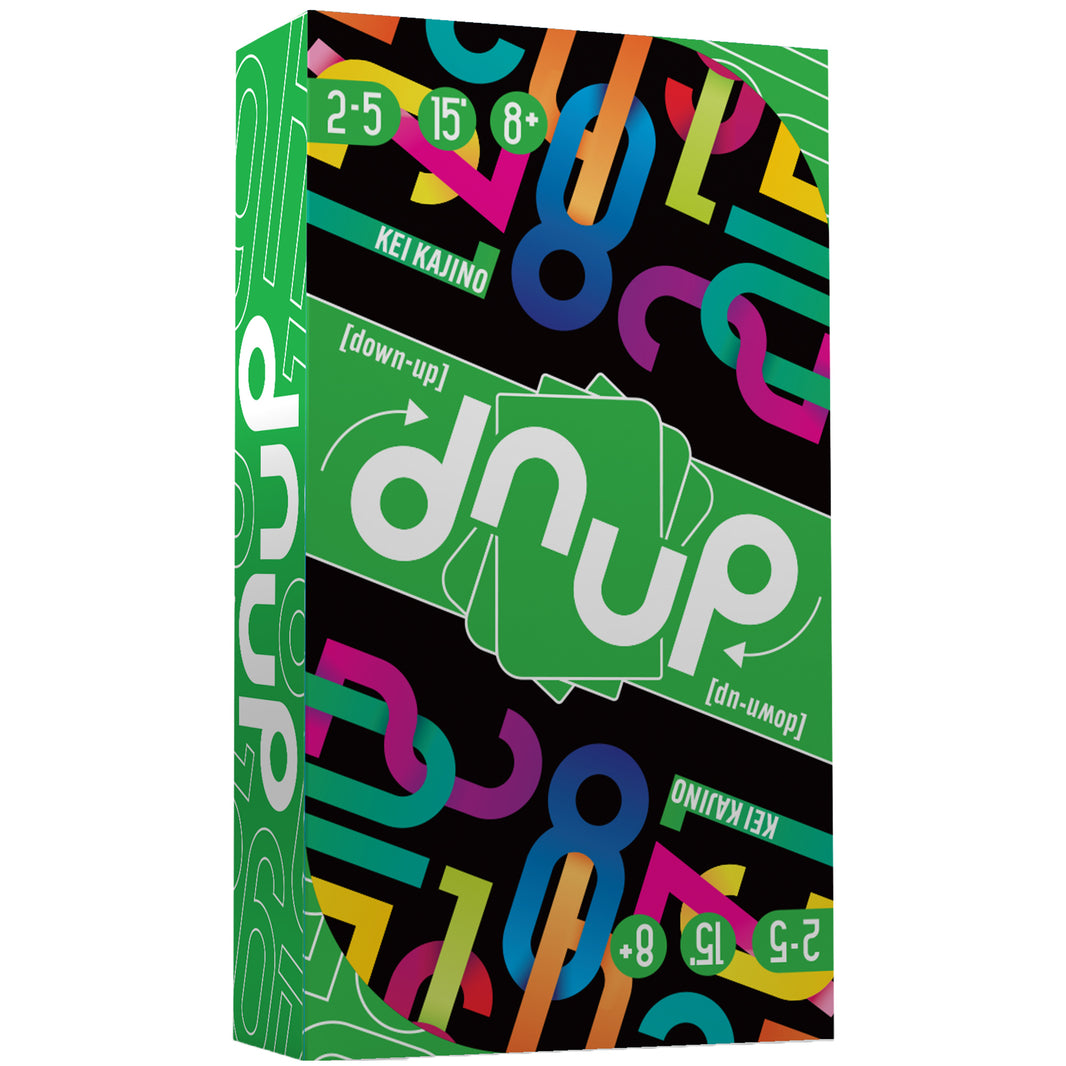
dnup is – or will be shortly, as the game comes out in the U.S. on May 29th – the latest game from SCOUT designer Kei Kajino, and once again we have a card-shedding game of two-valued cards, which have a top and bottom value but can’t be flipped once they’re in your hand. It’s not quite as good a game as SCOUT, but it’s a more clever design, and I’ve found it quite addictive because of how much you thought each move requires.

In dnup, the deck has cards valued 1 through 10, with differing values top and bottom and no connection between them. That is, a 7 card could have any second value on the other side. Players will try to play sets of same-valued cards to the table, but must beat the value of any sets of the same size already in play. So if there is a set of 2 cards on the table on your turn, you can only play another set of 2 if the value is higher than that of the cards already out there. If your played set lasts all the way around the table until your turn comes up again, you get to discard it and play something else. If someone else beats your set, however, you must take those cards back into your hand and rotate them so their values flip.

On your turn, you can play any number of cards from your hand to form a set in front of you, as long as it’s a legal play by beating any set of the same quantity already on the table. You can also take a single card from your hand and add it to someone else’s set, as long as you aren’t creating an illegal set: If there’s a set three 7s and a set of two 4s, you can’t add a 4 to the latter because it would create a set of three 4s that doesn’t beat the set of 7s. If someone later beats that set, you don’t get your card back – the set’s ‘owner’ does. Or you can rotate your entire hand at once and play nothing.

This all means that you will often want to play cards to the table with the hope that someone will top them, returning them to your hand rotated so that you can end up with a more powerful set (or two, or three) to play on future turns. Every time you get to play, you have to consider whether you can play a set in the hopes of shedding those cards permanently, or should play something to top someone else (such as to prevent them from going out too soon), or should play cards to try to get them rotated.

The round ends when two players go out: The first player to do so gets two letters, and the second gets one. The game ends when any player has reached all four letters of “dnup,” regardless of how they got there. This means the number of rounds is limited by the player count – I believe a game can only last as many rounds as there are players.

That’s the real genius of this design: Your decision set is limited, but there are enough factors going into each decision that it feels very tense, and you also can only partly plan for each move because the previous player’s decision can change everything, including putting cards back in your hand you didn’t expect to have.

dnup says it plays 2 to 5, but it is clearly better with more; with three players, your odds of having another player beat your card/set are too low, and it reduces that essential conflict that makes this such a fun, clever game. There are rules for two players where each player plays to two ‘zones’, simulating a table of four players, but I haven’t tried it and the variant seems to take much of the fun out of the game. Some games are just meant for more players – SCOUT is one, dnup is another. I’m a huge fan of dnup, in case you couldn’t tell, even though it took me a lot of plays online to grasp some basic strategy and find that balance between shedding cards and setting up my hand.

Stick to baseball, 5/16/26.

For subscribers to the Athletic, I posted my Big Board for this year’s draft, ranking the top 100 prospects in the class, and then held a Q&A on Thursday. I also posted a minor league scouting notebook last weekend, covering Liam Doyle, Ike Irish, Dante Nori, and others.

I filed two more pieces this morning, so next up will be a new issue of my free email newsletter, followed by a game review to run here.

And now, the links…

  • Tennessee continues to show its ass to the world. Keith Ervin, a school board member in Washington County, Tennessee, said to a teenaged girl speaking before the board, “God, you’re hot,” and put his arm around her. The board declined to remove him, and she blasted them in speech before the board last week, saying “you are all cowards.” Which they are.
  • Restoration Games has a video trailer up for their upcoming Lord of the Rings: The King’s Gambit game, a new implementation of the 2000 game Star Wars: The Queen’s Gambit.
  • The crowdfunding effort for the game Vanea: Guardians of the Eldertree has been relaunched and is already funded.

Stick to baseball, 5/10/26.

I posted my first mock draft of 2026 for subscribers to the Athletic this past week. I held a Q&A on Thursday to take your questions on the mock and anything else. I also posted a scouting notebook on Liam Doyle, Ike Irish, Dante Nori, and some other Phillies & Orioles prospects, as well as a draft scouting notebook on some Arkansas and Mississippi prospects, three of whom are probably going in the first round.

I also sent out another epistle of my free email newsletter. Trying to ramp that up to at least every other week.

I’m on Bluesky more than anything else right now. I’ve also been posting longer videos to Instagram and TikTok, talking about players I see or reacting to news, including two clips about the mock. I’ve also been messing around on the restaurant app Beli, if anyone else out there is using it.

A very short links post this week, not sure why. Anyway, and now the links…

  • Longreads first: Babies are dying because their parents have been scammed by online misinformation into rejecting the vitamin K shot, possibly thinking it’s a vaccine (which is also stupid, as vaccines are safe). Vitamin K is essential for clotting and this ProPublica story reports on babies who have bled to death because they didn’t get the shot.
  • All life on earth emerged from a single common ancestor, about 4 billion years ago. A new study posits that it was about 200 million years before previously thought, while also revealing some new info on what that first prokaryote was like.
  • Ravenous is a new worker-owned food journalism outlet founded by five people who had previously worked/published at Eater.

The Most Secret Memory of Men.

In 1968, a Malian novelist named Yambo Ouologuem saw his first novel, Le devoir de violence, published to great acclaim, including winning the Prix Renaudot, before accusations that he’d plagiarized text from two other novels stained Ouologuem’s reputation and led to his withdrawal from public life. He eventually returned to Mali, publishing two books under a pseudonym and some poetry, before leaving writing entirely, dying in 2017 with his book still out of print in France. (A new edition appeared in 2018, and a new English translation came out in 2023.)

Senegalese writer Mohamed Mbougar Sarr took Ouologuem’s story and spun it into a novel of his own, The Most Secret Memory of Men, in which Diégane, a young Senegalese writer in Paris, learns of an obscure 1938 novel by T.C. Elimane, nicknamed “The Black Rimbaud” before he, too, was mired in a scandal of plagiarism accusations. He refused to address the claims and disappeared from public life entirely, while the novel, scarcely seen for decades, created a cult-like following in all who read it, with some readers trying to locate Elimane as he slides silently across the globe in his seclusion. Much as the Entertainment film in Infinite Jest drives everyone who sees it to madness, Elimane’s book, The Labyrinth of Inhumanity, possesses all who read it, driving Diégane to learn more about the author, the book’s publication, and the controversy that brought it and its author down.

Ouologuem became the first African author to win the Prix Renaudot, and his defenders have argued that the attacks on his authorship were motivated in large part by racism and nationalism. (In a lovely twist, Sarr won the Prix Goncourt for this book, making him the first African author to win the prize.) Sarr clouds the issue around Elimane’s case; the fictional author’s book did not borrow as much from any single source as Ouologuem appears to have done, but instead patched together lines and phrases from many books, maybe dozens, to create an entirely new work of art, like an album made entirely of samples that ends up sounding nothing like any of the original material. Elimane is, according to his acolytes, using colonialist literature as the building blocks for a post-colonialist novel that might have shaken the world had its white critics not had their way.

Sarr’s novel is itself a giant experiment, as he plays with genres as diverse as noir and the epistolary novel, and the result is a book that feels more out of breath than simply breathless. There is tremendous narrative greed as Diégane searches for Elimane, or anyone who knew him, or anyone else who has read the book. There are also some long monologues, particularly by one of the women who knew Elimane and tells her story in winding paragraphs that may not be reliably narrated. Sarr also includes a tangential subplot that nods to the Arab Spring, where a Senegalese activist lights herself on fire to protest the autocratic regime that rules their country, although its connection to our main story is tenuous. (Senegal did have an election in 2024, with some controversy, but the current leader has still clamped down on civil rights.)

The Most Secret Memory of Men’s greatest strength its anger: Elimane dared to win a prize previously reserved for white French authors, so they tore his novel and ultimately him to pieces. That may explain what happened to Ouologuem; it is also a powerful metaphor for post-colonial Europe, where countries that exploited the people and land of Africa, South America, and much of Asia have paid lip service to their ‘special’ relationships but still engage in racist and nationalist practices most obvious in the so-called migrant crisis. France wasn’t ready for an African writer to put them in their place in 1968; maybe they’re more ready to hear it now.

Next up: I just finished Rivers Solomon’s Sorrowland and started Jo Walton’s Tooth and Claw.