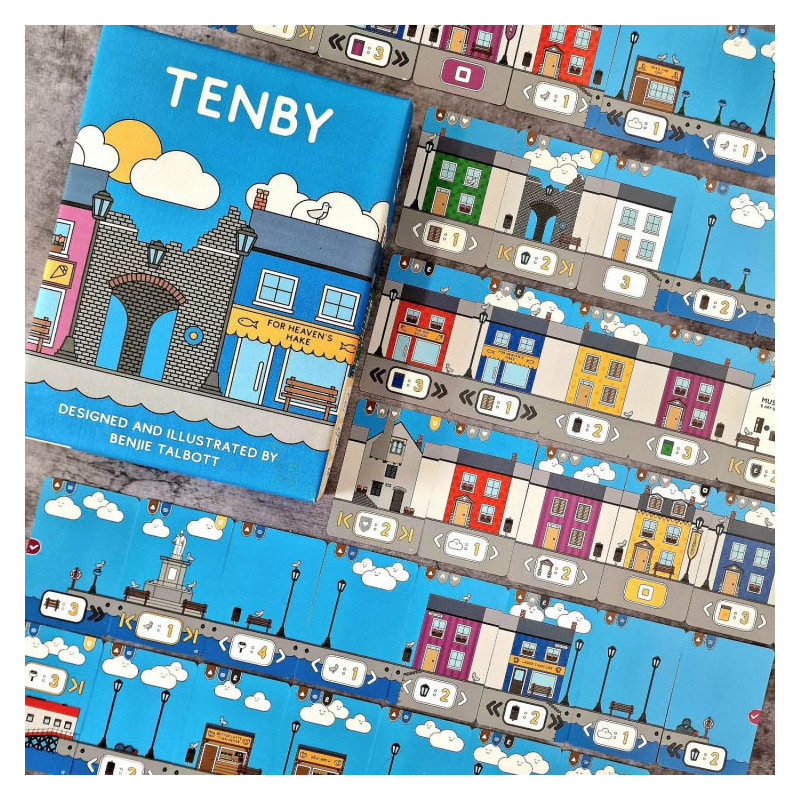
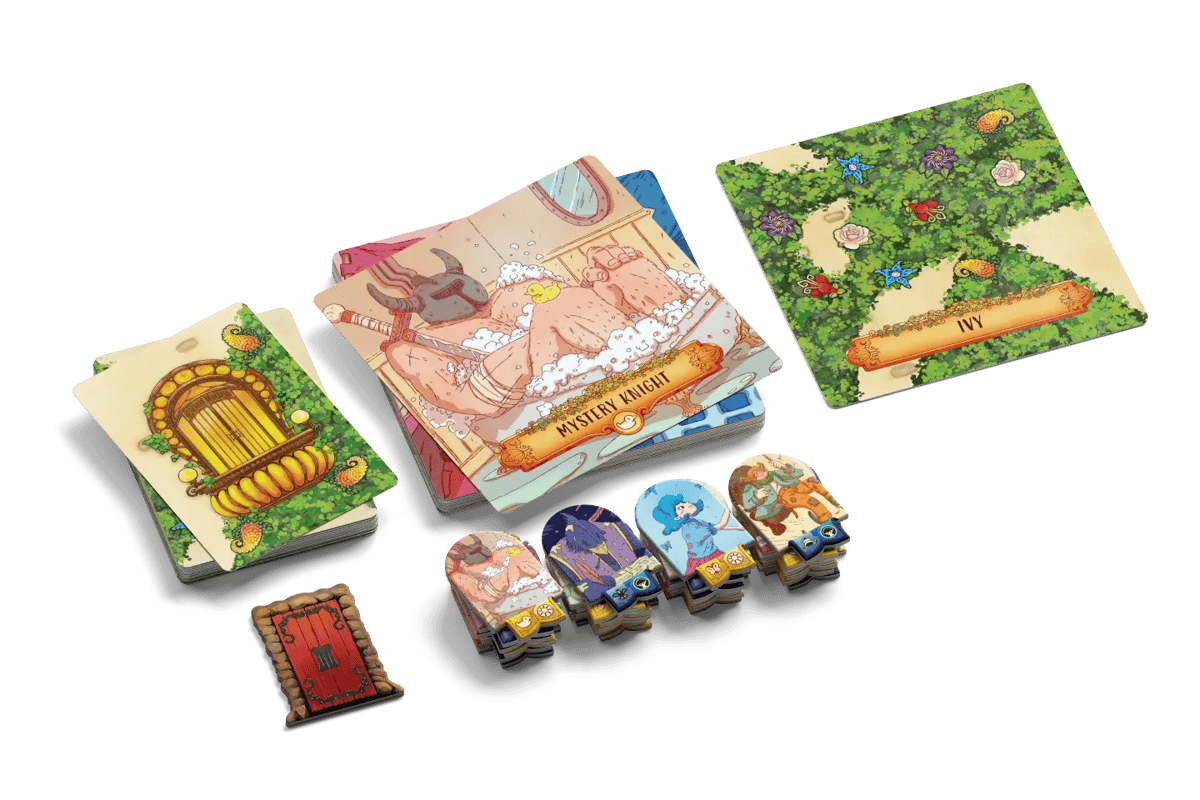
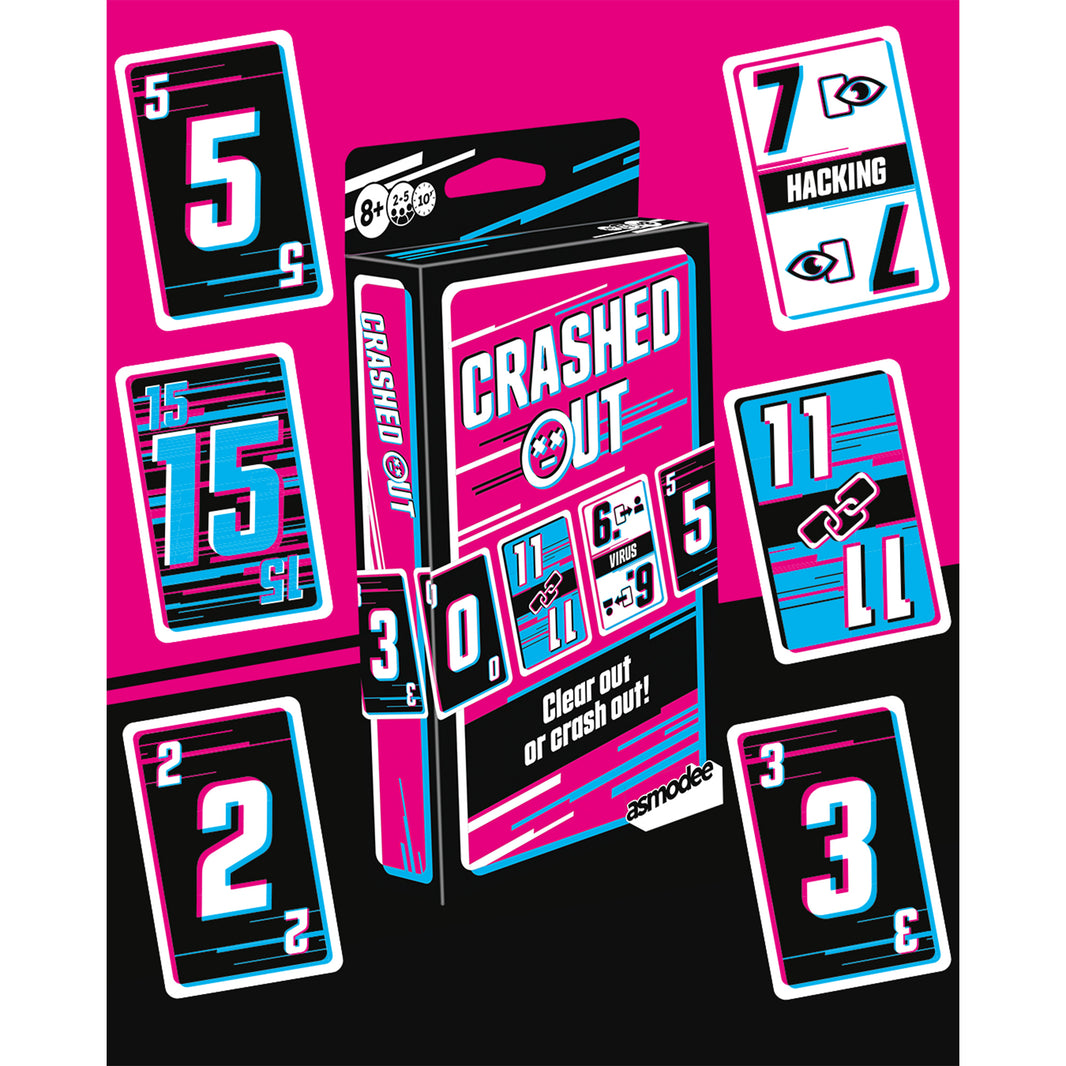
First Giants.

First Giants is a rethemed version of the 2015 game Elysium, which had a pretty good theme of its own but ultimately didn’t work because the game ended before you could get anything interesting going. (I reviewed it for Paste/AV Club.) This new game is a streamlined Elysium that focuses just on the set-collecting aspects, ditching the card-drafting mechanic of the original, so that the game is faster but a little more random.

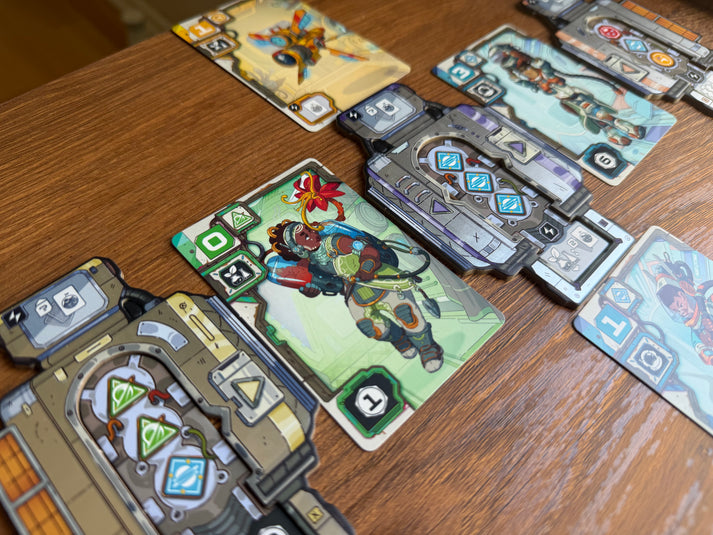
In First Giants, you’re trying to collect sets of fossil cards in five colors, numbered 1 through 3, each of which has an immediate or an ongoing power on it. There are four ‘depots’ or dig sites from which you select cards, with two cards at each site; once you’ve gone to a particular dig site, you can’t go there again until you recall all of your markers (you have four, but can recall them at any time). When you take a card, you use its immediate power if it has one, then check the cards still in your active area to see if any of them have a power that applies to give you points, amber, or the ability to transfer a card.

When you recall your markers, you choose for each one whether to take one amber token or to pay the numerical value on a card to move it to your collections. Once it’s in a collection, its power goes away, but you don’t score any cards that aren’t in collections. You can create collections of 1-2-3 in any single color, or three cards of the same value in different colors. There are news tokens that you claim when you have the largest set of each type, and if you’re the first to get a set of three in any type, you get that bonus permanently, worth 3 or 5 points at game-end. (Board Game Arena’s implementation of the game has additional news tokens that give bonuses for transferring cards of specific colors all in the same turn, such as two oranges and a blue.)

The game ends once the last set bonus token is taken, which scales to the number of players, at which point you add up the points you earned during the game from card powers, the points from set tokens you obtained (2 points for 2 cards in a set, 3 if you got all 3), and points from your news tokens. This variable end condition means the game can drag on a bit if all players try to load up on points by not transferring cards to collections against the modest incentive to do so first for those news tokens.

Anyway, I never loved Elysium because it seemed like the game ended too quickly; you’d plan something, get it started, and then boom, the game was over. First Giants doesn’t have that problem at all; you can keep your cards active for long enough to get some benefit from them, and then shuffle them over to collections while replacing them with new cards that give you further benefits. It feels like you’ve always got something cooking. My issue with First Giants is that there’s nothing novel here: it is a workmanlike game, breaking no new ground, perfectly playable but not one I’m yearning to play again. I also still prefer the Elysium theme, as fossils/dinosaurs are kind of overdone. But I’m still going against the consensus here and saying First Giants is a slight improvement on the original, and definitely a more accessible game than Elysium is.

Waddle.

I did not know that a group of penguins is called a waddle until I encountered the small-box board game Waddle, published by Allplay, last year at Gen Con. It’s one of the best games Allplay has produced, playing 2 to 5 but best with at least 3, and is great value at $19. (It’s $24 on amazon for some reason, but $19 direct from Allplay, or $26 for the base game and the three-in-one expansions.)

In Waddle, you’ll place your penguins on the white ice hexes on the modular board adjacent to the blue water hexes, which form fishing ponds of varying sizes. You only score points in two ways in Waddle, which is something of a relief: you score for every waddle of penguins you create, and you score for having the most or sometimes second- or third-most penguins around a pond with at least one fish (scoring icon) on it. So there’s some pattern-building and some classic area control, with very quick turns.

On your turn you either can place one of your penguin tokens, most of which show one penguin but two of which show a pair of penguins, or ‘scout ahead,’ passing your turn to move up in the turn order for the next pond. Once you’ve build the modular board, you find the pond with the white number 1 on it, and players begin placing penguins on open white hexes around it, going in turn order. Play moves to the pond with next number once all hexes around the current one are filled with penguins.

If you would rather jump ahead in turn order for the next pond, you can scout ahead, taking your marble off the current turn order track and moving it to the next track, either at the bottom or behind any players who’ve already scouted ahead. If you are the last player with a marble on the current track, however, you must place penguins on all open white hexes around the current pond before play can continue. (Single penguin tokens are considered unlimited, so you can’t run out.)

There are twenty pond tiles with numbers on them, and play progresses through them in ascending order, although you may skip some because there are no open hexes adjacent to them by the time you get there. Once you’ve finished pond 20, all white spaces should have penguins on them, and you begin the scoring. Your waddle is worth anywhere from 1 point for a single penguin all by its lonesome to 36 points for a waddle of 8 or more penguins; there’s a table on each player aid card, but for the math-inclined among you, the number of points for a waddle of size N is the sum of all integers from 1 through N. Double penguin tokens count as 2 penguins for both scoring methods.

Then you check each pond with yellow points icons and look at all white hexes surrounding the entire pond. The player with the most penguins around it gets the number of points shown on the highest icon in the pond. If there are multiple fish/scoring icons, then the player with the second-most penguins gets the second-highest points total, and so on, until you’ve either scored all of the fish or each player has scored once. All ties are ‘friendly,’ so ties players get the full amount shown.

There are a couple of rules tweaks for playing with two players, but that player count kind of obviates the scout-ahead mechanic, and I don’t think Waddle is nearly as good without at least three. It sings at four or five, though, as there’s a ton of competition and you can often find a move that helps you and blocks someone else, and with turns this quick you can play with five and never get bored. Allplay promises a one-minute teach and that’s about right – I think I described every single rule in this review, and you don’t need all of those details to get started.

I’ve played nine of the games in Allplay’s Small Box Big Game series, with one more on my Shelf of Shame (9 Lives), and I’d put this near the top. It might be second, behind Sail; I think Sequoia is a real sleeper, but I’m one of its bigger fans, I think. I would even put Waddle over Mountain Goats, which is good but I think has a limited ceiling. It’s a keeper for me, and the best game Allplay put out in 2025.

Qomet.

Qomet is the latest game in Gigamic’s line of well-produced abstract strategy games that have made-up titles starting with Q, dating back to the 1991 game Quarto. Qomet’s all-wood components are indeed impressive, but the game itself is a little too light and doesn’t have enough room for any deep strategy, instead coming down to which player makes a mistake first.

In Qomet, each player is trying to create a square on the board with four of their seven stones. A square of any size counts as long as the paths between the corners are connected by the carved grooves on the board – you can make a square that is 45 degrees off from those grooves, but it won’t count. On your turn, you can place a stone on any open space on the board, or move one of your played stones one space along a groove. If there’s another stone in that direction and nothing beyond it, you can push that stone one space at the same time as you move your own. A second stone beyond that one would prevent you from moving in that direction at all. You may push a stone off the edge of the board as well, using any of the eight spaces around the perimeter, giving that stone back to its player to re-use on a later turn. Play continues until one player makes a square or one player has no legal moves.

The extent of the strategic elements in Qomet is trying to set up a situation where your opponent has to choose between two options, either of which works for you, so that no matter what they do, you can either get the square on your next turn or set up an inevitable win from there. It seems like control of the center is helpful, although the board’s concentric squares allow you to win without placing anything in the nine central spaces, assuming your opponent hasn’t won by filling those up. In my few plays, the plays after the first few felt very reactive, without enough pieces or options to build up towards something. It’s also easy to fail to see a square in progress, but that may decline with more plays as you get used to the board and the rules.

The components here are all wood and extremely high quality. That wooden board is surprisingly heavy and polished to the smoothness of plastic, and the game should be able to withstand years of play. I assume that’s why the game retails for $40, but for a game I didn’t love and that you could easily replicate at home with some coins and a print-and-play board, I couldn’t justify purchasing it at that price, even though I respect the decision to go for high-end components. Qawale is a better strategy game in the same line and comes in a mini version for $25 that’s more reasonable and also takes up less space on the shelf. I’d give Qomet a 5.5 on the old Paste grading scale, with some regrets given how much effort Gigamic put into its production.

Yokohama Duel.

Yokohama is a medium-heavy economic worker placement game that incorporates some engine-building, route-building, and set collection mechanics, along with a board that’s quite a table hog. It’s a great game, but it’s heavy enough that I don’t own it, not even the beautiful new edition brought out by Synapses Games in 2024. (I should note that it’s also the rare game set in Japan that is designed by someone from Japan, Hisashi Hayashi.)

Synapses followed this with a new edition of the two-player game Yokohama Duel, and while I’m in the minority on this, I prefer this two-player version. It strips down the game to the best parts, reducing the complexity, producing a game that plays reasonably quickly but still gives you most of the satisfaction of building something from the original game.

In Yokohama Duel, you’re both merchants in that Japanese city as the opening of the port has led to an economic boom. You’ll collect materials to fulfill orders for yen and trade goods and other rewards, and use the gains to upgrade your power (worker) cards, gain favor at the church, add technology cards, and finish off those trade goods for more points. The game lasts just four rounds, with sixteen total turns per player in the entire game.

Each player starts with the same four power cards, with powers 1 through 4, and will play them to any of the ten action spaces on the board, two of which (new orders and technology) are unlimited while the others are blocked once one worker card is on them. Four of those action spaces get you the game’s resources of silk, tea, fish, and copper. The bank gets you yen. The Chinatown card lets you trade goods for yen and sometimes yen for goods. Customs lets you take trade goods you’ve acquired and flip them over to their finished sides for more victory points at game-end (1 point per unflipped good, 4 per flipped). The church lets you take cards worth victory points and sometimes immediate rewards.

On your turn, you place the lowest-power card still in your hand on an available space and then take the associated action. What you get is a function of the total power of your worker, which is equal to the number on the card, plus any +1 or +2 power cards you play (you can play just one per worker), plus one more for a shop and one more for a trading post if you’ve built either on that site. You then check the little table and take the reward, which can be nothing if you don’t have enough power. You may then build a shop on that site for 1 yen and a trading house for 4-7 yen, as long as you don’t have one of that type already on the site.

You also have free actions available on every turn, which include fulfilling order cards in your hand by paying the resources shown and taking the reward; and collecting and using foreign agent cards. You get a foreign agent when you fulfill your third order card, buy your third tech card, get your second church card, or flip your second trade good. There are only seven foreign agent cards, however, there’s a competitive aspect here as someone will get four and the other three. Foreign agent cards have power 3 and can be played as a bonus worker, giving you a turn within a turn. They can even be modified by a +1 or +2 card, and they can visit a site that’s already occupied by a power card.

When you play with power 5 or more, you can claim a power bonus card, gaining up to three rewards if you play with a total power of 7. It doesn’t make your regular action stronger, but it’s usually worth aiming for once you have some shops out on the board.

Once each player has played all four of their power cards, the round ends. Refresh the technology cards, retrieve all of your workers, and then, if you wish, upgrade one of your four workers by paying the cost in yen. You flip that worker card to the other side, with 1 more power, for the remainder of the game.

After four rounds, with each player getting two rounds as the start player, the game ends and you add up your points. There are eleven ways to get points, including what you get for leftover yen and resources. You get the points from your order cards, church cards, any tech cards that give rewards, shops (1 point each), trading houses (5 points each), flipped goods, and unflipped goods. The player with the most completed orders gets 6 points. The player with the most total production on their tech cards gets 6 points. That’s it.

It’s not Yokohama, especially since it dispenses with that game’s mechanic of needing to trace a path for your workers through the city, which I respect but also found more frustrating than fun. Yet this two-player game keeps the spirit of the original, and has plenty of direct competition between the two players – the sites for power cards, the foreign agents, even the trading posts, which are limited to just one per card. You may not be constantly vying for the same things, but you will run into each other plenty. It’s just not that big of a city. This is also about half the cost of Yokohama and comes in a much smaller box. If, like me, your most common player count is 2, this is the better choice. I also love the new art, which is attractive and also very bright and easy to look at for the 30-40 minutes it’ll take to play a full game.

I’m a big fan – if I were still doing grades, as I did at Paste, this would have been an 8.5. You can get Yokohama Duel on Amazon but right now it’s about $10-12 cheaper on specialty sites, so probably still less even with shipping.

dnup.

dnup is – or will be shortly, as the game comes out in the U.S. on May 29th – the latest game from SCOUT designer Kei Kajino, and once again we have a card-shedding game of two-valued cards, which have a top and bottom value but can’t be flipped once they’re in your hand. It’s not quite as good a game as SCOUT, but it’s a more clever design, and I’ve found it quite addictive because of how much you thought each move requires.

In dnup, the deck has cards valued 1 through 10, with differing values top and bottom and no connection between them. That is, a 7 card could have any second value on the other side. Players will try to play sets of same-valued cards to the table, but must beat the value of any sets of the same size already in play. So if there is a set of 2 cards on the table on your turn, you can only play another set of 2 if the value is higher than that of the cards already out there. If your played set lasts all the way around the table until your turn comes up again, you get to discard it and play something else. If someone else beats your set, however, you must take those cards back into your hand and rotate them so their values flip.

On your turn, you can play any number of cards from your hand to form a set in front of you, as long as it’s a legal play by beating any set of the same quantity already on the table. You can also take a single card from your hand and add it to someone else’s set, as long as you aren’t creating an illegal set: If there’s a set three 7s and a set of two 4s, you can’t add a 4 to the latter because it would create a set of three 4s that doesn’t beat the set of 7s. If someone later beats that set, you don’t get your card back – the set’s ‘owner’ does. Or you can rotate your entire hand at once and play nothing.

This all means that you will often want to play cards to the table with the hope that someone will top them, returning them to your hand rotated so that you can end up with a more powerful set (or two, or three) to play on future turns. Every time you get to play, you have to consider whether you can play a set in the hopes of shedding those cards permanently, or should play something to top someone else (such as to prevent them from going out too soon), or should play cards to try to get them rotated.

The round ends when two players go out: The first player to do so gets two letters, and the second gets one. The game ends when any player has reached all four letters of “dnup,” regardless of how they got there. This means the number of rounds is limited by the player count – I believe a game can only last as many rounds as there are players.

That’s the real genius of this design: Your decision set is limited, but there are enough factors going into each decision that it feels very tense, and you also can only partly plan for each move because the previous player’s decision can change everything, including putting cards back in your hand you didn’t expect to have.

dnup says it plays 2 to 5, but it is clearly better with more; with three players, your odds of having another player beat your card/set are too low, and it reduces that essential conflict that makes this such a fun, clever game. There are rules for two players where each player plays to two ‘zones’, simulating a table of four players, but I haven’t tried it and the variant seems to take much of the fun out of the game. Some games are just meant for more players – SCOUT is one, dnup is another. I’m a huge fan of dnup, in case you couldn’t tell, even though it took me a lot of plays online to grasp some basic strategy and find that balance between shedding cards and setting up my hand.

Stick to baseball, 3/7/26.

For subscribers to the Athletic, I ranked the top 30 prospects for this year’s MLB rule 4 draft, and ranked the top 20 rookies by potential MLB impact in 2026. I also posted two draft scouting notebooks, one on the loaded Globe Life Field last weekend that featured Roch Cholowsky, and one on potential top 5 pick Grady Emerson and some second-tier college guys.

At AV Club, I reviewed the two-player game The Yellow House and the capture-the-flag game Space Lion.

With the support of the Athletic, I’m now posting some short videos about prospects, the draft, etc. on Instagram and TikTok. You may also see these videos embedded in stories on the Athletic’s site. As always, my main social media outlet for links and commentary is Bluesky.

Next up for me is a new issue of my free email newsletter, plus my February music update.

And now, the links…

  • A crypto scammer known as Bitcoin Jesus lobbied Trump and got himself a sweetheart deal where he just had to pay the taxes he owed, neither pleading guilty nor spending a single day in prison.
  • A new cohort study found that people who very frequently (‘always’) listen to music have a lower risk of dementia, as do people who also play music. Excuse me while I go practice guitar…
  • Mike Piellucci wrote about the Rangers’ disgraceful decision to install a statue of a racist who fought integration in the 1950s and then refuse to answer questions about it. That’s the same team that refuses to host a Pride Night, the only MLB team not to do so, and one of two MLB teams without a paid maternity leave policy. They are who you thought they were.
  • A story in Quanta asks if Georg Cantor plagiarized or at least failed to credit Richard Dedekind for large parts of his 1874 letter on the different sizes of infinities and the existence of transcendental numbers. I find it odd that the story never mentions the name of Cantor’s paper, “On a Property of the Collection of All Real Algebraic Numbers,” which demonstrated that the set of algebraic numbers is countable. (Thanks to reader Shaun P. for sending this along.)
  • An ICE hostage held at concentration camp in Florence, Arizona, died of an untreated tooth infection. And there’s a raging measles outbreak at an ICE concentration camp in Texas.
  • Meanwhile, Customs and Border Patrol dumped a nearly-blind man who didn’t speak English on the streets of Buffalo, where he was found dead outside a Tim Horton’s several days later. The agents didn’t take him home, and put him out without shoes.
  • The University of Mississippi fired an executive assistant who reposted a comment on the legacy of Charlie Kirk after his murder; faculty members in Oxford have testified that the firing “chilled free speech” on campus. She’s suing the school, saying her First Amendment rights were violated.
  • For example, a woman who went to a Tennessee hospital for a sterilization procedure was admitted, given an IV, and then told that the hospital wouldn’t do the procedure because the hospital’s Catholic Ethics Oversight Committee said they had “a duty to protect her sacred fertility.” Sounds like they set her up to waste her time, just like those pregnancy ‘crisis’ centers do.
  • Longtime essayist and blogger Michele Catalano re-shared her 2025 post about how gambling wrecked her family in the wake of the various infuriating news items about people betting on the Iran war and the use of nuclear weapons.
  • One new Kickstarter this week, for Kaelora, a set collection game from Tangerine Games.

For the Emperor.

For the Emperor is another tiny-box game from Allplay, part of their line of games in their smallest packages with a list price of $9. It’s a dueling/capture-the-flag game that adds the twist of limiting the number of cards players can play to each flag – but those numbers aren’t assigned to the flags at the start of the game, only appearing as the game progresses. It’s a very good idea that the game doesn’t fully execute.

Players in For the Emperor fight to control seven battlefields between them, with those battlefields all the same when the game begins. Each player has a deck of nine warrior cards, numbered 1 through 9, each with a unique power, with a hand size of three during the game. There are also banners, separate from the battlefield flags, numbered 1 through 4, that will help determine when flags are full. On your turn, you play one card to any flag that isn’t ‘full,’ then use its power if you so desire. After that, you check all flags to see if any of them has a number of warriors equal to the highest numbered banner that isn’t already on a battlefield. You’ll place banners on battlefields (flags) in descending order until you don’t have any more matches, which starts to clamp down on where you can place your cards – once a battlefield is full, meaning it has as many cards as the number on its banner, you can’t place there unless someone uses a power to pull a card back. You also can never have more than three battlefields with three or more cards.

The result of those rules is that your choices narrow quickly, making the game seem to speed up as it progresses. The beginning is a little slow, almost amorphous, because you’re just putting cards down without a ton of information to guide you – nothing’s restricted, you only have three random cards in your hand, your opponent doesn’t have many cards down either, so you both sort of throw stuff out there to maybe set up a better endgame situation given the cards you happened to draw. That makes the endgame more exciting because you’ll be resolving flags more quickly, but also means your moves later in the game are more obvious. There will usually be one clear, optimal move, as some flags will be out of reach even if they’re not resolved.

When all battlefields are full, you compare the strengths of the cards on each side, also counting any tokens you added as a result of card powers. Higher total strength wins the flag; whoever controls the majority of flags wins the game. My plays were all very close, and the game does truly play in less than 15 minutes.

The art is from the Japanese artist Sai Beppu, who’s also illustrated some other great Allplay games, as well as some other games that originated in Japan (Trio/Nana, No Loose Ends) or have Japanese themes. It’s probably the game’s strongest attribute, as the cards go beyond the usual Edo-inspired style of most Japanese-themed games, with more whimsical, cartoonish (in a good way!) drawings of the various warrior characters.

I filed a review to Paste for another capture-the-flag game, 2024’s Space Lion, that will run this week or next, and while they’re very different games in complexity and components, at the end of the day they’re both fundamentally like Air Land and Sea, which is itself a kicked-up version of Battle Line. You’re playing cards of varying powers to the flags between you, trying to control a majority of them or some other combination to win the game. I’m very interested in games that follow that template and add something new to it, but they have to flesh out that vision in the game play. For the Emperor does give that new twist, but the way it’s implemented here, it ends up feeling rote.

I’ll get to it soon, but of the Allplay Tiny Box series, my favorite so far is Soda Jerk, which truly lives up to its name – you win by being mean.

Darwin’s Journey.

Darwin’s Journey is one of the greatest complex board games I’ve ever played – although I’d call it more medium-heavy than heavy – with its incredible balance of various mechanics, strategies, and even a little player interaction. It first came out in 2023 and has since soared into the top 100 overall on BoardGameGeek, a list that skews towards heavier games, while also jumping on to my own top 100 at #16 this November, the highest new entry of any game this time around. I’ve owned the game for probably two years, having picked it up on Prime Day in either 2023 or 2024 for half off, and also love the fact that the box is half the width of any other game of its playing weight I own. (It’s out of stock right now at Miniature Market, but Noble Knight has some used copies.)

Designed by Simone Luciani*, who has three games on my top 100 (Grand Austria Hotel is #17, Tzolk’in is #57), and Nestor Mangone (Masters of Renaissance, last year’s Stupor Mundi), Darwin’s Journey is a worker placement game at heart, asking players to place their four crew members on various action spaces to move their ship, place and move explorers on three mini-maps, gain ‘seals’ to give those crew members more abilities, place stamps for ongoing rewards at the end of each round, deliver specimens to the museum or research ones already there, and more. There are countless opportunities to chain your actions as the game progresses, and you can even add a fifth crew member if you complete a gold-level objective. There are also objectives for each round, plus end-game objectives, with two (one gold and one silver) given to each player at the start, then more available as the game goes along. You also have to make sure you have enough cash on hand, because taking actions nearly always costs at least one coin. There’s a lot going on here, to be sure, although I think the turns are so simple – and your options become more limited within each round as you have fewer workers left to place – that the game play isn’t that complicated.

The rounds are marked by the progress of the HMS Beagle, and that’s one of the few places in this game where the actual history of Darwin’s voyage intersects with the mechanics. (It’s still better at that than the acclaimed In the Footsteps of Darwin, a much inferior game to this one in every way.) You lose points if any round ends with your personal ship behind the Beagle’s position, after which it moves forward to the next marker on its path.

Within a round, each player will place one worker per turn, based in part on the seals (skills) that worker has. You start the game with four workers, one with a wild seal, and then three others with seals you’ll choose in a crew-card draft before the game. The seals represent ship movement (blue), explorer movement (green), stamps (yellow), and more seals (red). When the game begins, there’s one available space for each color of seal, and each of those spaces holds an unlimited number of workers. Once there’s one worker anywhere on the blue/green spaces or the red/yellow spaces, however, placing another one there will cost 2 coins (or 3 in a two-player game). Players can unlock further, more powerful action spaces under each of those four by paying the unlocking cost to place a ‘lens’ on those spaces, making them available to all players – although anyone else has to pay you a coin to use yours. There are six special action spaces that change each game, two of which are available at the start while four are locked. You can also go to the museum to submit or research specimens, go get another objective tile and gain some coins, or go move up in the turn order and gain some coins. If everything’s unlocked, which I don’t think is technically possible, there would be 24 possible action spaces by the end of the game; I think the maximum is actually 22, and I’ve never seen that many in an actual game.

Darwin’s Journey also offers players all sorts of … not quite mini-games, more like side quests that carry real bonuses. You start with 12 stamps in three sets; if you send out all four of a set, you get a bonus. Explorers can place tents on certain spaces on all three maps; you get five of them, and after the first one, each subsequent one you place gets you a bonus. Each crew card you drafted at the beginning has a specific set of five seals shown on it; if you get all five of those seals on one worker’s row, you can assign that card to that worker and get the bonus shown. Getting five seals on a worker also gets you three points at game-end; getting the sixth gets you seven points, and having at least four seals of a certain color gets you an additional benefit when you use that worker for that action. Still with me?

The game goes five rounds, after which you do the end scoring, adding to points you gained during the game from each round’s objective and from points you picked up with your explorers. You score all of your personal objectives. Then you score the research track: every time you submit a specimen, you gain some research points and/or coins, while you can also move up the research track via exploration and occasionally through a special action space. You count the completed rows of specimens in the 4×4 museum, add two, and multiply it by the highest number your marker has passed on the research track; it’s the weirdest part of the scoring by far, but the point gains here can be substantial, easily a quarter or more of your total. I’ve seen winning scores over 200 points, and I have won a game with only about 155 or so.

I’m worried I’m not selling this game enough: It’s fantastic, easily one of the best complex games I’ve ever played, behind only Great Western Trail on my top 100, one spot ahead of Grand Austria Hotel and four spots ahead of Agricola. GWT is a little more accessible, I think, but it has a small deckbuilding element, which is one of my least favorite mechanics. Darwin’s Journey is more forbidding, and getting all of the parts to work together in your head is a real challenge – and even after many plays, I’m still not great at it, because my preferred strategies may not work as well with the specific actions and maps and other facets specific to that game’s board. If you pulled both games out and asked me which one I’d want to play, I’d have a hard time choosing.

* I actually haven’t played Luciani’s highest-rated game, Barrage, which I’ve heard is amazing and quite brutal in its interactive elements. I hated Rats of Wistar – literally got up mid-game at a First Look demo at PAXU and left, although part of that was one of the other players was insufferable – and I would say I like but don’t love Lorenzo il Maginifico, preferring the card-game version. He also co-designed a new version of Railway Boom with Hisashi Hayashi, who won the Spiel des Jahres last year for Bomb Busters and designed the excellent Yokohama games. As always, forza azzurri!

Menagerie.

Menagerie comes from the designer collective known as Prospero Hall, which was acquired by Funko Games in 2019 but then effectively shut down when Funko sold its games division to Goliath Games in January of 2024. There were a few releases last year that were probably already completed when the sale took place, so this is the first new game we’ve had from Prospero Hall since late 2024 (the Only Murders in the Building tie-in game), and one of fewer than a half-dozen in the last eighteen months.

That makes it all the more disappointing to report that this game just doesn’t work. It feels unfinished, with moves almost automatic and no real strategy beyond collecting cards in the same colors you already have. The art is fantastic and the cards are high-quality, but beyond that, I don’t see anything here.

Players in Menagerie, which has the unwieldy full title Menagerie: Unlock the Wonders of a Miniature World, are collecting insects for their collection. Each player has three rows in their terrarium and must choose a different one on each turn into which they will place the insects they select. Then they get to pick two adjacent insects from the six on display and place them in that row, possibly using one of the relatively powerless powers from the symbols on the cards to move an insect, take an iridescent crystal, or break the adjacency requirement. Play continues until someone fills their terrarium with 15 cards, at which point you score.

The bulk of the points come from sets of the same color within a row, with the biggest bonus coming from getting all five cards in a row to be the same color. Each player also gets one private objective card to start the game, and leaning into that can also produce significant points. There are also some small point awards for getting sets of the same symbol within a row.

There is nothing to do in Menagerie aside from taking two cards of the color you want for that row if at all possible. You pick the row before the turn, so you can see what cards are available, and you can pick the row best suited to hold those cards. You can’t refresh the display, which seems like the most obvious power to give a player. It’s just the luck of the draw, and if you’re playing with just two players, you can plan ahead another move or maybe even two by anticipating what the other player might select.

I was a little surprised to see a game this thin come from Prospero Hall, as the group made a strong name for themselves for producing highly thematic midweight or medium-light games for family play, games like Pan Am, Horrified, and Villainous. I didn’t like the last Prospero Hall game I reviewed either, the 2023 game based on the film Rear Window, and looking back through their catalog, the last game of theirs I played and liked was 2021’s The Rocketeer: Fate of the Future. Maybe the makeup of Prospero Hall has changed, or different people are taking the lead, but Menagerie makes me think that their brand isn’t what it used to be.

Menagerie came out last August and remains a Barnes & Noble exclusive, which you can buy here.

First Class Letters.

First Class Letters is a light party game of wordbuilding, taking bits of Scattergories, Boggle, and other similar games in a simple format where you’ll play seven one-minute rounds, trying to create the most valuable word you can in each round based on the rolls of four dice. Three of the dice will show letters you want to use, while the fourth, the red die, has a forbidden letter – and of course, they’re common ones, A-E-I-O-S-Y.

At the start of the game, you roll the three non-red dice and sort them alphabetically. Those become the required start letters for the words in rounds 2, 4, and 6; your seven words throughout the game must go in alphabetical order for you to score, and these start letters further constrain your options. In each round, you roll all four dice, placing the one forbidden red die on the mail carrier card. If you come up with a word that uses any of the letters on the regular dice, you get one point per appearance of each of those letters in your word. If you use all three letters, you double your score. If you use the red die’s letter by mistake, you score zero, and you will score zero if your word violates the alphabetical order of your seven answers. You’re only allowed to do ‘normal’ words – no proper nouns, no abbreviations, no foreign-language words, etc – although you can always tailor the game to your group/mood, including variants mentioned in the rules that include omitting the red die entirely.

And the resulting game is perfectly fine, although I also didn’t feel like it offered anything new among word games. I do Wordle and the Spelling Bee every day, I will play Boggle if it’s out, my daughter loves Scattergories (I think it’s mid, but I’ll play it), and I’m not sure what First Class letters brings to the proverbial table. “You have one minute to come up with a word that doesn’t use this one letter, uses as many of these three letters as much as possible, and that comes alphabetically after the last word on your scoresheet” is a very specific demand of a game, and each time I’ve played this one, I finished it thinking I wish there were more to it. I like anagrams and building words, and I do like the idea in here that you can up your score with words that reuse letters on the dice, but is that enough to supplant the few word games I already own? I ended up on the ‘no’ side, just barely, even though I do think this game will appeal to a small niche in the word-gaming audience.

Fun side note: I demoed this game at Gen Con at the GameHead booth, right next to Trinket Trove, and when the person giving the demo rolled the dice and explained the rules, I suggested the word “scuttlebutt.” The demo person told me that the rules say it has to be a real word. I, uh, protested the ruling.