Crashed Out.

Crashed Out is a new $10 card-shedding game with a memory component as well as some hidden cards, playing very quickly and allowing for a little strategy because many of the cards in the deck either have immediate effects when discarded or allow you to ignore them if you collect enough. It’s a little similar to Cabo and the Silver series, but plays faster, and sits more on the bridge between a card game and a party game than those titles do.

The goal in Crashed Out is to have the lowest total value of your cards when the game ends, so most of the time you’ll be trying to replace high-valued cards or cards of unknown value with low-valued cards. The game ends when one player decides they’re good with their cards and says “Crash Out!” or when any player discards the single value-20 card in the deck.

You begin the game with six cards face-down in front of you in two rows of three. You can look at the first row before you, but just once. On each turn, you draw a card from the deck, and choose to discard it or to keep it and discard any other card from your tableau, in which case you reveal the discarded card. If the card you discard is a 6, 7, 8, or 9, you must take the action shown on the card: 6 lets you draw a card and put it face-down in front of an opponent, 7 and 8 allow you to peek at any card in front of any player (including you), and 9 lets you swap one of your cards with an opponent’s.
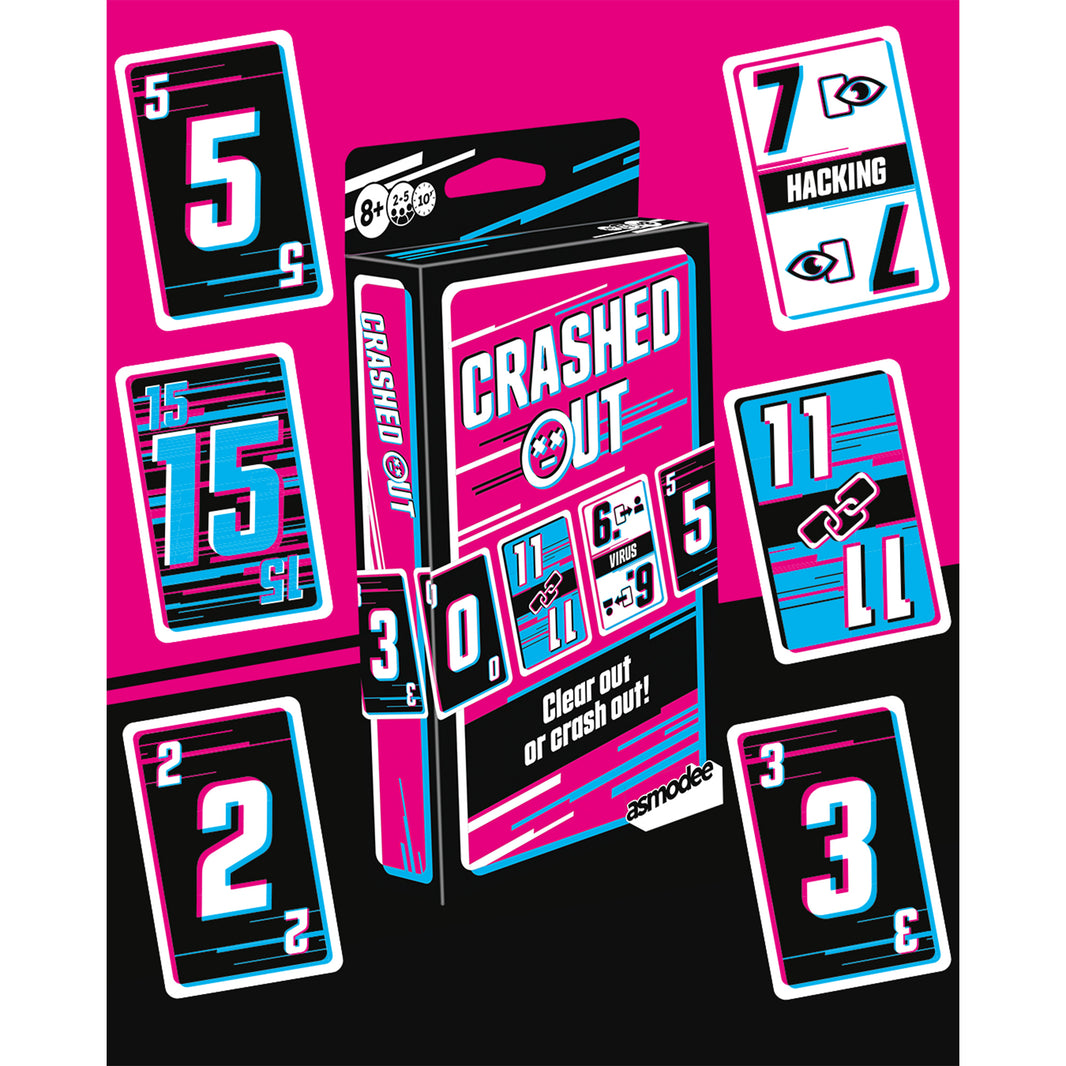
If you discard a card and you have one or more matching cards in your tableau, you can discard those as well – and so can other players, even though it’s not their turn. If, however, you discard a card that doesn’t match, you take it back and draw another card, without looking at it, as a penalty.

The deck has cards valued from 0 through 12, 15, and the lone value-20 card. Cards 0 through 9 always count towards your total points at game-end. The cards valued 10 through 12 also count for their face values unless you have a set or three or more, in which case they all cancel each other out.

If a player is satisfied with their cards, they can call “Crash Out!” to end the game, after which each other player will get one more turn. The player who called the end takes the Shield card, so other players can’t give them new cards or swap cards out on those final turns. However, if someone discards the 20 card, whether or not they did so deliberately, the game ends immediately.

The result is a game that’s very fast-moving, offers a little bit of strategy, and gives you the social aspects of surprise moves, take-that tactics, and the occasional mistake. I’m not a party-game person in general because most party games are kind of dumb, especially ones that try to make you cringe, or that rely on inane questions. Crashed Out is a party-adjacent game that makes you think, as if someone took Scout or the aforementioned Cabo and reimagined them as highly social instead. It’s a grade B+ game for me, which is about as high as I’ll go on anything that bills itself as a party game.
Gen Con 2026 recap + Top 10 games.

This was my tenth Gen Con, and in some ways it was the best, although I think that’s more about the people at this point and a little less about the games I saw and played. That said, I did see a lot of great new games, and had a hard time paring my “top games of the con” list to ten, but almost everything that I even considered for the list was on the shorter side, with the exception of Railway Boom (the last cut). It was a little bittersweet, as it was also the first Gen Con where I wasn’t there representing Paste/AV Club, although I am very grateful that publishers continued to open their metaphorical doors to me even as a solo act.

Gen Con, for the uninitiated, is the largest board game convention in the Americas, attracting over 74,000 attendees to Indianapolis and over 800 vendors. It’s held over four days in late July or early August, with a very unfortunate habit of landing on or just before the trade deadline. It’s the main place and time for publishers in this market to release new games, with a lot of ancillary activities like author signings, artist booths, and even some celebrity sightings (apparently Felicia Day and Mychal Threets were there).

Some big picture thoughts first: here were three big themes I noticed at this year’s Gen Con:

  • Shorter is better. The vast majority of games I saw offered playing times of 45 minutes or less. Games are smaller, shorter, and many of them are $30 or less, some as little as $9-10 for a full game. I saw lighter or family-level versions of Wingspan, Distilled, and Azul. There were still a decent number of heavy games there for sale or previewed for an upcoming Kickstarter, as well as at least one (Ada’s Dream) that only had a deluxe Kickstarter version available for sale, but I am not bringing home anything with a playing time over 45 minutes, and that’s not by my design.

  • What’s old is new again. Bringing out-of-print games back, as is or in new skins, has been a trend for a few years, but it was as prominent as ever this year. Tigris & Euphrates, Schadenfreude, Scoville, Camp Grizzly, North American Railways, Las Vegas, and Hacienda are just some of the as-is reissues; Hanami (Samurai), Wild Magic (Vampire), Six Sojourns (Eight-Minute Empire), Gold Country (Spectaculum), and Skyward Republic (Skyward) are some of the old games made new again.

  • The forest is overpopulated with critters. We do not need any more games with adorable woodland creatures. Please. I’m begging you.

If you haven’t seen my Gen Con wrap-ups before, here’s how it all works. I use BoardGameGeek’s invaluable preview and create a list of games/publishers I want to see, and work my way through the exhibit hall each day, talking to publishers and demoing or playing everything I can. I take notes, which gets a comment maybe 30-40% of the time (usually good, people respect the pen and paper method), and then dump everything into this recap each year. I rank the ten best games I saw, and then I run through everything else, sorted by publishers, and those are listed alphabetically.


Here are my top ten new games of Gen Con 2026:

1. Drillers (Czech Games): I’m pretty sure this one sold out before Saturday, for good reason. Drillers is a midweight game where you send your mechs into an abandoned mine to collect ore and other valuables, opening up new levels by spending some of your resources, but avoiding going too far down to where you won’t have the fuel to get back up. You do all of this via hand management, building your deck to get additional powers so you can go deeper into the mine later in the game. I’ve read comparisons to CGE’s Lost Ruins of Arnak; there are some structural similarities, but Drillers is simpler mechanically and tighter thematically. (That’s not meant as a knock on Arnak, which I also enjoy.)

2. The Glasgow Train Robbery (Salt & Pepper): This is is a cooperative heist game for two players, with no talking allowed, as the players try to pull off a mission on The Great Train Robbery of 1963 (which had 15 participants, not 2). You each have different skills and must go through all of the steps from planning the heist to executing it, finishing all five plan cards before the train reaches its destination. The art is very stylish and the game play appears to be tight.

[Read more…]

dnup.

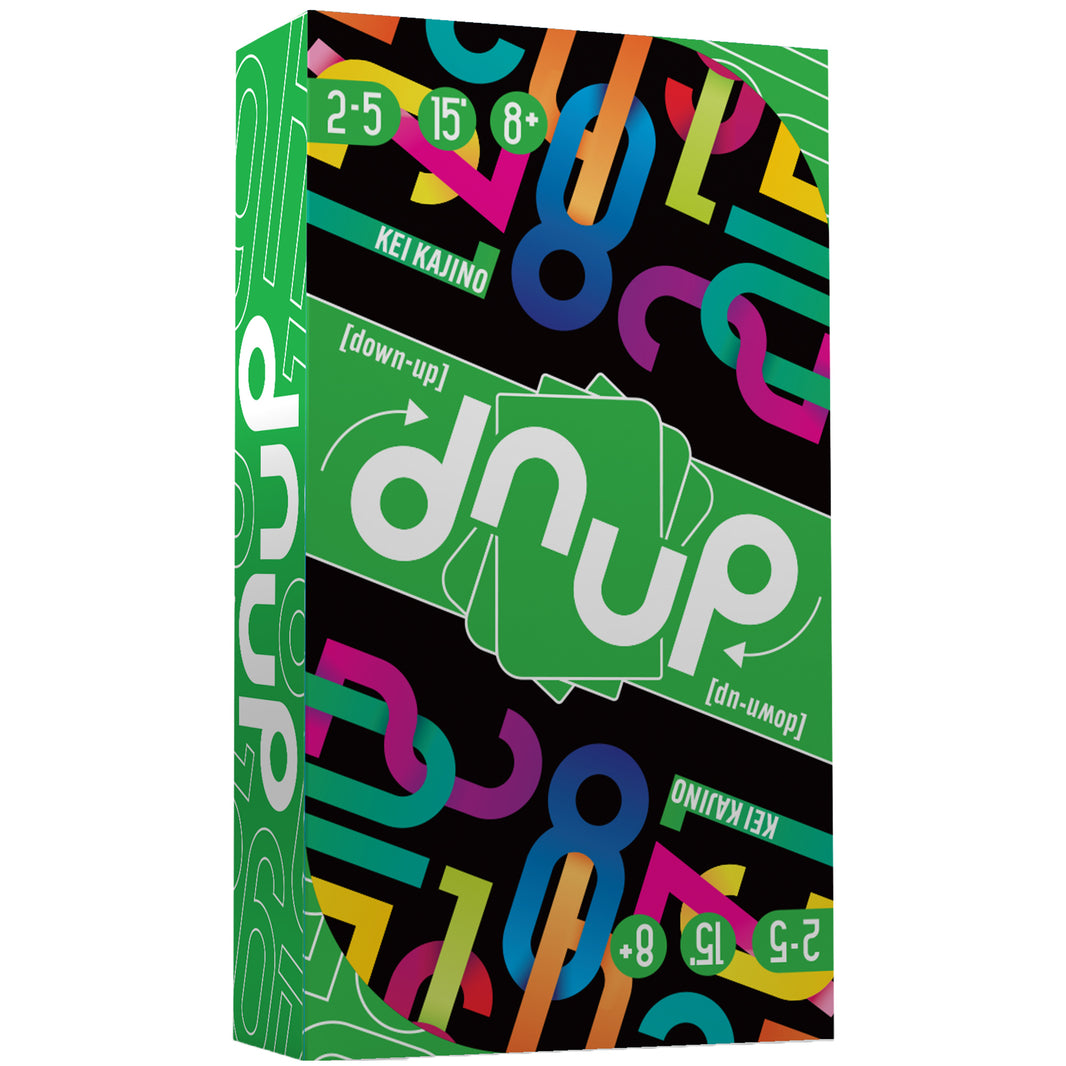
dnup is – or will be shortly, as the game comes out in the U.S. on May 29th – the latest game from SCOUT designer Kei Kajino, and once again we have a card-shedding game of two-valued cards, which have a top and bottom value but can’t be flipped once they’re in your hand. It’s not quite as good a game as SCOUT, but it’s a more clever design, and I’ve found it quite addictive because of how much you thought each move requires.

In dnup, the deck has cards valued 1 through 10, with differing values top and bottom and no connection between them. That is, a 7 card could have any second value on the other side. Players will try to play sets of same-valued cards to the table, but must beat the value of any sets of the same size already in play. So if there is a set of 2 cards on the table on your turn, you can only play another set of 2 if the value is higher than that of the cards already out there. If your played set lasts all the way around the table until your turn comes up again, you get to discard it and play something else. If someone else beats your set, however, you must take those cards back into your hand and rotate them so their values flip.

On your turn, you can play any number of cards from your hand to form a set in front of you, as long as it’s a legal play by beating any set of the same quantity already on the table. You can also take a single card from your hand and add it to someone else’s set, as long as you aren’t creating an illegal set: If there’s a set three 7s and a set of two 4s, you can’t add a 4 to the latter because it would create a set of three 4s that doesn’t beat the set of 7s. If someone later beats that set, you don’t get your card back – the set’s ‘owner’ does. Or you can rotate your entire hand at once and play nothing.

This all means that you will often want to play cards to the table with the hope that someone will top them, returning them to your hand rotated so that you can end up with a more powerful set (or two, or three) to play on future turns. Every time you get to play, you have to consider whether you can play a set in the hopes of shedding those cards permanently, or should play something to top someone else (such as to prevent them from going out too soon), or should play cards to try to get them rotated.

The round ends when two players go out: The first player to do so gets two letters, and the second gets one. The game ends when any player has reached all four letters of “dnup,” regardless of how they got there. This means the number of rounds is limited by the player count – I believe a game can only last as many rounds as there are players.

That’s the real genius of this design: Your decision set is limited, but there are enough factors going into each decision that it feels very tense, and you also can only partly plan for each move because the previous player’s decision can change everything, including putting cards back in your hand you didn’t expect to have.

dnup says it plays 2 to 5, but it is clearly better with more; with three players, your odds of having another player beat your card/set are too low, and it reduces that essential conflict that makes this such a fun, clever game. There are rules for two players where each player plays to two ‘zones’, simulating a table of four players, but I haven’t tried it and the variant seems to take much of the fun out of the game. Some games are just meant for more players – SCOUT is one, dnup is another. I’m a huge fan of dnup, in case you couldn’t tell, even though it took me a lot of plays online to grasp some basic strategy and find that balance between shedding cards and setting up my hand.

TEN.

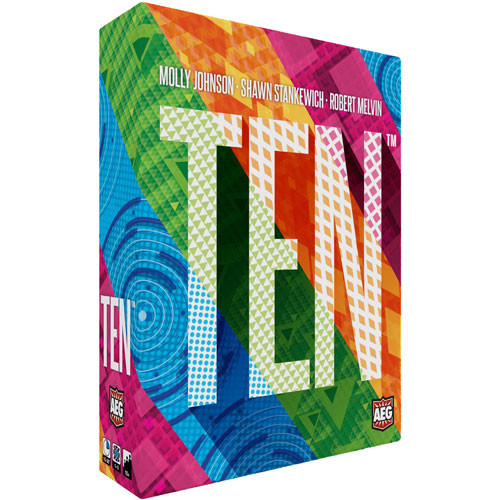
Somehow I never reviewed TEN, a great small-box card game from the Flatout Games group (Point Salad/City, Verdant), even though I first played it at least two years ago. We broke it out again on Monday and played a quick two-player game, refreshing my memory enough for a writeup. It’s fun, and so easy to teach and play.

TEN comes with a deck of cards numbered 1 through 9 in each of four colors and currency cards of value 1 through 5, with various wild cards I’ll describe in a moment, and black and white tokens used as currency in the game. The goal is to create sequential runs of cards in each of the four colors. You’ll score one point per card in your longest run for each color, and if you complete a run of cards 1 through 9, you get an extra point as a bonus.

On your turn, you flip cards from the top of the deck until you choose to stop, or until you bust by exceeding ten in total value on the numbered cards or on the currency cards (but not combined). If you chose to stop, you can take all of the numbered cards into your hand and all opponents get the tokens shown on the currency cards, or you can take the number of black tokens shown on the currency cards and your opponents get nothing. In the latter case, you move the numbered cards into the ‘market.’ If you take the numbered cards, you then get to buy one card from the market by paying tokens equal to its face value.

If you bust, then the numbered cards go to the market and you get a white token, which is equal to three black tokens. You can use black and white tokens to buy cards or in the auctions of wild cards (put a pin in that), and you can also discard any cards from your hand for a value of one in any purchase action.

The wild cards come in three flavors. One is just a straight wild card, which can be any color and any number of your choice; you don’t have to decide any of this until the end of the game. Then there are wild cards of a fixed number where the color is wild, and ones where the color is fixed and the number is wild. When the active player flips one over from the deck, they pause their turn and a one-round auction begins; the active player will always get the last bid. Then they resume their turn.

Play continues until the deck is exhausted; you alter the size of the deck based on the player count. Then each player picks the values/colors for their wild cards and scores their longest run of consecutively numbered cards in each of the four colors. That’s all there is to it.

TEN works best with more players, of course, as there’s more competition for the cards and within the auctions. You can’t plan on certain cards still being in the market, or know that once your opponent took a green 3, they’re not likely to keep another one, whereas in a two-player game, you’re probably going to get most of the cards you need, and the auctions are anticlimactic. Two-player still works, as long as you are fine with the higher scores and the probability that you’ll both finish at least two nine-card runs.

You can definitely throw this in a bag without the box – you don’t even really need the tokens if you have a pile of coins, and the cards are just a fat deck you can secure with a rubber band – and the teach is super quick. My younger stepdaughter had no problem grasping the game, and in our most recent play I beat her by just a single point, with only a little help required to get her to see how to maximize the points for the wild cards she had at game-end. The push-your-luck aspect of TEN is so fun and so easy for people to understand that I can’t imagine anyone over the age of 7 who wouldn’t be able to play it. I’m going to start bringing it on more trips.

Combo.

Combo is the latest game from new publisher Happy Camper, whose first title was Trio, an import from Japan that is one of my favorite games of all time. Combo’s not quite at Trio level, but it is another very easy-to-teach game that revolves around one pseudo-cooperative mechanic that helps it stand out from the sea of small-box games that arrive on my porch.

Combo is really just a deck of cards in six colors (suits … or fruits, which is the theme of the art here), numbered 1 through 12, with point values on the cards in inverse proportion to the face values. Players will play cards from their hands to the table in each round, and once all players have played the required number of cards, all players determine the most valuable set of four or five cards (depending on player count) they can make from everyone’s played cards. The values are just those of poker: a straight flush beats four/five of a kind, which beats a flush, which beats a straight, which beats an X-high set.

You score points in Combo by having your played cards as part of the most valuable set at the end of each round. So if I played an orange 8, and the best set was an orange flush (we are agents of the free) that included my 8, then I’d take that card and place it face-down in my “full value” pile, which means I’ll get the higher point value printed on the card. There are cases where multiple cards could be used to make the most valuable set, and in those cases of true ties, the players who contributed those cards put them in their “half value” pile and get the lower point value, which is, of course, half of the higher one.

The start player changes each round, and you play until everyone has been the start player twice, as there’s definitely an advantage to going last. The number of cards you play varies by player count, as does the size of the set. There’s a two-player rule where each player plays a card, then you draw the top card from the deck as if a third player played it, repeating that whole cycle, and then each player plays once more so you have eight cards on the table. With two or three players, you play three cards each; with more, you’re playing two. With five or six players, you’re making a five-card set rather than a four-card one. That’s about the whole game. Also, the first-player token is a pineapple.

It’s a little unfortunate for Combo that it came out right around the same time as The Gang, which is also poker-themed, and is just a better game – which is not to say Combo’s bad, not at all, but The Gang is great. Combo is fun, and it’s very easy to teach and to play. You can really just play it even if you don’t entirely get the poker-hand scoring; just about anyone can understand the ideas of sets, runs, and flushes, and you just want to put in cards to muscle in on those so you get some points. Higher cards are more likely to be included in the most valuable group of four or five cards at round’s end, but they’re worth fewer points, so there’s some strategy in what you play when; you may want to hold a better card for your last play to make sure it’s going to get scored.

This is a retheme of a Korean game called Surfosaurus Max, which I’ve never seen, but the rules are identical – Boardgamegeek has them listed as one game, which is a little confusing. It’s a good filler game for the family, or to play with relatives who say they like games but maybe don’t really like most games, just the easy ones. And there’s a place for that in just about any collection.

Top 20 board games of 2024, part two.

My annual post of the top 10 games of the year is now up over at Paste. Compiling that list has gotten harder each year, because I play more new games in a calendar year than before, and because there are more games coming out each year – good and less good. I started out with 17 possible titles for the top ten, cut it down for Paste, and then decided to throw together a second post here with the next ten. I’ll just reiterate that there are also games that came out in 2024 that I didn’t play but that might make the list based on what other people have said about them, what I’ve seen, and what the response and ratings are for the games on Boardgamegeek.

11. Harmonies

This might have made my top ten if I’d ever played the physical version, but I’ve only played it on Board Game Arena, and I think I really need to see the physical components. It’s a simple game with tight, medium-complex scoring, taking the general gist of Calico and making it somehow a little more forgiving without taking away what makes Calico good. On each turn, you take all three colored tokens from one spot on the board, and then place each of them on to spots on your own little map of hex tiles, with each color representing a different terrain type with its own placement and scoring rules. You can also select a new scoring card if you have room, with a maximum of four at any time, although once you fill all the spots on any scoring card you can set it aside and draw a new one. The game continues until someone has two or fewer empty hexes remaining. I’m also not 100% sold that all of the starter scoring cards are balanced, but that aside, it’s a wonderful thinker of a game, and really easy to learn – just hard to play well.

12. Dracula vs. Van Helsing

A great asymmetrical two-player game where the players play with the same deck of four colors with cards numbered 1-8 but have different goals: Dracula wants to kill four humans in any of the board’s five districts, while Van Helsing wants to drain all of Dracula’s hit points before that happens. To set up, each player draws five cards and lays them on their side of each of the five regions in the order in which they were drawn. Each number has a specific power that activates when you discard it, so on your turn, you’ll draw one card and either replace a card in front of you (discarding and activating that one) or discard the newly drawn one (activating that). Once the discard pile has at least six cards in it, either player can choose to end the round, giving their opponent another turn, or end it immediately by discarding a value-8 card. It’s surprisingly balanced for its asymmetry, and extremely tense like a sudden-death overtime because the game can end at any time. (Full review)

13. Harvest

A reworking of a 2017 game published by the now-defunct Tasty Minstrel Games, Harvest streamlined some rules and made the boards and components much nicer while retaining the “kinder Agricola” vibe. You’ll place three workers in each of the game’s four rounds, gathering and planting seeds, collecting water and compost, tending plants, and harvesting them, while also clearing more land and building buildings for powers and points. The core of the game is in the plants, but there are multiple ways to win here; you can focus on certain plants over others, or go heavy on buildings, and so on. It’s not as punishing as Agricola, which has a huge penalty if you can’t feed all of your family members at the end of certain rounds, but you can still end up knee-deep in compost if you don’t manager your resources well. (Buy it here)

14. Gnome Hollow

Gnome Hollow was a huge hit at Gen Con with its bright, colorful components and combo of route-building and set collection. You draw and place two hexagonal tiles from the market on every turn, placing them on the map all players are building in the center of the table, and then move one of your two gnome workers to take an action – claiming a path in progress, selling mushrooms at the market, gathering a flower, or visiting a signpost to grab some extra mushrooms. When you complete a path, you get the mushrooms shown on the path, and then you move one of your path tokens on your board, gaining a bonus if the path covers 5 to 7 tiles, and scoring more points at game-end the more ring tokens you’ve moved. The scoring is extremely simple, and there’s plenty of interaction on the map and in the competition for the best spaces at the mushroom market. It’s a very solid game across the board, pun intended. (Buy it here; full review coming in January.)

15. Castle Combo

I find it hard to separate this game entirely from Faraway, as they both came from the same US publisher/distributor (Pandasaurus) in almost exactly the same box size with similar cartoonish art. The designers aren’t the same, and the games don’t have a ton in common other than one trait – you will play cards early that will determine your card choices later on, because they only pay out if you get the right cards and place them the right way. You’re all building a 3×3 grid of cards, selecting from two rows, and on your turn you can only select one of the three cards in the row where the Messenger sits. You can pay a key to move him or to refresh the cards in the row. You pay the price in gold to buy a card and then place it wherever you want, usually getting some immediate return in gold or keys (with some other possibilities), and then earning points at game-end from that card based on what else is in its row or column or just your whole tableau. It’s just 9 turns and managing your resources while ensuring you snag the card you need keeps the game tense right to the last turn. These two designers have a very promising new game, Zenith, coming out next year from the company that published the next game on this list. (Buy it here)

16. Captain Flip

The first release from PlayPunk, the new publishing imprint from designer Antoine Bauza (7 Wonders, Tokaido) and Thomas Provoost (co-founder of the publisher Repos), Captain Flip is a light family game where players try to fill their pirate ships with different crew tiles. Your ship has five columns of varying sizes, anywhere from one to five spaces high, and the powers or rewards of tiles you place often depend on what else is in that row or column. If you don’t like the crew member on the tile you drew, you can flip it to the other side, but then you have to play that one, even if it might hurt you to do so. One character, the Gunner, gets you 5 coins (points) when you play it, but if you have to place your third Gunner, you lose immediately. It was one of the three finalists for this year’s Spiel des Jahres, losing out to Sky Team. (Buy it here)

17. Fairy Ring

This might deserve to be a little higher but I need to get more plays in before deciding. It is a really clever family-level game that blew away my expectations in terms of its strategic depth – the rules are simple, but you can play it pretty seriously regardless of your age. Players play mushroom cards to the area (village) in front of them, stacking them by type if you wish, and then moving their fairies around the table based on the number on the card they just played, passing through all players’ villages and taking points from the card on which they land. If your fairy ends up on one of your own mushrooms, you score based on the mushroom type. If it ends up on another player’s mushroom, that player gets points, and you only score if you have at least one of the same mushroom type in your village. The game has two seasons with different decks, bringing higher numbers in the second deck. Each season has six rounds, so you get just twelve rounds in total, limiting the game time. The big strategic question here is how to set up your village to maximize your points without handing too much to your opponents, with all the information out for players to see, so everyone can follow that plan if they wish. (Buy it here)

18. Seers Catalog

Seers Catalog is a card-shedding game where you play tricks to try to get rid of most of your cards – someone objected to me calling this a “trick-taking” game because you don’t take the tricks, but you do play them, so sue me – but not all of them. If you have five or fewer cards remaining in your hand at the end of the round, you gain points equal to the face value of the lowest card in your hand. Then all players lose 1 point per card in their hands. The catch is that once you’ve got 5 cards or fewer left, you can’t pass during a trick – you have to play if at all possible, so someone else can potentially bait you into playing your last card. There are two ‘artifact’ cards with 0 value (mostly) but special powers that spice up each game as well. Seers Catalog is also quite unusual for a trick-playing game in that it works well with two players. (Full review)

19. Pixies

Designer Johannes Goupy made my top 10 with Faraway and also designed 2023’s very solid Rauha and the complex game From the Moon (which I haven’t played), and he’s here as well with this wonderful small-box game for just about all ages – maybe 7 and up, to put an actual limit on it. The whole game is a deck of cards in four colors, numbered 1 through 9, and you can only play a card face-up to its matching space in your 3×3 tableau. If you can’t or don’t want to do so, you can flip the card face-down and put it anywhere. If you place a card in its proper space on top of a face-down card, or a space that already has a card of that number in it, it’s “validated” and scores its face value. You also score the net of the various positive and negative symbols on all of your face-up cards, and score for the largest contiguous area of one color. You play four rounds, one for each season, with the area bonus increasing in each round. The card-drafting mechanic (very similar to Faraway’s) gives you some real player interaction, too. (Full review)

20. Life in Reterra

Earth is on the rebound, as some unstated disaster has led to a world where humanity has to start over. In Life in Reterra (get it? it took me way too long), players place terrain tiles with various symbols on them that allow the placement of citizens, relic tokens, or buildings, the last of which can give you additional powers or gain you extra points. The real strength of Life in Reterra is its flexibility: in every game, you choose five buildings to use, taking one of the three recommended sets or just mixing and matching as you please, as long as you match all five required building shapes. Once everyone has filled their 4×4 grid, you score. It’s got a longer runway with the various building tiles’ rules, but the game play itself is very quick. (Full review)

Honorable mentions: Courtisans (full review), River of Gold, Parks Roll & Hike (full review).

I may receive a commission from any affiliate links on this page.

The Gang.

I admit I was pretty skeptical when I heard about The Gang, a new small-box game that was described to me as “cooperative poker.” It is that, but it works far better than I expected it to.

The Gang is based specifically on Texas Hold ‘Em, where players begin with two cards in their hand (pocket cards) that other players can’t see, and then five cards are revealed in three stages, first three (the flop), then one more (the turn), and then the last one (the river). In actual poker, players bet after each of these stages, but nothing is resolved until after all five cards are out and the betting has concluded. In the Gang, the players try to determine the ranking of all players’ best hands, best to worst, after the river card is flipped, but must not communicate at all about what’s in their hands. The only communication comes by taking the ranking tokens after each step – so, for example, if after the flop, your best hand is nine-high (which is terrible), you would probably grab the one-star token for that round, which is the lowest one. Someone else might try to take it as well, so you have to decide whether to let them have it or whether to swipe it from them as a way of signalling that, hey, your hand really sucks. You can never have more than one of those ranking tokens in front of you, and you can’t put a token in front of someone else – only in front of yourself or back to the middle of the table.

There are four sets of those tokens, one set for each stage, but you only ‘score’ the set for after the river. If all players have the correct ranking tokens based on their best possible hand, your team has completed the challenge and gets to flip a heist card; if any player is out of ranking order, you have triggered the alarm and flip one of those cards instead. You all play a best-of-five, so if you get three heist cards before you trigger three alarms, you win the game.

The game also comes with various cards to increase the difficulty or change some of the rules, like giving each player a specific power or requiring you to win in four rather than five. I understand why these exist, since otherwise the entire game is a regular deck of playing cards and the 16 tokens, but I don’t think it needs them. It just overcomplicates things without making the game any more interesting. I might feel better if I played this a few dozen times and maybe got tired of it, but there are just so many possible combinations from a deck of 52 cards that I think it’s got a lot of legs.

The one caveat I would offer is one the tutorial app acknowledges – the game plays 3 to 6, but with only 3 players, it’s just not that challenging. There are only six possible configurations of tokens/rankings with three players, so you could accidentally get it right now and then, and that takes a good bit of the fun away. I played with 4 and 5 and it was appropriately difficult, winnable but not easily so, and that meant that when we nailed it, everyone got that positive feeling from a job well done. We had one people where we had three people whose hands were separated by just four cards – something like queen high, jack high, nine high – and we got it right. That was incredibly satisfying. The group had a 12-year-old and an 8-year-old, and both were able to grasp the concept and the scoring with the help of the reference cards (which just shows the hierarchy of the values of possible hands), although the 8-year-old struggled a little bit with the nuance of being, say, second-highest – if he saw he had a good hand, he wanted the top token. I imagine that will smooth out with more plays.

Circus Flohcati.

Circus Flohcati is a 1998 game from the prolific designer Reiner Knizia, whose name you can’t mention without calling him a Prolific Designer; he’s published over 600 games, and has a number of all-time classics to his name, including Samurai, Tigris & Euphrates, Through the Desert, Battle Line, Lost Cities, Medici, Ra, High Society, and The Quest for El Dorado. I own seven of those, plus at least four more games by him, just at a glance at his BGG page. He’s good.

Circus Flohcati is actually one of his oldest games, but it’s out in a brand-new printing from 25th Century Games, which brought Ra back from purgatory, and uses art from the 2013 Korean edition. It’s a light push-your-luck game, listed for ages 6+, that is kind of perfect in its simplicity: there are just a handful of rules and the game works fine, with a high luck/randomness factor that should keep younger players in the game – as long as they grasp the main scoring mechanic.

The entire game is a massive deck of cards, 80 circus cards and 9 action cards. The circus cards come in ten colors, with cards numbered 0 through 7 in each. The action cards have three varieties, with three of each in the deck. The goal is to build the most valuable circus through collecting high cards in each color; through playing trios with three cards of the same numerical value; and possibly by causing the end of the game by collecting one card of each color in your hand.

On your turn, you may select one card from the face-up cards in the market, or, if you don’t want one, you may flip over cards from the top of the deck until you find one you like. If you flip a card with a color that’s already in the market, you discard that new card and your turn ends immediately. If you flip an action card, you take that action: take a random card from an opponent, choose an opponent to give you a card of their choice, or reveal cards from the deck until you get to a duplicate color and then choose any card from the market that you want.

If at any point you have three cards of the same value, you may play them to the table as a free action, forming a trio that is worth 10 points at game end. If you get all ten colors in your hand, you may call a “gala” and end the game, taking 10 points as your bonus. Once the game ends, each player scores the face value of the highest card they have in each color. Any lower-valued cards in those colors don’t score at all, so getting them out in trios if possible is the only way to get any points for them at all. You add those points to the trio points and the gala points and that’s the whole shebang. There’s no penalty for having lower-valued cards, or having too many cards – there’s nothing punitive in this game at all. You’re just drawing until you get high cards and/or trios.

One commenter on BGG gave this game a 7.5 out of 10 and said “It’s stupid and lucky but I love it!” and that’s pretty apt. I don’t know if I’d say it’s stupid, but it is simple. It plays very quickly, and it works with 2 to 5 players. BGG ratings are pretty heavily skewed towards longer, heavier, less luck-driven games, and this is kind of the anti-BGG game in that way: it’s super simple, quick, very random, and very fun. It reminds me a little of Splito, another small-box card game from 25th Century that was one of my favorite new games of 2023. I think I like Splito a little more, and it has the benefit of playing up to 8 people, but they’re in the same vein – you can bring these games to a family gathering where you have players of all ages and experience levels and you’ll have a good time.

Seers Catalog.

Seers Catalog is yet another trick-taking game, this time a game where you’re trying to get rid of most of your cards, but not all of them. It has a lot in common with SCOUT until you get to the scoring, where it has a novel way of awarding points – or taking them away – that makes this game so fun and so very hard to play well.

A remake of a self-published game called Of What’s Left, Seers Catalog has a deck of cards numbered 2 through 13 in five suits, although you’ll cut that down based on player count so that each player will start with a hand of twelve of those cards plus one wild and two ‘artifact’ cards. Those artifact cards have various special powers but nearly all of them have values of 0 for scoring at the end of the round, so you want to use them rather than holding on to them. Some work in tandem with another card you play, such as changing its suit or adding or subtracting 1 (or ½!) to its value, while others you play on their own, like a card that automatically is the highest one on the table, or the Go First card that, as you might infer, means that player goes first (but doesn’t have to play that card immediately).

The player who starts a trick must play a ‘meld’ from their hand: a set of cards of the same value with different suits, a run of cards of the same suit with consecutive values, or a single card. All players may follow by playing the same type and size of meld – so if I play a run of 3-4-5, you must play a run of exactly three cards – but must have a higher card value than the last trick played, so in that example, you would have to play at least a 4-5-6. Players may pass; whoever wins the trick opens the next one. When any player has fewer than six cards in their hand, they go in the Bonus, flipping the indicator token in front of them. From that point on, they may not pass: if they have a legal play, they must make it.

A round ends when any player is out of cards. They will score zero points for the round, as will any players not yet in the Bonus. All other players in the Bonus score as follows: Take a number of points equal to the value of the lowest card in your hand, then subtract the number of cards in your hand. So if you have two cards remaining, a 6 and an 8, you would get 4 points (6 for the card minus 2 for your two cards in hand). Wild and artifact cards are (mostly) value 0, so if you have one, you get 0 points minus the number of cards in your hand.

It should be obvious that the goal is to end up with one high-value card at the end of a round, or at worst just a couple of high-value cards. Because you’re required to play once you’re in the bonus, however, that’s really hard to do. Later in the round, players are more likely to make smaller plays – a single card or a run/set of two – and it’s similarly likely that you’ll have a legal play. And if you have the misfortune to win a late trick like that, you may end up having to lead the next trick and end up playing your last card.

I haven’t mentioned the theme here, because beyond the wonderful title – which, I’ve discovered, you probably have to be at least 45 or so to get – the theme is irrelevant. There’s flavor text on the cards, but I never read them; I played this once without my glasses, so I couldn’t have read it if I’d wanted to, and it didn’t affect my ability to play the game at all. I can say that the game plays well with two players, which is unusual for a trick-taking game. It’s different, since it’s easier to guess what the other player might or might not have, but it still works really well. I prefer SCOUT, but if you love SCOUT and want something in a similar vein that’s offers a few new twists, you should put Seers Catalog on your order form.

Seven Games.

The title of Oliver Roeder’s book Seven Games: A Human History is a misnomer in two ways: It’s not really a book about games, and it’s far more a history of computers than of humans. It is, instead, a history of attempts to use what is now unfortunately referred to as “AI” to tackle the myriad problems posed by seven popular board and card games from human history, from chess to bridge. Each of these games presents the programmers with specific, novel issues, and while machine-learning techniques have succeeded in solving some games (like checkers), others have and may forever prove inscrutable (like bridge).

Roeder is a journalist for the Financial Times and clearly a gamer, and someone who loves the games for what they are beyond their competitive aspect (although it becomes clear he is a fierce competitor as well). He writes as an experienced player of all seven games in the book, even though he must have varying skill levels in each – I’d be shocked if he were much of a checkers player, because who on earth in the year of our lord 2024 is a great checkers player? His experience with the games helps infuse a book that could be a rather dry and grim affair with more than a touch of life, especially as he enters tournaments or otherwise competes against experts in games like poker, Scrabble, and backgammon.

What Roeder is really getting at here, however, is the symbiotic relationship between games and machine learning, which is what everyone now calls AI. (AI is itself a misnomer, and there are many philosophers who argue that there can be no intelligence, artificial or otherwise, without culture.) Games are perfect fodder for training AI modules because they tend to present short sets of rules and clear goals, thus giving the code and its coder targets for whatever optimization algorithm(s) they choose. In the case of checkers, this proved simple once the computing power was available; checkers is considered “weakly solved,” with a draw inevitable if both players play perfectly. (Connect 4 is strongly solved; the first player can always win with perfect play.) In the case of bridge, on the other hand, the game may never be solved, both because of its computational complexity and because of the substantial human element involved in its play.

In one of those later chapters, Roeder mentions P=NP in a footnote, which put an entirely different spin on the book for me. P=NP is one of the six unsolved Millennium Prize Problems* in mathematics, also called the P versus NP problem, which asks if a problem’s correct solution can be verified in polynomial time, does that also mean that the problem can be solved in polynomial time? The answer would have enormous ramifications for computational theory, and could indeed impact human life in substantial ways, but the odds seem to be that P does not equal NP – that the time required to solve these problems is orders of magnitude higher than the time required to verify their solutions. (For more on this subject, I recommend Lance Fortnow’s book The Golden Ticket, which I reviewed here in 2015.)

*A seventh, the Poincaré Conjecture, is the only one that has been solved to date.

You can see a thread through the seven chapters where the machine-learning techniques adjust and improve as the games become more complex. From there, it isn’t hard to see this as a narrow retelling of the ongoing history of machine learning itself. The early efforts to solve games like checkers employed brute-force methods – examining all possible outcomes and valuing them to guide optimal choices. More complex games that present larger decision trees and more possible outcomes would require more processing power and time than we have, often more time than remains in the expected life of the universe (and certainly more than remains in the expected life of our suicidal species), and thus required new approaches. Some of the attacks on games later in the book allow the algorithm to prune the tree itself and avoid less-promising branches to reduce processing time and power, thus leading to a less complete but more efficient search method.

Roeder does acknowledge in brief that these endeavors also have a hidden cost in energy. His anecdotes include Deep Blue versus Kasparov and similar matches in poker and go, some of which gained wide press coverage for their results … but not for the energy consumed by the computers that competed in these contests. We’re overdue for a reckoning on the actual costs of ChatGPT and OpenAI and their myriad brethren in silicon, because as far as I can tell, they’re just the new crypto when it comes to accelerating climate change. That’s nice that you can get a machine to write your English 102 final paper for you or lay off a bunch of actual humans to let AI do some things, but I’d like to see you pay the full cost of the electricity you’re using to do it.

I’ve focused primarily on one aspect of Seven Games because that’s what resonated with me, but I may have undersold the book a little in the process. It’s a fun read in many ways because Roeder tells good stories for just about all seven of the games in the book – I might have done without the checkers chapter, because that’s just a terrible game, but it is an important rung in the ladder he’s constructing – and puts himself in the action in several of them, notably in poker tournaments in Vegas. There’s also a warning within the book about the power of so-called AI, and I think inherent in that is a call for caution, although Roeder doesn’t make this explicit. It seemed a very timely read even though I picked it up on a friend’s recommendation because it’s about games. Games, as it turns out, explain quite a bit of life. We wouldn’t be human without them.

Next up: Dark Matter of the Mind: The Culturally Articulated Unconscious, a book by Daniel Everett, a former evangelical Christian missionary who became an atheist and turned to linguistics after his time trying to convert the Amazonian Pirahã tribe. He appeared at length in last year’s outstanding documentary The Mission.