This was my tenth Gen Con, and in some ways it was the best, although I think that’s more about the people at this point and a little less about the games I saw and played. That said, I did see a lot of great new games, and had a hard time paring my “top games of the con” list to ten, but almost everything that I even considered for the list was on the shorter side, with the exception of Railway Boom (the last cut). It was a little bittersweet, as it was also the first Gen Con where I wasn’t there representing Paste/AV Club, although I am very grateful that publishers continued to open their metaphorical doors to me even as a solo act.
Gen Con, for the uninitiated, is the largest board game convention in the Americas, attracting over 74,000 attendees to Indianapolis and over 800 vendors. It’s held over four days in late July or early August, with a very unfortunate habit of landing on or just before the trade deadline. It’s the main place and time for publishers in this market to release new games, with a lot of ancillary activities like author signings, artist booths, and even some celebrity sightings (apparently Felicia Day and Mychal Threets were there).
Some big picture thoughts first: here were three big themes I noticed at this year’s Gen Con:
- Shorter is better. The vast majority of games I saw offered playing times of 45 minutes or less. Games are smaller, shorter, and many of them are $30 or less, some as little as $9-10 for a full game. I saw lighter or family-level versions of Wingspan, Distilled, and Azul. There were still a decent number of heavy games there for sale or previewed for an upcoming Kickstarter, as well as at least one (Ada’s Dream) that only had a deluxe Kickstarter version available for sale, but I am not bringing home anything with a playing time over 45 minutes, and that’s not by my design.
- What’s old is new again. Bringing out-of-print games back, as is or in new skins, has been a trend for a few years, but it was as prominent as ever this year. Tigris & Euphrates, Schadenfreude, Scoville, Camp Grizzly, North American Railways, Las Vegas, and Hacienda are just some of the as-is reissues; Hanami (Samurai), Wild Magic (Vampire), Six Sojourns (Eight-Minute Empire), Gold Country (Spectaculum), and Skyward Republic (Skyward) are some of the old games made new again.
- The forest is overpopulated with critters. We do not need any more games with adorable woodland creatures. Please. I’m begging you.
If you haven’t seen my Gen Con wrap-ups before, here’s how it all works. I use BoardGameGeek’s invaluable preview and create a list of games/publishers I want to see, and work my way through the exhibit hall each day, talking to publishers and demoing or playing everything I can. I take notes, which gets a comment maybe 30-40% of the time (usually good, people respect the pen and paper method), and then dump everything into this recap each year. I rank the ten best games I saw, and then I run through everything else, sorted by publishers, and those are listed alphabetically.
Here are my top ten new games of Gen Con 2026:
1. Drillers (Czech Games): I’m pretty sure this one sold out before Saturday, for good reason. Drillers is a midweight game where you send your mechs into an abandoned mine to collect ore and other valuables, opening up new levels by spending some of your resources, but avoiding going too far down to where you won’t have the fuel to get back up. You do all of this via hand management, building your deck to get additional powers so you can go deeper into the mine later in the game. I’ve read comparisons to CGE’s Lost Ruins of Arnak; there are some structural similarities, but Drillers is simpler mechanically and tighter thematically. (That’s not meant as a knock on Arnak, which I also enjoy.)
2. The Glasgow Train Robbery (Salt & Pepper): This is is a cooperative heist game for two players, with no talking allowed, as the players try to pull off a mission on The Great Train Robbery of 1963 (which had 15 participants, not 2). You each have different skills and must go through all of the steps from planning the heist to executing it, finishing all five plan cards before the train reaches its destination. The art is very stylish and the game play appears to be tight.
3. Tenby (Mighty Boards): I’m a little partial to this one, as I’ve been to the Welsh seaside town that gives the game its name. It’s a big game in a small box, as players draft cards to build out streets with shops, landmarks, terraces, piers, and more, with each card bearing its own scoring condition based (mostly) on what else is on its street. There’s also an action-drafting mechanic that determines the selection order for the subsequent round. Designer Benjie Talbott did all of the art, and also wrote and performed a soundtrack to the game that’s on streaming services. It’s also great if you’re a fan of terrible puns, as the shop names all involve groanworthy wordplay (but, alas, are not actual Tenby establishments).
4. dnup (Asmodee): I have already reviewed this one, so I’m bending my rules a little to avoid punishing a publisher for sending me one of their best new games ahead of time. dnup (down/up) comes from the designer of SCOUT, and it’s another card-shedding game with cards that have top and bottom values. Here you’re trying to discard sets of the same number, and if you play something that another player bests, you take your cards back while flipping them upside down, so often you’ll play cards with the specific hope you’ll get them back for a better play later in the game. It’s not as good as SCOUT, but it’s excellent.
5. Kingdom Crossing (Pandasaurus) Kingdom Crossing takes the seven bridges problem and builds a whole game around it, with resource management and engine-building components. You travel around the board visiting five guilds of adorable woodland creatures, collecting resources or other benefits, but the catch is that you can’t cross the same bridge twice in the same ‘day,’ with four days in the entire game. It’s about to hit retail and the Pandasaurus site this month. At 45-90 minutes it’s one of the longest games in my recap.
6. Kan? (Surfin Meeple): A medium-light set-collection and tile-laying game where players collect paints to make Japanese paintings called emakimono, but where you must be efficient: if you collect too many paints and don’t use them in the same turn, they dry out and block squares on your board. The game looks incredible and the components are very high quality – 3D paint cups, a killer box insert – for $40.
7. Frosted Blooms (Synapses): A light puzzly game of tile-laying from Bruno Cathala and Ludovic Maublanc where you take a polyomino tile from the supply and then must play one of the three landscape cards in your hand for immediate scoring. The tiles have four different flower types as well as water, and you score the one or two flowers/water on your played card from the tile you just played plus any contiguous regions of the same flower/water. If you create an enclosure of up to 4 squares, you also get a building, which adds points at game-end. There are objectives for being the first to create contiguous regions of certain sizes for flowers and water or for being the first with a certain number of each building type, with some removed randomly for each game. Turns are simple but the puzzle of maximizing short- and long-term scoring is intricate.
8. Under the Leaves (Grand Gamers Guild): A very cute tile-laying, pattern-building game where you place tiles showing four squares in five different colors into your tableau. Any contiguous region of three or more squares of the same color gets pollinated and attracts a bee; if all four squares on any tile are in pollinated region, that tile attracts a hummingbird. There are also three objective cards each game that bring creatures for other patterns you create. My only critique is that we’ve seen all of these mechanics before; Under the Leaves combines them in an elegant way, with very simple scoring.
9. Night at the Zoo (Capstone/Albi): A light family-level game where the animals have escaped from the zoo and are trying to sneak back in before the zookeepers notice. Each animal type moves and scores differently, and you can use different animal combinations in each game. This was one of the biggest hits and most talked-about games of the con.
10. Wingspan Pocket (Stonemaier): Yeah, I know, I’m being a little basic. Wingspan Pocket is a $20, short Wingspan game that strips it down to its foundations but keeps the art and variety of the bird cards. You build one row of bird cards, with no habitats, and once someone gets six cards the game ends. You get points for your birds, eggs laid on the birds, cards tucked behind them, and two end-game objectives if you choose to use them. You activate all of your cards on every turn, regardless of whether you play a bird or take food cards. I love Wingspan, and I don’t think I would ever choose the Pocket game over the real McCoy – but this seems like a fantastic gateway game to scaffold newer players into learning the original once they’re hooked.
Here’s everything I else new that I saw, played, or demoed, listed by publisher. Grab yourselves a drink; this may take a while.
25th Century: Intent to Kill is a mystery game pitting a serial killer against a detective, with space for four players to play in any team combination, with two sets of rules – a logic mode, more like traditional games of this sort, and an advanced ‘intuition’ mode that adds more powers and capabilities to give the game more of a narrative feel. 25th Century continues its reissues of the Ra series with Ra: the Dice Game, rolling five dice to determine how they can play to each of the areas of their board, with variable round lengths depending on when a fixed number of Ra symbols appears. The First Tsar is a medium-heavy game for up to four players competing for influence and power in the reign of Ivan the Terrible, who I think was just misunderstood. Six of VIII gets its first big release – it was first published by indie shop New Mill Industries in 2024 – with improved art on the box and cards. It’s a trick-taking game with two teams of two where the trump suit changes six times, once for each of Henry VIII’s wives, with the duration of each trump suit tied to the duration of that wife’s tenure.
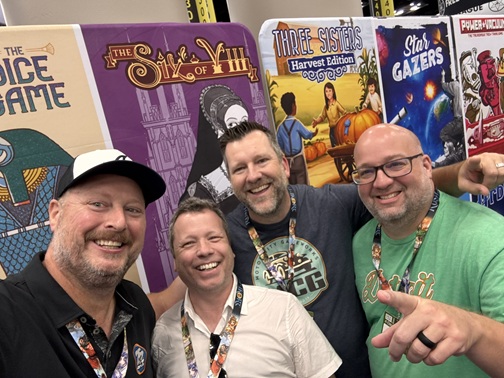
Chad Elkins of 25th Century, some guy, and Ben Pinchback & Matt Riddle (designers of Fleet, Three Sisters)
Green Team Wins Again is the second iteration of their popular party game, joined in the party category by VNTYPL8S, a game where you create your own custom vanity license plate and players have to guess whose plate is whose; and Bullseye, a word-guessing game where you go letter by letter, but after each letter all players pass their clue to the left, so each is now working with a different player’s letter(s) to try to guess the answer. They’ve also brought back Reiner Knizia’s 1999 village-building game Rheinländer, and just completed a Kickstarter for his evergreen classic Tigris & Euphrates.
3WS: Relative Space is a simple card-shedding game where each player starts with a dozen cards in a pyramid shape, with five of them face-down, and has to be the first to get rid of all of their cards by playing them to an escape module, where you can only do so if your card is higher than the ones below it. Canvas Critters is a party game of adorable woodland creatures, where you have to use meeples of those creatures to make mosaics that match the chosen word.
Adam’s Apple: Gnomeville is a bag-building game with a match-3 mechanic and a little bit of tower defense, with players building and guarding their gnome villages over five rounds. There are also public objectives to score in the last three rounds. It’s due out at Spiel.
Albi: Prague Unseen is a worker-placement game with just four places to go, where each of your four workers is different. It’s a competitive game where each player works to rebuild Prague after a flood, enlisting the help of fantasy creatures and playing mini-games around the board. It’s one of the few truly new heavy games I saw at the con. Potemkin Village is a trick-taking coop game with 16 characters to choose and multiple scenarios as you try to move the cards, representing building façades, along quickly enough to fool the queen. Both games are due out at Spiel in October.
Alderac: Electrify is a new game from Mystic Vale/Cubitos designer (and Dodgers fan) John D. Clair, who has taken his hit game Space Base and turned it way up to 11 here, with card-stacking and layering, and a similar mechanic where you activate an entire stack on each turn. It’s due out next year. Into the Machine was released at Gen Con this year; it’s an engine-builder with a big racing component, from Magic Maze designer Kasper Lapp. You spend tokens to place your workers, paying more to be able to go into an occupied space, trying to get your pieces to the end of the track and then all the way back to place them in the scoring area.
Alley Cat: Foxglove Farm is a tile-laying pickup-and-delivery game with adorable woodland creatures on the cover, although the game within is more of an economic one, as you lay tiles with buildings or paths to connect buildings so you can move your goods to the right tiles for points. It’s a remake and retheme of a Japanese game previously called My Trolley Town or Minecart Town.
Allplay: Allplay had the retail version of Container, a grail game about shipping containers – no, really, and people love it. You’re building factories, filling containers, shipping them out to the market on a different island, and trying to time them properly to maximize your profits. Mountain Goats Legacy is just what it sounds like, although unlike most legacy games, you’re not destroying or defacing any components, so it has more replay value. Stonk Market remakes a Reiner Knizia title from 2002 called Wheedle. The deck has cards in seven colors, with numbers 5, 7, or 9, representing how many cards of that color are in the deck. The goal is to end the round with only majorities in your hand – so if you have one of the 7 suits, you must have at least 4. You do this by swapping one card with the single card in the center, or trading cards any way you wish with other players. It’s quick and really fun. Enchanted Ivy is a solo game of card placement and pattern-matching, with a narrative campaign around it but light mechanics, and some outstanding art. I picked up Le Chocolat, another of their $9 tiny-box games, sight unseen, on the recommendation of a designer I was chatting with at another booth. You lay out a 7×5 grid of chocolate tiles, representing a full bar, and then take turns with your opponent cutting the bar via straight lines, claiming any segment created that has one to three tiles. There are multiple scoring options, so you can vary it each time you play. Allplay was also selling R2i’s Bordeaux, their “and-write” version of Fromage/Formaggio, where the entire game is a legal-sized pad of varied sheets, and you choose your actions freely but – as in the original games – choosing some actions will block them out for multiple turns afterwards. And they announced some upcoming releases for 2027, including Through the Mountains, a sequel to Knizia’s Through the Desert; a reissue of Dominant Species; and Have a Magical Day, a game about touring a theme park co-designed by John D. Clair. I got a sneak peek at an unreleased tiny-box game called Woo, because I know the designers; it’s card-shedding game for two teams of two, where you play tricks of sets, runs, ‘stairs’ (two pairs of consecutive values), or ‘bombs’ (four of a kind) – but both partners have to contribute at least one card for a legal play. You can play strategically to manipulate the turn order, and there are ways to pass one card to your partner if you open a trick but they can’t complete it.
Arcane Wonders: Leylines is a complete reimplementation of the 1987 Spiel des Jahres winner Auf Achse, with a new theme around magic and mystic items, while at heart it remains a pickup-and-delivery game with action programming via dice rolls. Aquatica Duellum is a two-player spinoff of their highly-rated game Aquatica, with more direct player interaction including a tug-of-war mechanic (think the military track in 7 Wonders Duel) and multiple ways to win. Crescendo is a lighter game where you try to be the first to organize your five face-down cards in ascending order. The cards have ranges on the back that show you roughly where the values lie, which is a start, but mostly you’ll replace them with cards you draw or move cards around using the power shown on the top card of the deck.
Asmodee: Crashed Out is a card-shedding memory game where you’re trying to get rid of your highest-valued cards, but your cards are face down. You start with six and can only peek at three. You draw a card on your turn and can discard it – along with any matching cards you have – or swap it with one of your existing cards. There are also some special power cards that let you bend the rules, including one that swaps cards between players. Forest Shuffle: Smoky Mountains is the latest standalone game in the Forest Shuffle series after the original and Dartmoor, with new woodland creatures (they’re not that adorable) and terrain cards. Dragon Overload is a two-player lane battler with one great mechanic and one not-so-great one. Each player can play up to 3 cards to each of the 5 lanes of different colors, with the higher total score winning a lane, but if you double your opponent’s score you’ve overloaded the dragons and they win the lane instead. If you can’t make a legal play, however, you lose, and with a five-card hand limit it’s far too easy for that to happen. The Lord of the Rings: The Two Towers Trick-Taking Game is the second in its series of cooperative, narrative trick-takers where the players play as various characters from the books and try to complete a series of missions with specific win conditions. It’s from Bryan Bornmuller, who designed the previous game and the still-unreleased third title. I watched a little bit of a playthrough of The Trial of the Forest, a 1-2 hour game where adorable woodland creatures move around an evolving board gathering resources, searching for artifacts, and occasionally fighting each other; I can’t say I had that much of a feel for how the game is, other than it looked much more intense than the 2.50 weight rating it has so far on BGG.
BA Games: Goats & Goblins is a family-level game where you, the goblins, must go into a cave to rescue your goats, who are stupid and got themselves trapped again, but also, hey, there’s treasure, let’s get some of that too! It’s a push-your-luck game where going too deep can cause a cave-in and reward the players who chose not to go on that expedition.
Barrel Aged: Wanted Wombats is a very silly but fun guessing game, where you know the distribution of money cards in the small deck and have to guess what’s next; if you’re right, you can keep going, or can quit and bank your winnings, but if you’re wrong you lose everything from that turn. It’s a 2022 release from Kaya Miyano, the designer of Trio. They also have what I think is the first North American release for Plantopia, a 2020 game from Daryl Chow (Come Sail Away) where you’re collecting sets of different plant types and hoping for favorable weather to grow your plants.
Bézier: The Game Makers is a massive worker-placement game, with a rondel and a modular board and a zillion pieces, where you build your engine to manufacture board games, with the titles of over 300 real games used within this one. There are also tech tracks and some dice-rolling and an economic component. The listed play time is 60-90 minutes but I feel like it would take me that long to set it up. I haven’t seen the price for a basic retail edition yet; the Kickstarter deluxe edition goes for $200.
Bitewing: Moytura is a two-player area-majority game, set on a map of Ireland, where the players also compete against a neutral third faction for control. You place your units by selecting a god tile from the track; once selected, that tile goes back to the beginning of the track, making it more expensive to use. You can’t attack your opponent, but you can attack the neutral faction. I liked the goth Small World vibe to the art, too. Azure is a light tile-laying game with a highly modular board where you compete to control rows and columns with your tokens, which you place by way of ‘qi cards’ in your hand. Gold Country is a redo of a forgotten Reiner Knizia game from 2012 called Spectaculum, keeping the stock-holding and manipulation theme while switching the theme to mining and changing some of the rules. I mean, the man has so many games, it’s easy for one or fifty to fly under the radar.
Blue Orange: a_way is a small-box $10 game where up to four players try to move their spaceships across the X-shaped board of cards to their home spaces; with four players, every player’s starting space is another’s destination. Movement comes via cards that let you jump other players, teleport, shift the cards on the board, and more. I only got a quick explanation but it seemed like a clever game for its price point.
Board & Dice: For the sake of completeness, I’ll mention Entropy, which sold out almost immediately – Board & Dice’s booth was almost devoid of games to buy on Saturday afternoon. Entropy is a very heavy game where players build their star systems and create life, with tableau-building, hand management, and resource management mechanics. It’s not my type of game, but it was a huge hit. I didn’t get to see Tianxia, the latest T-game co-designed by Daniele Tascini, as they had it for sale but not for demo.
Burnt Island: Treeline is an upcoming small-box game where you fight for area control while playing with a limited number of tokens, scoring rows and columns when they’re completed, and trying to set up your opponent to force them to play or move one of their tokens in a way that favors you.
Capstone: Ants is an area-control tableau builder where you choose from just four actions on each turn but have many things you can do, including placing little tiles to create rooms in your ant colony, and a mechanic where you lay eggs and grow your workers over several turns. Papyria is a long game but not a very complex one where you advance on two tracks, earning victory points on every turn, but never more than your knowledge track allows, so you have to build up your knowledge track early for big VP gains later. I reviewed it a bit more after last year’s PAX Unplugged. Capstone also had a new expansion for the wonderful family game Wandering Towers that adds tiles to turn the board from a ring to an oval, and adds two little towers where you can bounce off, doubling your movement, or refill a used potion.
Cardboard Alchemy: Whisperwood is a massive Euro sandbox game with bag-building and tech tree mechanics. It’s a huge table hog and apparently takes 2-3 hours to play. Cardboard Alchemy also published Flamecraft Duals, the two-player spinoff of Flamecraft, which is set in the same world but has very different game play, with pattern-building and tile-laying elements.
Cephalopahair: Mercenaries wanted is a card-drafting and hand management game set in the Gloomhaven universe, but with entirely differently mechanics and game play – it’s a true board game, not an RPG in a board game box. You’re building up your team of mercenaries, sending them out on jobs to fulfill objectives for gold, then deciding each round which ones to keep and promote and which ones to replace. It’s due out at PAX Unplugged.
Crafty/Playte: Crafty is a U.S. publisher that works with the Korean publisher PLayte to bring the latter’s games over to this market. Orapa Mine is a Battleship-like game where you shoot sonar beams to try to determine where your opponents’ vessels are; you say the point where you want your beam to enter your opponent’s grid, then it bounces off anything it hits, sometimes at a 90 degree angle, and your opponent tells you where it exits the grid. They also had Orapa Space, which is a larger version of the same game and introduces black holes. North American Railways is a reprint of a 2016 Peer Sylvester game that brings an 18xx experience to a small box, stripping it down to stock-buying and building out railway lines, all through cards. Ada’s Library is a reprint of a 2003 small-box, two-player game of organizing your books to match the order in the ‘master’ display for that round. They also brought back the Sid Sackson classic Can’t Stop in a smaller box. I’ve never written about Can’t Stop but it is a true evergreen game and a wonderfully fast press-your-luck game.
CrowD: Railway Boomfirst came out inJapan in 2022; it’s a fairly heavy economic/railways game from Hisashi Hayashi, the designer of Yokohama, where players gather resources and build up their rail companies to lay tracks across Japan in the late 1800s. This new version is a co-design with Simone Luciani (Tzolk’in, Darwin’s Journey), who streamlined some of the resource management and the auction system, while the player count is now 2-4 instead of 2-5, which I assume was to cut the max playing time from 150 minutes to 120. It was one of the fastest games to sell out that I saw at the con, and might have been in my top 10 if I’d gotten more time with it. CrowD also had the new printing of the heavy economic area-control game Nippon, and the peculiar game Winnie the Pooh: Serious Detective, a cooperative mystery narrative game with three cases in the box that’s a longer game than you’d expect given the kids’ characters involved.
Darrington Press: A Familiar Find is a bluffing game with an I-split-you-choose mechanic set in the world of the Critical Role web series where players try to collect the most valuable ingredients and stick their opponents with negative point cards.
Detestable: The Path of the Priest is a solo game where you have to run a gauntlet of cards, left to right, to get your priest character to the end. The cards are a mix of blue (good) and red (evil); on your turn, you activate one blue card’s power, which may help you move cards or flip them or discard them, and then you activate all of the red cards.
Devir: 7th Seal is a solo dice-rolling battler where you choose how to attack and defend against a set of monsters led by one boss character by deploying your dice across various cards. Berlin 1960 is a hidden-role game for 4-8 players, with some playing as CIA agents and the rest as KGB agents, as you try to complete your investigations and interfere with the other side’s without revealing your identities. It’s from designers Flaminia Brasini and Virginio Gigli (Lorenzo il Magnifico, Egizia). Orloj is a massive, heavy game based on the Astronomical Clock Tower in Prague, where you rotate two rings to determine your primary and secondary actions. It’s a worker-placement game with a long setup (even the person demoing admitted that), but you can plan your primary action a turn ahead based on what the previous player does, so that makes turns shorter. The board is extremely ornate, and I don’t know how I feel about that. They also had the revised edition of Ace of Spades, the solo game that was one of the best new games of Gen Con 2025 but had some highly problematic artwork in its first edition; and Rock Hard: Ear Candy, the first expansion for the great game Rock Hard 1977, by musician and Jeopardy! Champion Jackie Fox.
DVC: I saw a prototype of Inkwell at Gen Con last year, and now it’s out and looks fabulous. It’s a straightforward game of set collection where you pull tokens in groups from a central supply, similar to Harmonies, and then use them to fill out your manuscript pages, matching patterns for points. Some pages score fewer points but let you finish them sooner to get to another page, lending a little more strategy to the game. Pacts is a two-player area-control game where you’re making deals with the fae creatures of Ireland, using an I-split-you-choose mechanic. Dust is a one-player narrative choose-your-own-adventure game designed by a 22-year-old named Joshua Ehrlich. It has no rulebook, and no specific win condition, with scenarios and missions to play as you explore its purgatory world. Photo Club is due out at PAX Unplugged; it’s a game where you’re setting up a board of 3D animals and trees to try to get the best picture to meet conditions on your cards.
Eerie Idol: The Old King’s Crown is a sprawling, complex game where up to four players compete to seize the throne, now that the king is dead, building their decks and then playing cards to different regions of the board to try to claim influence in each and undertake the associated actions. It’s massive, and has an enormous amount of text on the cards and the board. The game had quite a bit of buzz at the con, even though their booth was stuck in the back, but I think this is above my threshold for complexity.
Flatout: I previewed Cascadia Alpine Lakes for its Kickstarter last fall, and now it’s out, taking the Cascadia mechanics but adding a cool layering feature where you build your landscape up, scoring more for placement on higher layers. It’s the same game at heart, but the scoring is different enough that it is more than Cascadia Part Deux. Forage is a roll-and-write with simultaneous play, where each player tries to complete three cards at a time in three different categories. You’re trying to complete those cards while also unlocking intermediate bonuses, often chaining them to check off more spaces on the same or other cards as you would in a typical paper-based roll-and-write game. It really flies. Honeypot is an I-split-you-choose game of a sort, where you’re playing as bear spies (spy bears?), putting a set of six cards in a cute folder for others to pick from; they can look at the first two and take them, or skip those and do the same for the next two, or go for the last two, but once they’ve passed on a pair of cards they can’t go back. You’re trying to collect sets and avoid the many negative cards in the deck.
GameHead: I saw four new releases from GameHead, all remakes of older games that I hadn’t heard of before. Trick to the Future (fka Twinkle Starship) is a trick-taker, obviously, from the designer of No Loose Ends and 9 Lives. The cards’ numbers are drawn like those on an old digital calculator, where an 8 would have seven lines in a rectangle with a crossbar, and all other numbers would be formed the same way with fewer lines. Each player gets a card of wooden rods, and can play them to change the number on a played card, but their remaining rods are their bid number. If you win more tricks than you have rods, you don’t score in that round.
Wild Magic is a new, improved version of Reiner Knizia’s Vampire, a 2000 release that has quite low ratings on BGG. Wild Magic keeps the set-collection aspect of the earlier game, where you’re collecting and playing sets by color, getting a bonus if you have the largest set of a color and scoring nothing if you have the smallest one. Knizia has added new cards with special abilities that weren’t in the first version. Friendly Fishing is a remake of a game previously released as Tonari, which itself was based loosely on an abstract game from 1986 called Veleno (I don’t remember it, despite being old enough for that era). You’re all fishing from the same boat, and you score from the fish you catch plus the fish the neighbor on your left caught, so you want to help them a little during the game – just not too much. Pet Quartet reimplements a small 2023 release called Audition, not based on the Japanese horror film, because that would be a very different game. It’s a set-collection game where you want to get four cards in a set, or only one; two or three cards in a set scores nothing.
Gamewright: Forbidden Legacy is, as you may have guessed, a legacy version of the cooperative game Forbidden Island. The game has seven episodes in its campaign and comes with a graphic novel to take you through the story.
Good Games: Skyward Republic brings back the out-of-print Skyward, an I-split-you-choose game with incredible steampunk art, while streamlining some of the play by reducing the text on the cards, adding some new meeples, and including the never-published expansion.Mythic Baths is a contract-fulfillment game with the art of a kids’ game, as you try to clean the dirty mythological guests by collecting ingredient cards for them. Jisogi Anime Tycoon is a medium-heavy worker-placement game where you are running an anime film studio and try to release films by cooking up scripts by collecting their plots, settings, and twists (I guess characters don’t matter?) to gain points and income.
Grand Gamers Guild: Kokeshi gets its first U.S. release thanks to GGG; it’s a tile-laying engine-builder where you’re creating the Japanese dolls of that name, trying to collect more happiness. The real secret is in the way you can chain actions across multiple columns, potentially activating more tiles on each turn. Under the Leaves is also a tile-laying game, and also allows you to chain your actions, as you try to build a garden to attract bees and birds to increase your point-scoring.
Hachette: Omens, also known as Présages, is a team trick-taking game for four players, where the cards have values from 1 to 36 and each card has a unique power or scoring method written at the bottom. The goal is to have either member of your team be the first to get down to one card, winning the round, with three rounds per game. Mythologies is a fast-playing card-drafting game where the drafting mechanic is the most interesting aspect – each player has three tokens, two yes and one no, and will draft two cards from four regions in each round via a semi-secret bid. You’re never selecting from the same region as an opponent in the same round, but regions aren’t refilled until the round ends, so your choices become fewer as the round progresses. You place the cards you take on your 3×3 grid, gaining bonuses for completing rows and columns, for placing cards in certain places, and for actions you take when certain cards are placed. So much action takes place simultaneously that the game takes well under an hour even with four rounds. Hachette’s booth also had the latest Tag Team game, Tag Team: Arthur’s Legacy; the newest cooperative mystery game in the Kronologic series, Babylon 2500; and Panorama, a very quick tile-placement game with variable turn order where players try to complete the most valuable panoramas based on images on their tiles and public objectives.
Happy Camper: Beach Bandits is a family game of set collection where you can play the loot cards you collect to get more points, or hand one to an opponent to invoke a special action, like letting you draw a card and take another turn. They’ve also reprinted the 2015 party game Bring Your Own Book, where each player grabs a random book from whatever’s nearby and then must answer prompts on cards with actual lines or quotations from their book.
Horrible Guild: The Queen’s Dilemma, the sequel to their Kennerspiel-nominated game The King’s Dilemma, is a huge asymmetrical, narrative legacy game of negotiation and backstabbing, with a whole new story, new characters, and a new ‘ideology’ system that help define your character as the game progresses. It’s for 3-6 players and has a longer playing time than the original.
IV Studio: I got my first look at Tend, the massive, $80 roll/flip-and-write game of farming and fishing on an unexplored world. It is stunning to look at, and seems to have the kind of elaborate chaining that a complex roll-and-write needs, similar to Hadrian’s Wall or Twilight Inscription. The Tend offshoot game Graft is a push-your-luck set collection game where bigger combos score more points but can also cause you to bust in your next turn because they can preclude you from playing certain cards. Soar is a bidding game based on Fractured Sky, but simpler and shorter, playing in a half hour, where the player in last place gets the neutral Skyborne’s score, so you may choose to finish last on purpose and swoop in for the victory.
Keymaster: Hanami is the new version of my favorite Reiner Knizia game Samurai, switching the theme to make players tourists in a Japanese garden, competing for area control around tokens that represent sakura blossoms, nigiri, and lanterns. The board has two sides, one with the traditional Japan map and very few rule changes; and a new Tokyo map that introduces new cards and player powers. I’m a purist here, and you can pry my copy of Samurai out of my cold, dead ninja hands. They’re also bringing out Parks Europe, a standalone sequel to their hit game Parks, in November.
KOSMOS: Wildblooms has players building 3D flowers by moving their tokens up various tracks, and scoring combos on anyone’s turn, not just your own; I think it looks a bit better than it plays. Temple Twist is a cooperative game where you all work together to move one explorer through a temple that changes size and dimensions as you play your cards. They also had a new version of their hit cooperative poker-based game The Gang called The Gang Deluxe, including a new expansion.
Last Night: Last Night had a new expansion for Panda Royale called Mayhem, adding mischief dice that you can use to force your opponent to reroll; mercenary dice, which get big multipliers but go away when their rolled value matches the round number; and cannon dice, which you get to use just once but are multiplied by 10. Feather Lane is a simple tableau-building game where each play has four public objectives and players place their drafted cards to try to maximize their scores against those objectives.
Lowtek: Drakaina is a quirky two-player game where you and your opponent move your dragon and familiar tokens on the 6×6 board, placing flowers to try to create four or more matching ones in a row, allowing you to capture them. It’s an abstract game at heart, and each move has a significant effect on what your opponent can do next, giving it a very tit-for-tat feeling.
Lucky Duck: Oakspire, due out next spring to retail, is a resource-management and tableau-building game of adorable woodland creatures, where you’re each trying to build up your civilization (of cards) to complete projects for the city. I got some Everdell vibes from the theme and general description, although Oakspire is definitely longer and a little more complex.
Mighty Boards: In addition to Tenby, they had Yotei, a similar game of tableau-building, this time with a worker-placement mechanism as you try to build your little town in Hokkaido. Potatoes are the currency, and there’s a light auction mechanic as well. It’s available to pre-order.
Mindware: Trail to the Temple is a new light game from Reiner Knizia with a Luxor-like track that players move along to collect jungle tokens, but the tiles that players pass over entirely move the scoring markers on the temple, so focusing just one or two colors might mean you end up with zero points because those markers didn’t move up enough. Seeker of Spells is a new version of a 2020 game called Doughnut Dash; players play as wizards moving around a board full of spellbooks, but the books you collect form a last-in-first-out stack, and other players can steal from the top of yours or manipulate the positions of your books.
Oink Games: This Korean publisher known for small-box wonders like SCOUT had three new games, including Compress (0110), a memory game where you use cards to help yourself remember a string of 0s and 1s; The Frozen Passage, a cooperative game of limited communication where you try to play your cards to create a specific pyramid pattern to steer your ship through icy waters; and Kobayakawa, a party game of bluffing where you want to have the highest card, but the lowest card gets to add a wild card to its value when all is revealed.
The Op: The publishers of Flip 7 have a sequel game, Flip 7 With a Vengeance, but I don’t love the original so I’m the wrong person to ask about that. Tap4 is a card-shedding game where you have to play a lower card than the last one on the table or else you take the pile, while you start with several face-down cards you must play blindly at some point. As far as I can tell, it is the same as the indie card game Swoop. Hummingbirds is a memory game of sand timers, with times ranging from 30 seconds to 10 minutes; you have to guess correctly when a timer has run out before you flip it with one of your magnetic bird tokens. Oasis is a two-player lane battler with 5 oases in the middle, some with positive values and some negative, meaning you don’t want to necessarily win a majority of lanes. You can play cards face up or down, to your side or your opponent’s, and animal cards can attract each other and move their friends to different lanes.
Osprey: Threaded is a lovely-looking worker placement with a quick teach, where players collect thread cubes to match the colors on their tapestry pattern cards. You send your workers to stores to collect equipment, commissions, and thread cubes, and then draft tapestry cards to fill with thread. Your needle can only hold so many thread cubes, however, so you have to be very precise with your choices.
Pandasaurus: Machi Koro Life is the latest game in the Machi Koro line, this time ditching the four monument buildings at the heart of the original game and asking players to create tableaux with more hearts so they can buy dream cards for victory points. It looks like it also fixes the major balance problems in the original. Sand Castles is a tile-laying game where you try to accumulate various symbols that score – shells, shovels, buckets, starfish, windows in your bottom row, birds in your sky row, maybe a little point-salady, with every row except the sky row subject to gravity (so you can’t build a tile over nothing). They also had the new edition of Hacienda.
Paverson: Small Batch is a family-level version of their wonderful heavy game Distilled, from Fromage designer Ben Rosset. It’s playable in under an hour and has some simultaneous play, so you’re not waiting on other players’ turns as you are in the original. It’s due out in April. Class of ’89 is a lighter game than Paverson’s previous releases, where players are competing to fill out their 1989 yearbooks with cards showing students, teachers, group activities, and more. You score for creating patterns, collecting sets, and getting your cards in the proper order. It’s due out for PAX Unplugged. Ringy? is a heavier game set in feudal Japan, where players play simultaneously, placing their workers and activating tiles to build sustainable forests that can also withstand unpredictable weather events. It just completed its Kickstarter run and it should go to backers next July.
Portal: Abroad is a game where players portray travel bloggers moving around a map of Europe over 28 days, with an area control aspect, VPs from the trips you take, and some tableau building as well. I feel like they need to partner with Jay from Daadi Snacks for a special “oh my god you guys!” expansion.
Rabble: Sprout just finished up its Kickstarter campaign, although late pledges are still available. It’s a game about growing and tending plants in your apartment, mostly multiplayer solitaire with a little bit of interaction, with a push-your-luck element because you can, in fact, have too many plants. I like the art and the bold colors quite a bit.
Ravensburger: Amidst all the Lorcana TCG hoopla were two new releases of traditional board games – a reprint of Rudiger Dorn’s dice-roller Las Vegas, adding a new slot machine as a variant sixth casino that tweaks the rules a little; and the latest game in their cooperative Horrified series, Horrified: Dungeons & Dragons – Ravenloft, a highly-punctuated game with four new monsters and the same general mechanics, where players and monsters alternate turns, keeping the 20-sided die and the character classes from the previous entry.
Red Raven: Six Sojourns is Eight-Minute Empire on Steroids; it cleans up the original a little to open the board up while adding a dozen expansions in the base game box. 8ME was an early game by Red Raven owner Ryan Laukat, better known for his Above & Below and Sleeping Gods games, and really did play in as little as eight minutes, with unit placement and movement driven by cards you had to buy from a market where cards became less expensive as they moved to the left to fill in for purchased cards. It’s out of print now, replaced by this new, bigger version.
Restoration: Thunder Road: Ignition is a standalone version of Thunder Road: Vendetta, making it smaller and faster to play, although it’s still compatible with the original as an expansion. You’re still racing in a post-apocalyptic world, moving your cars, avoiding obstacles, and firing missiles at your opponents, but the track itself is shorter and your options are streamlined. They also had a big display of Lord of the Rings: The Queen’s Gambit, which comes to Kickstarter in September. Two to four players play as the two sides from the LotR stories, competing across three boards that represent the trek to Mount Doom, the battlefields of Minas Tirith, and the fight against the Haradrim, using dice and cards to take actions across all fields of play. It’s a remake of the 2000 ‘grail game’ Star Wars: The Queen’s Gambit, used copies of which sell for over $500.
Salt & Pepper: Battle of the Divas is a card-driven two-player game that has the players in direct combat of a different sort – they play as the singers Maria Callas and Renata Tebaldi, fighting to be the greatest diva in the opera world. There are set collection and pickup-and-delivery aspects, and it’s a lot of game (in a good way) in a smaller box with a promised 45 minute play time, although I bet the first game is going to go a lot longer than that. Queen of Spies is a solo hand management game with a bag-building element where your bag gets worse as you play each chapter. You’re a spy in Belgium in World War I, and will undertake multiple missions, each running about 20 minutes to play, trying to complete them before your main character dies or time runs out while you’re in jail.
Stonemaier: Duel of Meloch: Scythe vs. Expeditions is a two-player standalone game that can also expand either of those two earlier games. It’s played on a tight 12-space board and has more combat and interaction than Scythe or Expeditions does.
Trick or Treat: Trick or Treat’s reprint of the ‘grail game’ Camp Grizzly is out, so you don’t have to pay $250 and up to try to get a copy of the original. It’s a semi-cooperative game set at a sleepaway camp where there’s a killer on the loose, borrowing from the slasher-film trope, where players try to achieve one of the objectives to trigger end-game and then escape. This edition contains all of the expansions in the base game and has a two-sided board with a second camp map. They also had their second edition of Scoville, a surprisingly meaty game of breeding hotter and hotter chili peppers; and are about to release their second edition of Uwe Rosenberg’s At the Gates of Loyang, adding a cooperative mode to this economic game that’s part of Rosenberg’s ‘harvest trilogy’ with Agricola and Le Havre.
Tycoon: Everdell Emerland is the latest game in the Everdell series – I will always be partial to the original, so it’s hard for me to be objective on these – where you still have adorable woodland creatures, but there are no more card pairs to college, and you have helper meeples that you can use to double your resource gains or that make locked spaces available to you. Your tableaux are smaller here, down to 12 cards from 15, and there are more bonuses and rewards available on/under the central platform. It’s also a longer game, with a listed play time of 30 minutes per player.
Weird Giraffe: Perhaps the biggest news is that Logic & Lore’s second printing is coming soon, and there’s an expansion as well called Variance, which adds new questions based on probabilities and a full set of D&D dice. Reef and Ruins is a big roll-and-write similar to the great game Hadrian’s Wall in that you’re working across multiple sheets and rakcing up combos, although it has better art and looks like it’s easier to get into. Surplus of Sloths is a simple card-drafting game where the undrafted cards fall into the ‘net’ and determine how the cards you did play end up scoring. Flockton of Flamingos is an upcoming card game of set collection where you try to build out your flamingo family, mirroring the birds’ real-life behavior. Effervescent is a tile-laying game where the tiles are irregularly shaped and create pools between them where colony tokens get trapped and scored once they’re surrounded. Both of the last two games are coming to Kickstarter this fall.
Speak Your Mind