Targi.

Andreas Steiger’s two-person game Targi, published in 2012 as part of Kosmos’ two-player series, combines several simple, familiar mechanics for a new, easy-to-learn game that still requires moderately difficult strategic decisions, with more interaction than most two-player games offer because of the nature of the board. Games took us 30-45 minutes, and I had no problem teaching the game to my eight-year-old daughter, especially since most of the scoring is clear and immediately visible on the game’s cards. The game was nominated for the Kennerspiel des Jahres (Connoisseur’s Game of the Year) in 2012, but lost to Village, which I own but haven’t opened yet.

Each player represents a tribe of Tuareg nomads competing to acquire goods (salt, pepper, and dates) as well as gold to allow them to acquire “tribe cards” that award both victory points and special abilities. Players purchase tribe cards and arrange them in their own camp, a 3×4 array where each row of four can earn bonuses based on the symbols on the cards placed there – four of a kind or four unique symbols in a row. The game has two end conditions, so its there’s a cap on how long a game can go, and also creates a little tension if neither player has filled his/her array before the final turn arrives.targibox
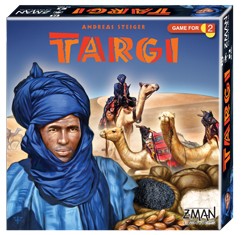
Targi’s board is created by placing cards on the table in a 5×5 grid, with the sixteen cards around the border fixed in every game. These “noble cards” include twelve cards that award free goods or special abilities that may be used only on that turn, as well as four “raid” cards that require all players to surrender goods, gold, or victory points to the robber. The central nine cards (3×3) change every game, and vary over the course of the game; they begin with five goods cards, from which a player may get salt, pepper, dates, a combination of two of those, gold, or a victory point; and four tribe cards, described above, awarding one to three victory points, bearing one of five card symbols, and possibly granting some special abilities. When a player purchases a tribe card from the central square, a goods card replaces it, and vice versa.

Each player has three Targi tokens and two marker tokens, and players alternate placement of the Targi, with the first player changing on each turn. A player places his/her Targi on the noble cards around the outside of the board, creating two points of intersection on cards in the central 3×3 grid, on which the player places her two marker tokens for a total of five affected cards for each player. One noble card is out of play on each turn because the robber occupies it, and a player may not share a noble card or place his own Targi on a noble card directly across from one of his opponent’s Targi. On his turn, a player may resolve his five tokens in any order he wishes. If a player has the opportunity to purchase a tribe card but lacks the necessary goods and/or gold, she may hold one tribe card in her hand for purchase on a later turn. After each player has taken a turn, the robber moves forward one space on the noble card track and all cards in the central grid that were used or purchased are replaced with a card of the opposite type.

The Targi "board."

The Targi “board.”

There are several ways to score points in Targi, starting with the most straightforward method – scoring one to three points for each tribe card purchased. There are a few opportunities to take a victory point directly from the supply, such as a goods card that awards one point rather than awarding salt or pepper. The key to maximizing your score, however, is to get the right cards into your 3×4 camp array in the right order. Each row can earn a four point bonus if all four cards in the row have the same symbol (there are five symbols in total), or can earn a two point bonus if all four cards have different symbols. Many tribe cards award other bonuses, such as granting an extra point for every two cards of a specific symbol in the camp – for example, one extra point for every two “oasis” cards the player holds – or doubling the two point bonus for a row of cards with unique symbols. Other tribe cards award goods rather than points, reduce the costs to buy tribe cards with specific symbols, or offer protection from or bonuses during raids, while tribe cards that bring three victory points carry no bonuses at all.

The main constraint in the game is gold. Of the 45 tribe cards in the deck, 26 require a gold token as all or part of the purchase price. Each player begins the game with a single gold token, but acquiring more is harder than acquiring more goods is. Three of the 19 goods cards reward the player with a gold token, but the exterior noble cards track has no direct way to get a gold token, as opposed to two noble cards each for salt, pepper, and dates. Players may use the Trader card to swap three goods of a single type for a gold token, a function available once per turn to whichever player places a Targi token on that noble card, and unavailable when the robber occupies it during the game’s fourth turn. There’s also one tribe card that grants a one-time bonus of a gold token, and that’s it. Therefore acquiring gold is key for players, as is using it wisely and avoiding a commitment to a strategy that requires more gold than the player can get.

The game’s main interaction comes in the competition to place tokens around the noble track. It can be easy to guess what your opponent wants or needs, and because the game includes just three goods it’s also likely you’ll be going for the same thing(s) and can line up your move with one that blocks your opponent or at least reduces her options. There’s one end-run around this, the “fata morgana” noble card, which allows the player whose targi is on it to move a token from one central card to any unoccupied one, but at the cost of using two tokens (one Targi, one marker) to accomplish one goal.

Winning scores tend to be in the upper 30s and low 40s, and we’ve had games end due to both conditions – one player buying his 12th tribe card or the robber making it all the way around the noble track to the fourth and final raid card. Even our first game, where we only botched one rule (a record of sorts for us), took maybe an hour. Because the options for moves are few and there’s a constant back-and-forth, the game feels quick and players rarely have long to wait before they’re asked to do something. I’d still slot it behind Jaipur for pure two-player games, but Targi is among the best of its breed, a two-player game that doesn’t feel like it was dumbed down in any way.

Saturday five, 7/26/14.

My content at ESPN.com over the last seven days…

* My analysis of the Huston Street trade
* My analysis of the Chase Headley trade
* My (very brief) analysis of the Kendrys Morales trade
* This week’s Klawchat

I reviewed the outstanding new boardgame Splendor for Paste, giving the Spiel des Jahres nominee a grade of 9/10. It’s also back in stock at amazon for $35, after some insane pricing earlier in the week when the award was announced. My daughter loves this game and grasped the basic strategy very quickly.

And now, this week’s links – a few more than five, as I came across too many things worth passing along…

  • Nobody had a better take this week on the joke of a punishment wife-beater Ray Rice received from the NFL than Keith Olbermann did.
  • The little girl who may hold the secret to aging. She’s five years old with the body of an infant, but is her whole life just to be a test subject for scientists?
  • On the nascent baseball culture in Iran. I love the idea of sport as diplomacy, although I fear it makes for better headlines than understanding.
  • Nestlé is bottling huge quantities of water from the California desert. Not that anyone’s inclined to stop them.
  • John McPhee on writing, part of The New Yorker‘s now-free archives. Warning: There’s a fair amount of rambling here for a piece on writing.
  • How to spend the first ten minutes of your day, from Harvard Business Review. I use several of these tips, from a morning to-do list to tackling some more daunting tasks earlier in the day – but I also try to knock off a few quick items in the first hour, because there’s a quick psychological payoff from crossing off a few things on the list.
  • R.J. Anderson with a good piece on Big Data coming to baseball. His piece is ostensibly about defense, but the real message here is how critical data management, from building and maintaining a data warehouse to developing tools to access and query it quickly, has become to baseball operations – which supports David Murphy’s excellent column for philly.com on how the Phillies need to revamp their organization.
  • And finally, an audio clip from the BBC: This week’s World Have Your Say discusses balance and media bias in the coverage of the Israel/Gaza conflict, which is great until they invite three guests who claim the media are biased, all three of whom sound like tin-foil hat lunatics and/or teenagers who just read Howard Zinn for the first time and think they have the world figured out. The one guest who claimed there’s an anti-Israel bias was the worst, however, with frequent invocations of the guilt by association fallacy when discussing al-Jazeera.

Saturday five, 4/19/14.

My ESPN content from the past week:

* Scouting reports on prep RHP Tyler Kolek and JC righty Heath Fillmyer.
* My report on this week’s Sally League matchup between Hunter Harvey (Baltimore) and Lucas Giolito (Washington).
* Scouting notes from my Georgia trip last week, including a rant on NC State overusing Carlos Rodon.

There was no Klawchat this week because my flight to Houston didn’t have wifi, and the “Top 25 under 25” ranking has been pushed back to April 24th. Also, as I mentioned here last week, if you want new Behind the Dish episodes any time soon, let ESPN know.

* If you missed my review of Thinking, Fast and Slow, it’s worth checking it out – the book is popular among the more analytically-minded front offices in MLB.

* The wonderful Agricola iOS app is on sale right now, $4 (down from $7), and the two IAPs are on sale as well. I own the whole set, and it’s the best complex boardgame app available.

And now, to the Saturday links….

Takenoko.

Takenoko is our new favorite family game, easy enough for my 7-year-old to understand (and, after two plays, completely memorize) the rules, just complex enough to require some serious decision-making, with beautiful components and a kid-friendly theme. Aside from one small hiccup in the rules, it’s about as perfect as any adult/kid boardgame out there.

In Takenoko, the emperor of Japan has been given a panda as a gift, and the panda does what pandas do – he starts running around the emperor’s garden eating bamboo, frustrating the royal gardener. The board changes each game as players lay hex tiles in three different colors on the table, starting with the central pond tile, then irrigating each tile so they can add bamboo stacks to it – although the panda will move around the board and eat bamboo when the players need to collect some.

On a turn, a player takes two actions and may not perform the same type of action twice. Action choices include adding a hex tile (draw three, choose one to place, return the other two to the bottom of the stack); add an irrigation canal; move the gardener to an irrigated tile, adding bamboo to that one and any adjacent, irrigated tiles of the same color; move the panda, eating one bamboo section from the tile where he lands; or take another objective card to try to score more points. After round one, each player rolls a “weather” die before his/her turn, allowing him/her to take a third action, perform the same action twice, or do specific tasks like moving the panda for free.

Players all work to build up the royal gardens, earning points by completing “objectives” on three types of cards. The first kind involves creating patterns of hex tiles on the board, with the player scoring points once the tiles are placed in the right pattern and are all irrigated. The second requires the player to collect bamboo sections, scoring once he’s obtained the whole set shown on the card. The third and most difficult kind, the gardener cards, require constructing specific bamboo stacks – four sections of a single color on a specific tile type, or sets of three or four stacks of exactly three sections, all of the same color. Task rewards range from 2 points up to 7, and the game ends when a player reaches a specific threshold based on the number of players in the game (equal to 11 minus the number of players, if you don’t mind a little arithmetic). The player to reach that threshold first gets the Emperor card, worth an additional 2 points.

The tile types I mentioned above involve improvement tokens, some of which are printed on the hex tiles already, with 9 more miniature tiles available for players to add to tiles as they see fit. One type prohibits the panda from eating bamboo sections on that tile (which means the stack can never shrink); another makes the tile particularly fertile, so it adds two bamboo sections instead of one each time the gardener drops by; and the third, the watershed token, adds irrigation to a tile regardless of its access to the central network of canals. These can make reaching certain objectives easier, but the gardener cards that call for building a bamboo stack of four sections specify what improvements are required to earn points – some cards call for a specific token, and the others can only be scored if the stack is on a hex tile with no improvement tokens at all.

The lone hiccup in the game comes from the existence of multiple objective cards with the same pattern or requirement within each deck. In the gardener and tile-pattern decks, that means a player could draw the same card twice and, in theory, score twice for fulfilling its requirements just once. The rulebook points out this possibility and suggests a house rule to cover it; we’ve played with the simplest solution, that no player can score the same objective card from these decks twice. The panda objective cards don’t present this problem, because to score such a card you have to return the bamboo sections you’ve collected to the central repository; if you draw the same panda objective card again, you have to start collecting from scratch anyway.

Takenoko has a high interactive element with a low screw-your-opponent factor; you can sometimes infer what your opponent is trying to do, but you probably won’t be certain, and making a move to stop him/her just sets you back from achieving your own objectives. You can, however, benefit from what someone else does, or find an opponent has inadvertently blocked you, so choosing what steps to take when is a big part of Takenoko strategy. The time required to run irrigation lines out to hex tiles placed two or three spaces away from the central pond is also a big factor in deciding when or whether to go for a hex-pattern objective, and because the panda and gardener can only move in straight lines, you may also find yourself trying to position them in your current turn so you’ll have a fighting chance to get them ready to strike in your next one.

Games run very quickly, maybe a half hour for the three of us to complete a game, in large part because the rules are straightforward enough for my daughter to make reasonably fast decisions and to decide before her turn arrives what she wants to do. (This also involved her making vague threats to my wife and myself about what might happen if we screwed up what she was trying to accomplish on her next turn.) The components are well-made and attractive, with a sensible box for storage and the right number of small bags to keep the bamboo stacks and other pieces separated.

Top 30 iOS boardgame apps.

There’s been a small explosion in adaptations of quality boardgames to the iOS platform since the last time I wrote up this ranking in September of 2011, enough that I could double the size of the rankings and still dump a few titles that no longer belonged. For these rankings I consider both the quality of the underlying game and the strength of the app, including graphics, stability, tutorials, online multiplayer mode, and quality of AI opponents.

Linked app titles go to my reviews here on the dish; linked prices go directly to iTunes for you to purchase the apps (and yes, I get a tiny commission on those sales). I’ve taken out some apps that appear to be abandoned or broken or that don’t work for iPad. None of those was really worth the money anyway.

1. Carcassonne. ($9.99) Still best of breed, featuring great graphics, a range of AI opponents (including good “hard” opponents, and “evil” ones too), online multiplayer, and three of the game’s real-world expansions available as in-app purchases.

2. Samurai. ($4.99) The best port of a Reiner Knizia game, which says something since you’re going to see his name quite a bit on this list. The AI players are very tough and there’s a thriving community of online players that has been active for years.

3. Agricola. ($6.99) The best example of an app where the developers chose to rethink the game for the tablet platform, taking advantage of the format to make a good but complex game work better on the iPad than it does on the tabletop. Two additional card decks just became available as IAPs, and the only complaint I’ve heard is that the toughest AI opponents aren’t tough enough – but they’re not easy unless you’re already a solid Agricola player.

4. Ticket to Ride. ($6.99) Days of Wonder has done its app development in-house, which doesn’t always work for publishers, but in DoW’s case it’s been a boon for players, as their apps look great, work extremely well, and are actively supported with in-app purchases (IAPs) and expansions, including Europe, Switzerland, Asia, and the 1910 card set. The family of Ticket to Ride games also Pocket versions of the US ($1.99) and Europe (also $1.99) games for the iPhone/iPod Touch. There’s a big online player base as well, and this is our favorite game for pass-and-play with my daughter, who also likes Carcassonne and Battle Line.

5. Caylus. ($4.99) Like Agricola, Caylus fares better on the iPad than it does on the tabletop, and the Caylus app would still get my award for the best graphics – their use of bright colors and clear icons makes it much easier to stare at the screen for the ten minutes or so it takes to play this complex strategy game. The AI opponents could be a little stronger.

6. Tigris and Euphrates. ($4.99) Always a favorite of mine, this adaptation of a Knizia classic improved substantially with a graphics update about two years ago, and works well with online multiplayer or with local AI opponents (they’re good, but could also be tougher).

7. Stone Age. ($6.99) One of the best family strategy games on the market came a little later to the iOS platform, but the developers did a great job of reimagining the game, which relies on a big board with a lot of elements, for the small screen, coming first to the iPhone and maintaining the same format for the iPad. The AI players are solid and there’s a large online community, including an organized league with rankings.

8. Small World. ($9.99) Days of Wonder boosted this last summer with the 2.0 update, which included online multiplayer and support for 3-5 players. It’s gorgeous and one of the best apps for two players to play face to face with the iPad between them.

9. Pandemic. ($6.99) The challenge in making a cooperative game for iOS is lower than that of any other game, since coop apps don’t need AI players and online multiplayer is not a critical feature. That aside, the Pandemic app is superb across the board – the graphics are great, gameplay is easy to follow, and it’s easy to customize the game however you’d like, just as you would with the physical version. The On the Brink expansion is now available as an IAP if you want to raise the stakes a little.

10. Battle Line. ($2.99) One of the best two-player games out there, Battle Line’s app has a simple, clean implementation, with basic and full modes (basic doesn’t use the ten event cards) and good enough AI opponents to keep the game interesting. I’ve noticed some minor bugginess here, especially on older iOS devices. It’s one of the best games for the smaller screens, since most of the top 7 either require an iPad or just play better on one. This is also a Reiner Knizia game.

11. Puerto Rico. ($4.99)Much, much improved after an update a few months ago to step up the graphics – it’s easier to follow what’s going on (not perfect, but better) and the screen isn’t as tough on the eyes now. The AI players are some of the best I’ve come across, as Puerto Rico has one very strong strategy (produce and ship) and the AI players will try it. I don’t like the representation of buildings by shapes on each island, without labels, so it’s hard to know at a glance who has built what.

12. Ingenious. ($2.99) Yet another Knizia game, this abstract two-player game is a natural for iOS because the scoring is a little tricky – and I think abstract games, which are often heavily math-based, translate very well to app versions with AI opponents. (All of Knizia’s games are math-based at heart anyway.) The app can be frustrating in a fun way, because the hard AI opponent is very good and because you need to look or think a few moves ahead to avoid getting trapped. The $1.99 iPhone version is a separate app.

13. Through the Desert. ($2.99) Oh, hey, more Knizia, this one a territory-claiming game where players compete to cordon off sections of the board and to reach specific landmarks. The AI players are fair, and it’s a little tough to play on the smaller screen because the board is shrunk to a level that even good eyes may have a hard time seeing (and even little fingers may have a hard time pressing accurately).

14. Le Havre. ($4.99) Like Caylus and Agricola, Le Havre is so complex that moving it to iOS makes it easier to play because you lose all the setup and cleanup time involved with playing the physical game. This implementation is very faithful to the board game, with pretty good AI players – they’ll make good use of the special point-accumulating buildings available late in the game – but there’s so much information crammed on the screen that it becomes hard to find what you need, and some players may find the smaller text hard to read even on the iPad, let alone on the iPhone.

15. Hey, That’s My Fish! ($2.99) The one game on this list that’s more aimed at kids than at adults, Hey, That’s My Fish! is one of my daughter’s favorite apps and also one of her favorites to play with me, even though she’s had it for about two years. The board is bright and colorful, and the penguins (your tokens) look great, with some animation twists that make the game more fun to play (such as when a penguin falls into the sea). Completing achievements unlocks a number of different boards, but since about half of those achievements are simple I’m not as bothered by the requirement.

16. San Juan. ($4.99) The card-game version of Puerto Rico got a better app treatment right out of the chute than the master game did, and still looks really good, with strong AI opponents and clear graphics and text, even on the iPhone.

17. Lost Cities. ($3.99) More Knizia, and another two-player game, this one a very simple card-collecting/arranging game that looks great on smaller devices with big, bright graphics, since it was designed specifically for the iPhone 5. The AI players aren’t very good, but I’ve played this a number of times online and gameplay through GameCenter is as smooth as it gets.

18. Scotland Yard. ($4.99) An old-school title gets the app treatment, benefiting from the translation because of how intricate the board is (unless you’re intimately familiar with streets and bus routes in London). The developers even accounted for the fact that, in pass-and-play mode, one player’s actions have to be hidden from the others. The soundtrack is a nice touch. The AI could be a lot stronger, however.

19. Rebuild. ($2.99) I’m bending my own rules here, as Rebuild is the one title on the list that isn’t based on an actual board game. It’s a solo title, but it’s a board game from start to finish, just one that takes advantage of what you can do on a tablet (or computer) that you can’t do, or can’t do as easily, on a tabletop. Build up your community to recapture City Hall before the zombie hordes take you out, but don’t let that fundamentalist group get too powerful.

20. Settlers of Catan. ($4.99) Just called “Catan” in the App Store, this adaptation has always disappointed me in several ways. The underlying game is the same as the classic that spawned the boom in better (German-style) boardgames, such as the Cones of Dunshire. The app is very limited, however – the AI players aren’t good, trading is very awkward, the graphics are bright but too ornate, and all you get is the very basic board. Everything else is an IAP, including Seafarers and Cities & Knights ($4.99 each), which also unlocks some campaign scenarios. The $4.99 iPhone version is a separate app.

21. Elder Sign. ($6.99) A cooperative title based in the Cthulu universe, this app would rate higher if you got the full game. Instead, you get the game without the end battle against the big foozle (if you don’t defeat him before that, in the app you just lose), and you only get four opponents, with each additional one costing another $2.99. A few other rules are cut out as well. It does look slick and it helped us understand a few of the rules in the physical game we didn’t grasp the first time.

22. Qin. ($4.99) This Knizia title came out in 2012 as a board game and as an app, the first simultaneous release by a major designer that I’d heard about. It’s an abstract tile-laying game where players try to claim control of several landmarks on the board while also building up their tile chains so they can’t be taken over by other players. I’ve seen it described as Acquire meets Tigris & Euphrates, which is pretty apt, but I think both of those are better games than Qin.

23. Hacienda. ($0.99) A solid implementation of a good-not-great tile-laying, territory-claiming game. I wish the maps were a little clearer – sometimes adapting the precise graphics of the board game works to the app’s disadvantage – and the AI players were easy to beat after a few plays. Through the Desert does the same kind of thing, but better.

24. The Battle for Hill 218. ($2.99) A simple-to-learn, hard-to-win two-player card game where you are fighting to take over your opponent’s home space on his side of the titular Hill. The game is currently out of print, so pick up the app while you wait for it to come back around, and, if you’re like me, prepare to get your clock cleaned.

25. Medici. ($1.99) Another Knizia game, one I’m probably a little light on because the mechanics didn’t grab me – you bid against other players for shipments of goods coming into a Renaissance Italian port, and try to get the most of certain good types to rack up points, with bonuses available for having the most valuable ship in each shipping round and for shipping certain numbers of goods over the course of each game. It’s a good implementation; I just don’t think the game is that exciting.

26. Lords of Waterdeep. ($6.99) A D&D-themed game where the theme seemed patched on to a poor adaptation of the physical version. The board is overdesigned for the iPad – in thise case, I think it’s just the physical game itself, with no adjustments – and it doesn’t do the resource-constraint mechanic as well as Agricola or Caylus. A UI overhaul would go a long way.

27. Suburbia. ($4.99) Great UI, bright graphics, awful AI players, and bugs. It just came out on December 12th, 2013, so I’ll give them some time to improve the app. I haven’t used the save game feature without a crash yet, either.

28. Tikal. ($2.99) Much better in an app than in a physical game – it’s the only game I’ve bought and later sold – and even in app form it can take a while because each player gets 10 action points per turn. A software upgrade about two or three years ago made this much more stable and easier to play.

29. Ra. ($2.99) The last Knizia app on the list, this is another auction-based game that never grabbed me, but remains a favorite over at boardgamegeek. The app looks clean and easy to use but the tutorial (when I first tried it in 2010) was terrible.

30. Dominant Species. ($4.99) I just reviewed this last week and was not impressed. The underlying game might be great, but it’s very complex and the app’s UI is terrible, as is the tutorial. The AI players are also kind of dumb; I shouldn’t be beating them by wide margins when I don’t even understand all of the rules. I recommend this only if you want to try the game out before spending $60-plus on the physical version.

Dominant Species app.

The complex board game Dominant Species has moved up into the top 20 on boardgamegeek’s global rankings despite its high cost (over $60) and one of the most intricate decision trees I’ve come across. Players represent different classes of creatures, exploring and populating the planet by placing hex tiles on the board, receiving points primarily for “dominating” specific tiles. Players have a large number of potential actions but are competing for space on the board and for priority in each type of action. You have a lot to weigh each time you choose which action to take, and the cleanup and scoring in each round also takes a lot of time and effort.

There is an app implementation of Dominant Species for iPad that gives you a fair introduction to the game for $4.99, but still leaves much to be desired. I’ll review it here for completeness, but I don’t recommend it unless you want to try the game out before shelling out for the pricey boxed game.


Evolutionary status: It’s complicated.

In Dominant Species, players will build out the game board as they go, placing different land/water tiles and also putting “element” tokens on the vertices of the hexes, then populating those tiles with their own species. The bottom line is that you want your species tokens on tiles, especially water tiles, that are surrounded by several of the element tokens you also have on your card. Each player starts with two of these element tokens, depending on which botanical class he draws, but can add more as the game goes on.

The board can change in several ways as the game evolves, with tiles changing to tundra (where most species are removed, and eventually all might be wiped out) and elements added and removed frequently. Each player has a specific element type that gives him the potential to “dominate” any tiles where that element appears and he has species, but players can also acquire new element tokens for themselves and adapt to allow them to dominate new tiles on the board. The key to the game, at least in my limited experience, is the Domination phase at the end of each round: There are five Domination spaces for action pawns, and each player who places a pawn there can choose a tile on the board to dominate, where the player who has the right elements (matching those around the tile) and has species there gets a point bonus, and may get a Domination card that gives him more points or the ability to add or remove items from the board. There’s a lot more involved – players have several action pawns to place each turn, and can acquire more as the game goes on – but those are the key points. Players can undertake less significant actions like turning a tile to tundra, claiming points and potentially removing another players’ species; migrating species from one tile to another to avoid extinction; and knocking out a single opposing species token from any tile under “competition.”

The publisher of the physical version of Dominant Species, GMT Games, chose to develop the app in-house, and unfortunately they half-assed the initial release and may have abandoned the project entirely. The AI players are poor, and a promised introduction of a harder AI player remains undone after a year. The UI is also weak, mimicking the physical game rather than taking advantage of what the tablet can offer in different graphics, animation, even stuff like replacing colored wooden cubes with, I don’t know, maybe actual animal shapes? Trying to squeeze everything on to one screen – both the game board and the action selection board – means nothing is clear, and there’s still a lot of info hidden on drop-down screens. It feels rushed and uncreative, rather than an attempt to approach the game from an entirely new perspective. And it lacks online multiplayer.

I’m guessing that playing the physical game with people who’ve played before would be fun, maybe not top 20 overall fun but with enough interaction between players to keep it interesting and social. It is probably a touch too involved for my personal tastes, and I’m still not sure I understand all of the rules regarding some of the less-used phases in each round. A better tutorial, a hard AI opponent, and improved graphics would go a long way to making the app better, and with the boxed game selling for over $60 they could use the promotional boost.

Suburbia iPad app.

Unrelated to Suburbia – the death yesterday of School of Seven Bells founder Ben Curtis at age 35 (of lymphoma) spurred me to look back at my rankings of the top songs of 2012 and create a fresh Spotify playlist with a few extra tracks. Their haunting song “The Night” is on the list.

—

The boardgame Suburbia ranks in the top 100 on Boardgamegeek, with a combination of city-building mechanics and economic planning where what you do early in the game impacts how many points you can rack up late in the game. It’s reminiscent of more complex games like Agricola and Caylus in that respect, but with simpler gameplay and less direct interaction because players have more ways to change their plans on the fly. I’ve been playing the Suburbia iPad app for the last two weeks, and I enjoy the game itself but have found the app’s AI options way too weak to make the app replayable.

In Suburbia, between two and four players compete to build the most populated suburb around a central city by placing building tiles that are available for purchase in a common market. Each hex tile has specific costs and benefits. The benefits can include increases in income, population, or reputation; one-time cash infusions; or long-term effects that depend on what other tiles are adjacent to the hex, or in the same suburb, or in all suburbs combined. The costs include money but can also include a loss of income, population, or reputation, which may depend on what else is around. Place an industrial tile next to a residential one and you’ll lose reputation points because of pollution. Place tiles around a lake (free to add) and you’ll get extra cash.

The tile interactions are one of two keys to racking up large populations. You can’t do everything in your suburb, so it pays to concentrate early on one or two specific areas or tile types and try to build your income or population more quickly through synergies between tiles. You can add a farm or two, and then if you add restaurant tiles later they will be even more valuable. There are also tiles that include penalties for laying other tile types – if you add a high-end restaurant, adding a fast food restaurant afterwards will cost you an income point. The game’s tutorial suggests concentrating on income early and population later, as there are income and reputation hits built into the system when your population crosses certain thresholds.

The other scoring key lies in the various goals set out each game, 10 to 20 point bonuses for reaching specific milestones such as having the fewest office buildings or earning the highest income per turn. Four of these goals are visible and available to all players. Each player also receives one goal specific to him/her, not visible to other players, but that still requires beating all other players in that category to win it. Some goals even work against the main objective of maximizing your population, such as having the fewest residential tiles of any suburb. Without these goals, the game would be kind of boring because it would be so simple and too reliant on the central tile market, which uses the common mechanic of making two tiles available for free and all others in the queue more expensive, shifting them to the right as tiles are removed.

The app itself looks slick, with bright, clear graphics that allow you to read the costs and effects of each card easily. I only had one issue with stability, which occurred when I tried to use the game’s save feature – I couldn’t resume the game and had to kill the app process entirely to start a fresh one, which I guess is a pretty significant bug but wasn’t my main issue with the app. The AI players are terrible: you have your choice of five, and can use up to three of them (but can’t reuse any), and they’re all a little dim. They don’t plan well, which I imagine is a difficult issue for coding AI players, but they also miss obvious short-term moves or take actions that clearly reduce their chances to gain points. If I go first, I can beat the AI players just about every time. Going fourth of four reduces my chances a little, but I’m also a novice player and should get more of a challenge than this. I’m hoping that the expansion, Suburbia Inc., becomes available as an in-app purchase, and that the developers use that as an opportunity to introduce some harder computer players.

I’m due for an update to my top iOS boardgame apps rankings, but will review the Dominant Species app later in the week before I do the final list.

iOS games on sale.

There are a number of iOS boardgame apps on sale right now through Christmas (and sometimes beyond), so rather than tweet a bunch of links I figured I’d list the ones I recommend here. If you’re looking for recent content, my Top Chef recap went up Thursday night and contains links to everything I’ve written this week.

  • Small World 2, on sale for $4.99 right now. I love this game and app and gave the pre-update version a very positive review.
  • Reiner Knizia’s Tigris & Euphrates, just $0.99 right now, as are all Codito titles except Puerto Rico. I liked this one from the start, but the update to the graphics earlier this year made it much easier on the eyes.
  • Le Havre, also $0.99 as it’s another Codito title. It’s from the designer of Agricola but brings in elements of Caylus; I think it’s the most complex boardgame I’ve ever played, and it works way better in an app version than it did tabletop because of all of the pieces involved. My review from June 2012 is from the original release.
  • Agricola, down to $4.99 from $6.99, but now with the I and K card decks available as in-app purchases. If you haven’t played the physical game, those decks come standard and offer a lot more occupations and opportunities for interaction with other players. You can read my review of the base game from July.
  • Caylus – Big Daddy’s Creations, down to $2.99 from $4.99. My original app review came before some minor bug fixes, and this probably still has the best, brightest graphics of any game app in the field.
  • Baldur’s Gate: Enhanced Edition – Beamdog, down to $6.99. It’s not a board game, but a classic RPG that has been adapted to iOS. I’ve played and reviewed it; it’s very good, especially after a recent update included many of the features that originally appeared in the Throne of Bhaal sequel to BG2.
  • Sid Meier’s Pirates!, down to $0.99. Also not a boardgame, just another PC classic ported to iOS. My original review is from September of 2011; I liked it, but didn’t love it, because it becomes monotonous after an hour or two – but you’ll get your 99 cents’ worth.

Bora Bora.

I published a lot of content for ESPN Insiders the last 48 hours, including:

That’s all on moves that have already occurred, but I’ll continue posting this week as more stuff breaks.

One of our favorite new games of the past few years is 2011’s The Castles of Burgundy, which is one of the few games we’ve come across that brought an entirely new approach to the somewhat stale game styles like worker placement. The rules are lengthy but gameplay isn’t complex, and the game works a lot of decision-making into under an hour of playing time. It’s been a modest hit, rating very highly at Board Game Geek (12th overall) as well as with me, so it’s unsurprising that we’re now seeing other games with similar mechanics come along, such as the brand-new Ravensburger relase Bora Bora, a beautifully rendered game that borrows much from Castles of Burgundy but adds a new setting and a few minor twists.

In Bora Bora, two to four players set about building huts on the five islands on the game board so they can collect resources from the land and hire natives to perform various tasks, all with the goal of acquiring victory points to be tallied after the game’s six rounds. There are numerous ways to rack up these points, such as converting natural resources to buildings on your player board, placing priests in the central board’s temple, completing a task tile at the end of a round, buying jewelry with shells, or gaining status points in each round. Most point acquisitions come through a series of moves; for example, hiring a female native gets you shells, with which you can buy a piece of jewelry that is worth from 1 to 9 victory points at the end of the game, or that can be used to fulfill certain task tiles. Gaining natural resources helps you place a two-space building on the twelve-space building area on your player card, a move that is worth 10 points in the game’s first two rounds but just 4 points in the final two rounds.


The central board during the final round of play.

A round in Bora Bora comprises three phases: Rolling dice to place them on action tiles; using your natives for actions; and a scoring/roundup phase where the main board is refreshed with new native and task tiles. Your moves are dictated by dice rolls, as in Castles of Burgundy, although Bora Bora offers fewer ways to manipulate the dice. In Bora Bora, each player has his/her own set of three dice and can place those dice on any of five (for a two-player game) to seven (four-player) master tiles that allow actions like hiring a native, expanding to a different region on the map, or placing a priest in the temple. The wild card of those actions is the “helper” option, where the number on the die you place there converts into points you can use to gain shells or status points from workers, resources without having to expand your territory, or god cards and offerings to let you do more with your dice. Two players can use the same tile in a round, but a player may only place a die on a tile if the die’s roll is lower than all dice currently on the tile, creating a trade-off between using a high die roll on a tile to get more powers or resources and using a lower die to block your opponent(s) from using the same one.

The one way to tweak the dice in your favor is through pleading with the gods using god cards and offering tiles. There are five god card types, two of which allow you to change the way you use the dice: You can play a die normally but treat its face value as six for your move; you can place a die on a master tile even if it’s not lower than all dice currently on it. Other god cards allow you to score points for expanding into a new territory on the map, to employ additional natives during the action phase of a turn, or to help you complete a task tile on your card for which you just fall short of the requirements.

The task tiles turn out to be more significant as the game goes on because they offer additional bonuses of four to six points for things you may already have done, such as expanding to all five islands or having certain combinations of natives or resources already on your card. The end of the game offers even more bonuses for achieving the maximum number of something, like completing nine tasks, buying six jewelry tiles, or filling all twelve spaces on the building area on your card (called the “ceremony spaces” in a confusing bit of nomenclature).

Bora Bora suffers a little from its similarity to Castles of Burgundy, but also from pushing too far in the same general direction as its predecessor – players have so many options that gameplay can drag while you try to sort through them all. It’s easy to become paralyzed by all of the options before you because of how long-lasting some fo the effects can be; Castles of Burgundy doesn’t have that same depth, and it means Bora Bora has more in common with games like Agricola or Le Havre, where a decision in an early round can filter down through the rest of the game. It’s an ideal game to pick up if you love Castles of Burgundy but want something different or more complex, or if you are partial to games with great-looking components, since Bora Bora has bright colors and strong artwork. The extent of possible options for players and constant references to the rule book to explain the pictograms on certain tiles stretched the game out for us to the point where we’re going to reach for Castles of Burgundy first, but this represents a solid change of pace.

I wanted to slip in one more game review before posting my updated rankings later this week, so look for that post either later on Thursday or at worst on Friday, as long as the baseball world doesn’t go bananas again. You can see last year’s top 40 rankings while you wait.

Lords of Waterdeep app.

My analysis of the Phil Hughes signing is up for Insiders.

Playdek, the folks behind this summer’s spectacular iOS adaptation of Agricola, just released their most recent boardgame app, Lords of Waterdeep, a straightforward worker-placement/task-completion game with some modest interactions through the use of special Intrigue cards that let you sabotage your opponents here and there. (Amazon has the physical version of the game for $38; the game itself is currently ranked 28th on Boardgamegeek’s overall rankings.)

While Lords of Waterdeep has a theme from the Dungeons & Dragons universe, it’s pasted on to a game that has neither might nor magic in it, using the Forgotten Realms for artwork and nomenclature but nothing more. Each player tries to complete Quests in exchange for victory points and resources, where Quests in certain categories may earn the player additional bonus points unique to his player identity. Resources include money and four different worker types, the availability of which are unequal and can vary over the course of the game. Players begin acquiring money and workers by placing “Agents” in open buildings on the board, as in Agricola, but can buy and place new buildings, as in Caylus, to open additional opportunities for all players to earn resources while gaining commissions (money, workers, Intrigue cards, or victory points) for the builder. And the aforementioned Intrigue cards add an interactive element: You can steal resources from other players, or assign a “mandatory” quest with a tiny victory-point value to an opponent who must complete that quest before any others.

The game comprises eight rounds, with two distinct phases. In the first four rounds, each player has two Agents to place on open building spaces; in the last four rounds, each player gets a third Agent to place. Building spaces offer various returns:

* Most just offer resources – one or two workers of a specific type, or money, or a combination of both.
* Three spaces offer access to the four visible Quest cards, with each bringing something along with the Quest card, such as an Intrigue card.
* Three spaces in Waterdeep Castle allow a player to play one of his Intrigue cards, with the twist that an Agent placed there can be reassigned later in the round once all players have placed their Agents once.
* Another space allows the player to build one of three visible Buildings and place it on the right side of the board, assuming he can pay the cost (in money) on the card.
* And the final space allows the player to take over the Starting Player (going first in each round) role while also granting him/her an Intrigue card.

Once occupied by an Agent, a building space is unavailable to all other players (except those with a specific Intrigue card) for the remainder of the round.

The dynamic of each round is simple: Place two or three Agents for resources, money, or Quest cards; to play an Intrigue card; or to buy and place a building; and, whenever you have the right resources, complete a Quest, an action that does not require the use of an Agent. At the end of eight rounds, the player with the most victory points – from completed Quests, from Quest-related bonuses, from money (1 point per 2 coins left), and from unused workers (1 point per cube) wins.

In my experience, the path to victory revolves mostly around bonus points. You want to complete quests with high point values, or, failing that, complete a lot of quests with lower values, but it’s most important to stick to the Quest types for which you’ll earn rewards. There are various Quest categories, such as Piety, Arcana, Warfare, Commerce, and Skullduggery, and each player character gives four point rewards for each Quest completed in two of those types. Where possible, I’ve only acquired and completed Quests in my two categories, and also have tried to complete a Quest that increases those bonuses – for example, in one recent game, I earned an additional two points for each Skullduggery Quest I completed on top of the base four points I got from my character.

I’ve also learned from watching the AI players that laying down Intrigue cards is a high-return endeavor because of the ability to reassign that Agent later in the same round – so it’s like getting an extra half-turn. Some cards have higher value early in the game, both Intrigue and Quest cards, so obtaining and playing those in the first few rounds (if possible) is key.

Lords of Waterdeep ultimately comes down to a lot of little decisions around resource allocation, with minimal (but non-zero) interaction with your opponents and only a few small ways in which you can strengthen your abilities over the long haul. You don’t have any choice of Intrigue cards, and your choice in Quest cards is limited to the four you see in the open pool at any given time. There’s a fair amount of luck in the game as a result, but I don’t think it’s enough to defeat a player with a focus on completing Quests that provide the right bonuses.

The app is moderately entertaining, with competent AI players on the hard and medium levels, but the board layout is atrocious. It’s impossible to view everything on the screen at once, as the developers seemed to hew too faithfully to the physical game, and there’s so much unnecessary detail that critical pieces of text are often obscured unless you zoom in to see them. Caylus and Agricola are both stellar examples of how to display a game board that can’t fit comfortably into one screen, but Lords of Waterdeep is an example of how not to do this. Even after several plays, I still felt like it was hard to follow what the AI players were doing, and frequently had to zoom back to place my final agent because it wasn’t clear what building spaces were still free.

There’s a major two-part expansion for the physical game called Scoundrels of Skullport that adds buildings, characters, Quests, and Intrigue cards, which I hope becomes available for the app as it promises to increase the game’s replay value. For now, it’s a mid-tier app for me, a little too perfunctory to become an essential game and in need of a UI overhaul, but a straightforward, nicely balanced game that was stable through several plays and included a thorough, clear tutorial to get a noob (like me) started. If worker placement is your favorite style, it’s worth picking up.

Designed by