Stick to baseball, 10/7/25.

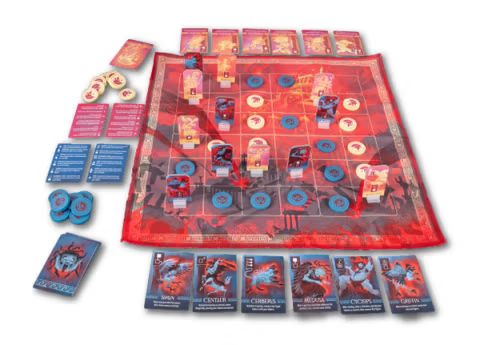
Nothing new from me at the Athletic recently, although I’ll make up for that later this month. My latest review at Endless Mode looks at the new edition of the Reiner Knizia game Botswana, a family-level bidding game that has been published under a half-dozen names, including one edition by Milton Bradley in a traditional mass-market size under the name Quandary.

Now that this is up, I’ll work on another edition of my free email newsletter next. The next Stick to Baseball post will run on the 18th.

And now, the links…

  • Longreads first: Billionaire Amy Griffin took psychedelics and “remembered” past sexual abuse by a grade-school teacher. She wrote a memoir about it … but no one can confirm any of the details, and she may have just ruined an innocent man’s life.
  • The Huffington Post spoke to Leonard Peltier, who is now under home confinement after spending 47 years in prison for a crime he probably didn’t commit, about being slightly free and the threat Trump poses to indigenous Americans.
  • A New Jersey teenager stalked a girl who rejected him, even describing some of his actions on his Youtube channel, and after police did nothing, he drove his car at 70 mph at the girl and her friend while the two were on their bikes, killing them. Did police fail to react because his father’s a cop?
  • Bluesky is dealing with its first real existential crisis, as noted anti-trans crusader Jesse Singal appears to have violated the site’s TOS, after which Bluesky execs … altered the TOS? TechCrunch and the blog Azhdarchid both delved into the controversy, including Bluesky CEO Jay Gruber throwing a tantrum on the site over it.
  • Writer Kaleb Horton died suddenly of a seizure in September, and shortly afterwards an AI-generated slop book supposedly about him appeared on Amazon.
  • It’s gotten very little attention here in all the chaos, but the Trump Administration is bailing out Trump ally Javier Milei, whose mismanagement of Argentina’s economy and alleged corruption have put the country on the brink, a $20 billion deal that also happens to help billionaire hedge-fund manager Rob Citrone, a buddy of Treasury Secretary Scott Bessent.
  • A Christian church leader in Miami had fifty-seven slaves – excuse me, “forced laborers” – in her mansion when FBI agents raided it in August. Michelle Brannon and her partner David Taylor are also accused of running a money laundering scheme, while Taylor is accused of sexual harassment.
  • The Alabama owners of three small Alaska newspapers edited an article to remove reference to Charlie Kirk’s “racist and controversial views,” leading to the resignation of three of the writers – which left one of the papers without any journalists on staff.

Music update, September 2025.

September turned out to be a monster of a month with new albums and tracks ahead of album releases for the next two months; as it was I had a hard time keeping this list to 33 tracks. As always, you can access the playlist here if you can’t see the widget below.

Geese – Cobra. One reader-friend who’s very into music mentioned that Geese’s latest, Getting Killed, is his album of the year so far; it’s going to end up high on my list, although Cameron Winter’s vocals sometimes come across like he’s not trying, even when the music behind him is experimental and ambitious. Regardless of where the album ends up on my rankings, Geese are one of the most interesting bands around, and the members aren’t even 25 yet.

SPRINTS – Need. The first ten songs on SPRINTS’ second full-length LP All That Is Over run 32 minutes in total, and then there’s the six-minute closer “Desire,” is a strange, slow-burning, gothic/post-punk track that stands in stark contrast to the straight-on punk of the rest of the record – such as this song, where singer Karla Chubb describes the desperation of being in a one-sided relationship.

Paris Paloma – Good Boy. The song is fine, but the intro, taken from a video where Emma Thompson dramatically reads the tremendous title of this Rebecca Shaw editorial from January, is a hell of a way to get me to put your song on a playlist.

Public Circuit – Samson. Is this Heaven 17? Bronski Beat? Early New Order? Rarely does a song take me back to such a specific time period, but this is straight out of 1982, a musical era that will always be central to my existence. And there’s a sample of Monty Python and the Holy Grail too.

Kid Kapichi – Stainless Steel. Maybe not as strong as most of their past singles but I do love the driving bass & drum line that provides the foundation for this track, their first since two of the four members left the band in May.

Portugal. the Man – Tanana. Not sure if this is about Frank, but it’s got the sweeping, psycheledic-inspired feel of their 2011 album In the Mountain in the Cloud. They also put out another single, “Denali,” that I didn’t like as much as this one. Their next album, Shish, comes out November 7th.

Maruja – Saoirse. If you like Geese, you might enjoy the debut album from Maruja, Pain to Power, which also reminded me a ton of the (probably) defunct band black midi and even a little of Swans. This track is probably the most accessible, combining free jazz, punk, and even hints of chamber pop.

Die Spitz – Riding with My Girls. Something to Consume, the debut album from this Austin-based punk/metal band, came out in September, and veers between those two genres, with some straight-ahead hard-rock numbers mixed in with more punk tracks like this one and a few that call back the crossover thrash era, like “Throw Yourself to the Sword.” (Speaking of crossover, Agnostic Front put out a new song in September. It was a big month for metal bands from the ‘80s, as you’ll see below.)

Creeper – Prey for the Night. The third single from the band’s upcoming Sanguivore II: Mistress of Death, due out on Halloween, is more in line with their previous stuff and less hair-metal than the last single, “Blood Magick.”

Sunflower Bean – Crashing Highs. A bonus track from the deluxe edition of Mortal Primetime, and a pretty strong indie-pop track – maybe a little too sunny for the album proper.

shame – After Party. Shame’s latest album Cutthroat, released on September 5th, is their most expansive and ambitious yet, although I have to admit this very Yard Act-ish track is one of my favorites.

flowerovlove – I’m your first. This 20-year-old DIY pop artist from London has released at least twenty singles already, so at some point I assume there will be an album. She’s got a great ear for creating catchy pop hooks that would fit in – and improve – any pop radio station’s playlists.

Hatchie – Lose It Again. This Australian singer-songwriter’s third album, Liquourice, comes out on November 7th; “Lose It Again” is yet another catchy-as-hell dream pop number from her, as she seems to have an endless supply of them.

St. Lucia – Lights Off. I know St. Lucia is never going to get back to the heights of his debut album When the Night, but this song, off the upcoming Fata Morgana: Dusk, is the closest he’s come since 2015’s “Dancing on Glass.”

Emma-Jean Thackray – Save Me (Radio Edit). A reworking by Thackray herself of one of the better tracks on her now Mercury Prize-nominated album Weirdo, one of the best albums of the year. Other notable nominees include the latest from Wolf Alice, Fontaines D.C., and, for some reason, Pulp.

Cœur de Pirate – Mélancolie. Béatrice Martin is having a moment, as “Corbeau,” from her 2008 eponymous album, was featured on The Summer I Turned Pretty’s final season, and Martin just released her seventh album, Cavale, last month, featuring this lush electro-pop track.

Tame Impala – Dracula. Best use of the name Pablo Escobar in a song yet. This is my favorite of the three singles released in advance of this month’s Deadbeat, by far.

Prides – Dynamite. This Scottish indiepop act had one of my favorite songs of 2014 in “The Seeds You Sow,” then disappeared after 2018 other than a few scattered guest appearances. They’re back this year with several singles, all of which have been pretty promising. They rose up during the peak of “landfill indie,” but I thought they were stronger musically and melodically than most of those groups.

Sudan Archives – Come and Find You. I haven’t loved the Sudan Archives singles this year as much as I did her last album Natural Brown Prom Queen, with this newest one the strongest yet because of the violin solo (as that is Parks’s main instrument).

Emma Swift – The Resurrection Game. The title track from Swift’s first album of original material is a lovely track of sophisticated folk-tinged pop, an impressive debut for anyone but especially someone whose previous output was an album of Bob Dylan covers and some tracks with her partner Robyn Hitchcock (who is 28 years her senior).

Yttling Jazz – Illegal Hit. I found this track on an NPR weekly new-music playlist, and only later discovered that this is Björn Yttling of Peter Bjohn and John, whose song “Young Folks” was a huge (and kind of annoying) hit about 15 years ago.

Lazarus & Rakim – Not to Be Defined. I love Rakim, and I’m warming to Lazarus, a Detroit-born rapper … and physician.

Bartees Strange – DCWDTTY. It’s not a cover of the DC post-hardcore song “DC Will Do That To You” by Smart Went Crazy, just alluding to it in the title.

Sloan – No Damn Fears. Sloan’s 14th album, Based on the Best Seller, dropped on September 26th, and the early reviews seem to be quite positive, although I don’t hear anything to match “Losing California” or “Everything You’ve Done Wrong.”

The Macks – Dually of Man. I don’t even remember where I found this song, from a longstanding Portland rock band that just put out their first proper album in September, but the intro synth riff is hypnotic, and the song just builds from there, passing through jam-band territory without ever drifting off into that direction entirely.

SONS – Do My Thing. This Belgian band has been putting out music since at least 2019 in Europe, although it seems like they’re making a push in the U.S. now with this latest single, which sounds a ton like The Hives (that’s a compliment).

Thrice – Albatross. Thrice’s latest album Horizons/West dropped today, the 3rd, so I haven’t had a chance to listen to it yet, but this was my favorite of the lead singles, with a dark, ominous vibe that recalls their 2016 album To Be Everywhere Is to Be Nowhere.

Castle Rat – Serpent. Castle Rat is full of gimmickry, but this is some excellent Sabbathesque doom metal, reminiscent of The Oath/Lucifer (since both have female vocalists with similar voices).

Coroner – Symmetry. It should be illegal for a band to go away for thirty-plus years and come back sounding this good. Not just good – ferocious. I would have been excited for any new Coroner album, but I cannot wait for Dissonance Theory to drop on the 17th.

Paradox – One Way Ticket to Die. This was a big month for ‘80s metal bands; Paradox put out two albums that decade, including one of the best concept albums in metal with 1989’s Heresy, then went on hiatus for 11 years. Their ninth album, Mysterium, was (possibly) recorded entirely by singer/guitarist Charly Steinhauer, the only remaining founding member, and it’s full of tight old-school Teutonic thrash, à la…

Kreator – Seven Serpents. The sixteenth (!) album from these German thrash icons, Krushers of the World, is due out on January 16th; their first album, Endless Pain, came out forty years ago this month. They proved extremely influential on the development of extreme metal, with their early sound similar to that of Celtic Frost, all of which led to the growth of ‘death metal,’ but by their third album Terrible Certainty they’d transitioned to a variation of thrash that became known as Teutonic thrash. (Old-school metal fans might remember MTV airing “Toxic Trace” and “Betrayer” on Headbanger’s Ball.) They still sound … pretty good, actually, better than any band this old has a right to sound.

Testament – Shadow People. One American thrash band for you, as these pioneers of Bay Area thrash metal are largely back to basics with this track. Their latest album Para Bellum drops on the 10th.

Elder – Liminality. Elder released two songs in September, but they’re a combined 18+ minutes, so isn’t that an EP? This sprawling prog-doom-metal track is a whole journey, full of the stuff that made their last LP Innate Passage one of my favorite albums of 2022.

The Naked Gun.

One problem the new Naked Gun film, now streaming on Paramount+ and rentable on iTunes/Amazon, has is that it’s not funny enough. The bigger problem it has, however, is that it’s not funny often enough. This movie shoots more blanks than me since my vasectomy.

The hallmark of the Zucker-Abrams-Zucker oeuvre, which includes AirplaneI, the Police Squad TV series (still the funniest show in the history of the medium), and the original three Naked Gun movies, was rapid-fire jokes that gave you little chance to catch your breath. That trio of writers had an endless capacity for humor, especially wordplay and sight gags, but they also understood that for jokes like theirs, it’s best to just keep them coming, so if one doesn’t land, there’s a better one right around the corner. Police Squad was the most joke-dense of their work, but most of their movies threw out jokes like automatic fire, so no one remembers the dull parts or jokes that weren’t as funny. You left all of those movies marveling about the jokes that did land.

So unfortunately the new Naked Gun film doesn’t follow that style at all, and is weirdly concerned with something the ZAZ crew rarely bothered with at all – plot. The film opens with a bank robbery where a very villainish-looking guy comes and retrieves a piece of electronics helpfully labelled as a “P.L.O.T. Device,” which I took as a wonderful sign that we were in for some silliness. Instead, there’s an actual plot, as Richard Cane (Danny Huston, unconvincing as an evil billionaire because he’s utterly charmless) wants to use this device to send out a frequency that will allow him to (the Brain voice) take over the world. It’s at least 50% more plot than the movie would need if there were more gags, and it seems like the writers made a deliberate choice to replace humor with plot, to the movie’s great detriment because the plot isn’t interesting or all that necessary.

Liam Neeson steps into some giant shoes – there’s a sight gag they could have used – as Frank Drebin, Jr., although he doesn’t have the same deadpan style or oblivious look that Leslie Nielsen brought to the Drebin role. (I still marvel at maybe the best joke from the TV show: “Who are you, and how did you get in here?” Drebin: “I’m a locksmith [pause] … and I’m a locksmith.” There is nothing as funny as that scene in this entire movie.) Drebin thwarts the bank robbery with a surprising display of combat skills and agility, although some of it is really quite funny, but of course it lands him and his partner Ed (an underutilized Paul Walter Hauser) in hot water with their boss (CCH Pounder, who gets one great scene). Frank is off the case, and gets reassigned to a car crash that might be a suicide, except it’s actually connected to the bank robbery and to Richard Cane and brings Frank into the orbit of femme fatale Beth Davenport (Pamela Anderson, the best part of the movie). She wants revenge, Frank wants Beth, and along the way they’ll both get what they want, along with a little hanky-panky with a snowman.

I was as primed to like this movie as anybody; I knew going in that it wouldn’t be the same as the original films or TV show, because it’s not the same writers, but I expected this film to mimic the original’s style a lot more than it does. Instead it tries to bridge the chasm between a conventional crime story and a ridiculous ZAZ comedy, and that just doesn’t work. There are many funny bits in the film – the windshield, the bedroom scene with Ronald, the name of the arena for the climactic scene – but they’re sparse. When Drebin asks Beth to take a chair, and she says that she has plenty of chairs at home, it’s such a callback to the original – and so rare in this movie – that it just left me with nostalgia for the first movie. You’ve got to follow that up with another gag, and another, and another. This film lets that joke hang, and revisits it at the end of the scene, without filling in the gaps with more one-liners, puns, and visual gags.

The ZAZ film Top Secret! had a bestiality joke that’s one of its funniest gags (and one I still can’t believe didn’t get the film an R rating), but it’s very quick and the scene quickly moves to the next joke. Compare that to the new Naked Gun’s bestiality joke, which is an eye-roller when it’s first on screen, and then it goes on … and on … and on. The writers failed to understand what made the ZAZ films and Police Squad tick: They would deliver a joke, and whether or not it worked, they’d just keep rolling to the next one. Instead we get the Krusty in the Big Ear Family treatment, even when a bit starts out promising (the Tivo gag).

Neeson doesn’t have Leslie Nielsen’s impeccable timing, which particularly shows up when his character delivers one of his nonsensical lines. When Drebin asks Cane to see some security footage, Cane asks “Oh. May I ask why?” and Drebin says, “Go right ahead.” The joke is great. The movie then screeches to a halt while Danny Huston screws up his face in confusion, as if they’re waiting for audience to laugh rather than just moving on to the next gag. The joy of the originals was that you often couldn’t catch your breath from one bout of laughter before the next, and you’d have to rewatch to see the jokes you missed from laughing the first time.

There are good jokes in The Naked Gun, from the snowman sequence to the Drebin’s conversation with a bartender to the football joke about Drebin’s late wife (where he was most reminiscent of Nielsen’s portrayal). There are a handful of great one-liners. There’s a very good running gag about coffee cups, something that the originals did well, going back to the same joke enough that a mediocre joke would become funny. There are even some pretty bold attempts at jokes that don’t work – the Bill Cosby one was probably too much – where you can at least respect the effort. They’re just dwarfed by fart jokes, shit jokes, a lengthy description of Drebin’s penis, and lots of lowbrow bits that don’t pay off. Fart jokes are the laziest type of comic writing there is, and in a movie that doesn’t even run to 90 minutes, it feels like padding the essay to get to the teacher’s word count.

It’s possible I am just too biased in favor of the originals and was hoping for something more similar to them in pace and style, but I’ve seen multiple reviews of this film that claim it’s a lot closer to the first Naked Gun film than it actually is. If ZAZ hadn’t set such a high standard, perhaps the new Naked Gun would seem stronger.

Stick to baseball, 9/27/25.

For subscribers to The Athletic, I wrote my annual column with my ballots for the awards I don’t have this year. A record number of people didn’t read the intro this year.

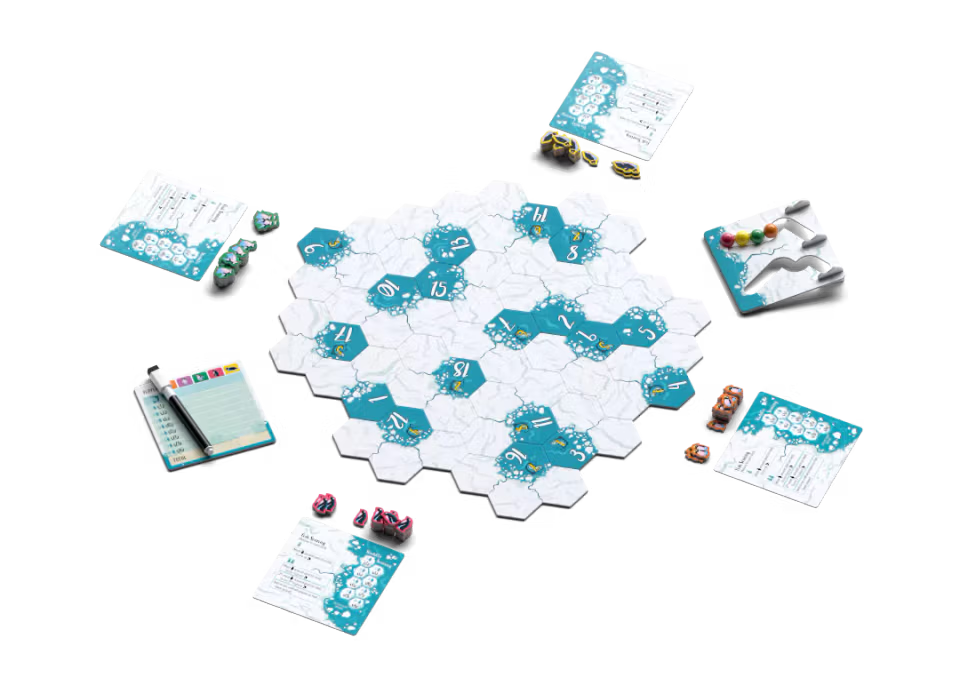
At Endless Mode, I reviewed the two-player game Naishi, which is a solid enough game, but which is yet another example of white European designers & illustrators using Japanese culture and history as a theme, and in this case they really misused it in a way that I couldn’t get past.

I sent out another edition of my free email newsletter on Friday, touching on (waves hands pathetically) all of this happening around us.

And now, the links…

Two books about games.

In Playing with Reality: How Games Have Shaped Our World, neuroscientist Kelly Clancy examines how the frameworks of games have affected myriad aspects of human society, and how more recently game theory and related ideas have led to damaging and even ruinous policies that continue today with the mindless (pun intended) push to make everything AI.

Playing games leads our brains to produce dopamine, and games with uncertainty function as variable reward systems, increasing those dopamine surges and further encouraging us to keep playing. Thus we see evidence of games going back to ancient Babylon (the Royal Game of Ur), Egypt (Senet), and Africa (mancala), with games often used as tests of intelligence or readiness for a position as a leader or even as royalty. Such games often included substantial elements of chance, including the progenitors of dice, which led to early calculations of probabilities well before the Europeans started to figure this stuff out in the wake of the Renaissance. Games have evolved over time in complexity, and as they have developed, they have further permeated our non-playing world.

Clancy sets the stage by giving that history and an explanation of what happens in the brain when we play games, including games of chance and games of strategy, and then moves into the more sordid history of games affecting … well, history. She goes into the story of Kriegsspiel, an early wargame that was first developed by a Prussian nobleman two hundred years ago, and after several decades found its way into military leaders’ hands, where it became a tactical training tool for officers in the Prussian and later German armies. Clancy connects it to the Germans’ early successes in World War I and the use of the Blitzkrieg strategy in World War II, both as a way to explain how we can use games to learn and to think more flexibly, as well as how games can lead to unexpected and even tragic outcomes when used without guardrails.

Game theory ends up the main character of the second half of Playing with Reality, as Clancy points out that the way game theoreticians took over much of economic teaching, dovetailing as it did with the myth of the ‘rational’ man, led to decades of policy failures across the world that were based on a set of faulty assumptions about how people would act. (She did not, unfortunately, mention the “it’s time for some game theory” meme.) This idea of “economic man” or “rational man” had a stranglehold on economic instruction throughout the world for decades, well past the point where folks like Daniel Kahneman and Amos Tversky had published research showing that people are in fact not rational, and often fall prey to cognitive biases, leading to results you won’t predict if you’re stuck in the standard model.

Clancy saves some of her particular ire for the AI gold rush and the grifters pushing it, cautioning that these LLMs are not actually exhibiting ‘intelligence,’ and that there’s danger in treating “language like a game without meaning.” Much of what she says about these energy-devouring scams could have been written this week, even though the book itself was first published last year; she decries the lack of regulation or even common sense in many of the uses of so-called AI, and the history of the overapplication of games and game theory to real-life – often treating the world as a zero-sum game, when it is manifestly not – shows how easily we can destroy the world by thinking in those terms. (She cites a specific example from the Cold War, where one Soviet engineer decided to ignore an alarm that a U.S. ICBM was heading towards Russia; the alarm was false, of course, but that one person’s decision, against the ‘rules’ of the game, saved us from World War III.)

Clancy’s focus is on how games are intrinsic to humanity, how we’ve tried to model reality in our games and then taken the games and tried to apply them back to reality, with mixed results if we’re being kind. Mathematician Marcus du Sautoy takes a different approach in his book Around the World in 80 Games: A Mathematician Unlocks the Secrets of the Greatest Games, which may not actually get to eighty games (and certainly not the greatest ones) but does at least provide some interesting histories of games outside of the western canon, truly going around the world to explain the origins and uses of games in Africa, South America, and across Asia. The book offers some superficial looks at the math behind some of these games, but it’s scant, and it’s hard to get away from du Sautoy’s pie-eyed optimism around AI, which he seems to view as an unmitigated positive that will take drudgery from our lives and allow us to play more games.

Du Sautoy succeeds most when he gets a little deeper into the specifics of a game, such as the analysis of which properties are the best ones to buy in Monopoly (the orange ones above all), or the history of tarot cards (which had nothing to do with the woo for which various charlatans have adapted the game), or the stories of games from non-European cultures that were unfamiliar to me, like Sudan’s Dala – many of which have been ‘solved’ by mathematicians, for better or for worse. Du Sautoy writes very much like a mathematician, so when he’s in the weeds, he’s actually clearer and his passion is palpable, but when he starts veering off into philosophy or his almost religious belief that AI is going to save the world, not only is the prose harder to read, but he’s clearly out of his depth.

Both books quote many of the same sources on the philosophy of games, including Bernard Suits’s The Grasshopper and C. Nhi Nguyen’s Games: Agency as Art, which makes their tonal differences more stark. Clancy is the realist here, someone who certainly seems to like games but understands their limitations as models for society as a whole, while du Sautoy is the Panglossian dilettante whose life of relative privilege – his grandfather ran the publisher Faber & Faber and his godmother was T.S. Eliot’s wife Valerie – has perhaps blinded him to the realities of daily life for most people. Du Sautoy does cover more specific games, if that’s where your interest lies, while Clancy has much more to say about games as a whole.

Next up: Staying on a theme, I’m reading Philip K. Dick’s pulpy The Game-Players of Titan.

Stick to baseball, 9/20/25.

At the Athletic this week, I wrote my annual Prospect of the Year column, giving the nod to the Pirates’ Konnor Griffin and mentioning a handful of other prospects who had great years.

For Endless Mode, I reviewed the cooperative card game Beasts, another limited-communication game that I thought was perfectly fine, but not novel or interesting enough to unseat better games in this genre for me.

I sent out a new edition of my free email newsletter on Friday. I feel like that’s going to be the best place for my thoughts on the state of things for now.

And now, the links…

  • NY Times reporter Michael Wilson details how he nearly fell for a phone scam, where the caller purported to be from Wilson’s bank, spoofing the bank’s phone number, with other plausible details.
  • Former Georgia Lt. Gov. Geoff Duncan was a Republican who refused to go along with Trump’s attempts to steal the 2020 election. He left the party entirely due to the harassment that ensued, and now he’s running for Governor as a Democrat.
  • Physicists at the University of Colorado-Boulder published a paper about how they managed to create visible time crystals, a strange state of matter that was only proposed in 2012 and had never been seen  at the macroscopic level until now.
  • Board game Kickstarters: Disco Heist Laundry is indeed a heist game, set in the early ‘80s; full disclosure: I know the publisher pretty well, as our kids go to the same school … Dinosaur Island: Fully Charged is an upgraded version of the 2017 tile & worker placement game, with better components and some rules tweaks to improve the game’s balance … I don’t know anything about this publisher but I’m intrigued by the game, Smallfolk, a “cozy” tableau-builder … I can’t remember if I linked this one before, but Bézier is publishing a new title called The Game Makers, featuring the images and names of 300 actual board games that you’ll compete to make.

Stick to baseball, 9/14/25.

I had two articles for subscribers to The Athletic this week, my annual look at players I got wrong (which, of course, generated a bunch of comments from people who said I was wrong about players who had a decent half-season) plus a preview of the Arizona Fall League rosters (which seem to have changed already since I got the preliminary ones, alas).

And now, the links…

  • In The Atlantic – not my employer – Charlie Warzel writes that the Epstein birthday book is “a nightmare” and shows that the conspiracy theorists were at least partly right. It appears many, many of Epstein’s friends knew of his crimes against children and joked about it.
  • A child in the Los Angeles area contracted measles as an infant, before they were old enough to receive the first dose of the MMR vaccine, some years ago, and died this month of the side effect known as SSPE, which can show up a decade after the measles infection and causes dementia, dystonia, and eventually cardiac or respiratory arrest. I wonder if 1) this child was infected during the 2014-15 epidemic and 2) if they got it from an unvaccinated person, which seems almost certain.
  • Texas A&M fired a professor and two administrators after the professor distributed materials that indicated recognition that there are more than two genders (which there are), claiming they were complying with Texas law (that does not exist) and President Trump’s executive order (which I don’t think binds them to do anything).
  • A Tacoma man who went to the house of a QAnon follower to serve her an order to leave the foreclosed house where she was living was cleared of wrongdoing after she shot at him and he returned fire, killing her.

Glyph.

Glyph was Percival Everett’s tenth novel, published in 1999, at a point when Everett was earning critical acclaim but not much commercial attention. It’s a much more academic work than any of his later novels I’ve read, satirizing post-structuralism and some of its leading lights, but you can see more than a few glimpses of Everett’s humor, foreshadowing his more broadly successful later work.

Glyph is narrated by Ralph, a very precocious baby who is able to read and write at the level of a graduate student before he turns one, shocking his parents – whom he calls Inflato (father) and Mo (Mother) – and eventually leading to unfortunate interest from a series of would-be evildoers who plan to use him for their own nefarious purposes. Ralph communicates via written notes, which, of course, people don’t believe he wrote at first, but after his parents accept that Ralph is indeed a genius, they take him to a psychologist for evaluation, only for the psychologist to decide that Ralph is her ticket to research fame and to kidnap him – which works until the government shows up.

The plot itself takes up maybe half of the book, with the remainder split between Ralph’s musings and various interstitials, like imagined conversations between important personages from history, including literary theorist Roland Barthes, one of the major figures of structuralism and post-structuralism – and thus a prime target for Everett’s satire. Inflato is a failing professor of literary theory, and at one point he has Barthes over for dinner, only for the French philosopher to leer at Mo and eventually admit he’s never read Inflato’s work.

Other literary theorists and thinkers in related fields like semiotics and philosophy come in for further satire or just outright mockery, whether directly in the text or in any of the many asides, like constructed dialogues between two such figures from different times in history. Every chapter is divided further with subheadings that almost seem drawn from a hat filled with terms from lit-crit movements of the latter half of the 20th century, including structuralism and post-structuralism, deconstruction, and post-modernism. Everett wrote the book while he was a professor of creative writing at UC Riverside, but had moved on to become chair of the English department at USC by the time it was published, which at least makes me wonder if he was mocking some of his by then former colleagues at UCR for their adherence to these philosophies – not least because he has said many times since that Ralph is the closest of all of his protagonists to his own character.

Glyph also has plenty of lowbrow humor, including a slew of potty – well, first diaper, then potty – jokes, bad puns, and Airplane!-esque gags, which softens some of the more abstruse material here for readers who, like me, don’t care for these distinctly anti-literary schools of thought. Yes, academics can certainly spend their time on textual analysis or examining the relationship between a work and its broader context. I’d probably do just that if I were a professor of literature somewhere, or if my livelihood otherwise depended on it. I read for pleasure, however, and I can’t read books in that way at all. If a book doesn’t grab me with its plot, or its protagonist, or its prose, I’m not going to like it or appreciate it. Glyph skewers some of the same ideas I disdain for their desire to strip literature down to the studs and ignore the trappings of great fiction, but it also does so with a strong and funny central character, Everett’s acerbic wit, and a ridiculous plot that just barely holds together for the novel’s 200 pages.

Related: This 2024 profile of Everett in the New Yorker, written by Maya Binyam, is outstanding.

Stick to baseball, 9/6/25.

Over at The Athletic, I wrote some brief updates & outlooks for five prospects called up on August 31st/September 1st, and an in-person scouting notebook on Guardians pitcher Joey Oakie plus some other Guards, Orioles, Nats, and Phillies prospects.

At Endless Mode, I reviewed the one vs. many game 2001: A Space Odyssey, where the player who takes on the HAL role does indeed get to close the pod bay doors. It’s a good game, Dave.

I’ve moved my free email newsletter over to Kit, away from the place that proudly hosts white nationalist newsletters.

And now, the links…

Music update, August 2025.

Solid month for new music, but there’s a lot more coming now that we’re into fall, with Suede’s latest dropping today to kick things off. As always, if you can’t see the widget below, you can access the playlist here.

Wolf Alice – White Horses. It’s crazy that my favorite track from Wolf Alice’s latest album, The Clearing, doesn’t feature Ellie Rowsell on lead vocals. She’s on the chorus, but that’s one of the boys doing the verses, and my god does this thing hum. I have such mixed feelings on the record; they’re one of the most interesting bands going now, so the album is all over the place, and I respect the ambition and daring. I just wish there were more bangers here. This song is awesome, so are “Bloom Baby Bloom” and “Bread Butter Tea Sugar.” There are some other highlights. I think closer “The Sofa” – not a tribute to JD Vance – is kind of a snoozer. I’m going to wrestle with this one through the end of the year.

Coroner – Renewal. I don’t usually push metal tracks to the start of the playlist, since I know some of you are here for pretty much everything but the metal stuff, but this is Coroner’s first new song in over 30 years. They never got their due while they were active, commercially at least, but their last two albums were landmarks in the thrash genre, sliding towards progressive thrash and also heralding some of what was about to come on the death metal side of things. It’s incredible that they sound almost exactly as they did on Grin, their final release before their breakup in 1993, which saw them shift hard towards proggier stuff. Their sixth album and first in 32 years, Dissonance Theory, is due out on October 17th.

IDLES – Rabbit Run. IDLES did the soundtrack to the new Darren Aronovsky movie Caught Stealing, and to their credit they mixed things up a bit rather than just writing a bunch of new IDLES tracks. This sounds like a song from a tense, violent action film.

Geese – 100 Horses. I had both this and “Trinidad” on the original playlist, settling on this one because it’s a little more of a conventional rock track, while “Trinidad” sounds almost like a meteor hit the studio mid-song.

Wisp – Serpentine. Wisp is Natalie Liu, a 20- or 21-year-old singer/songwriter who sounds a lot like beabadoobee but with a harder guitar sound. This track, which combines breathy vocals with some crunchy hard-rock music behind it, is from her debut album If Not Winter, which came out last month.

Pynch – Post-Punk/New-Wave. I feel like this song’s title is making fun of me.

Richard Ashcroft – Lovin’ You. Yes, that’s the intro to “Classical Gas,” which is one of the two songs I typically use to warm up when I practice guitar. I can’t decide if I think this track from the former lead singer of The Verve is a clever interpolation of a classic guitar line or just weird derivative stuff from a guy who’s done this to better effect on other tracks.

Automatic – Mercury. The third album, Is It Now?, from this American synth-rock trio is due out on September 26th. Their dark, almost gothic sound definitely hits the nostalgia vibe for me, but it’s more a hint of that early ‘80s sound I love rather than a complete throwback.

Creeper – Blood Magick (It’s a Ritual). I’ve loved most of Creeper’s work since their acclaimed 2020 album Sex, Death & the Infinite Void, but this track, from the forthcoming Sanguivore II: Mistress of Death, might be the campiest thing they’ve done yet. It’s giving hair metal in the wrong way. It’s still catchy, but I’m not sure this is the direction I want them to go in.

Courting – the twins (1969). These prolific British art-punks just put out their second album in fourteen months back in March, and they’re back again with a brand-new single, a very pre-Arctic Monkeys-sounding hard-edged bit of controlled chaos.

HAERTS – The Lie. This is the second single from HAERTS this year after they went dark in the wake of 2021’s Dream Nation; both are slow, piano-driven tunes that highlight Nini Fabi’s vocals, but neither has the incredible energy of their first album, 2014’s HAERTS. I don’t know if that sound just isn’t coming back, but I refuse to give up.

Color Green – Ball and Key (Free). This California quartet sounds like the next descendant in the line that runs from the Grateful Dead through Phish, and while I know there are a lot of pretenders to that throne, at least Color Green sounds great on record, which is more than I can say for a lot of so-called jam bands.

Just Mustard – We Were Just Here. Everyone is shoegaze now. Just Mustard actually does shoegaze, though, at least in terms of the musical style, with waves of sound that create as much of a sensation as they impart any sort of melody. It’s harsh and sometimes dissonant, but that’s what shoegaze originally entailed. This Irish band is more true to the subgenre than some of the original artists still going, like Slowdive and Ride, are in their contemporary music (which, to be clear, I’ve liked very much).

Black Honey – Soak. I’d call this song mid as Black Honey goes; they’ve had better, but I’m grading them against their own previous output there. It’s the title track from their fourth album, which came out while I was on vacation, so I still haven’t listened to it beyond the singles.

Cast feat. P.P. Arnold – Way It’s Gotta Be (Oh Yeah). That is indeed the Britpop band Cast, founded by The La’s bassist John Power, who racked up ten straight top 20 hits in the UK in the 1990s, including the bangers “Sandstorm,” “Alright,” and “Beat Mama.” They put out an album last year that didn’t have the same kind of edge or funk to this track, one of two singles featuring former Ikette (as in Turner) P.P. Arnold. Cast’s next album Yeah Yeah Yeah is due out in January.

The Hives – The Hives Forever Forever the Hives. Never let it be said that Howlin’ Pelle lacked for confidence. This is the title track from the band’s seventh album and second since they re-formed, coming out just a week ago.

clipping. – Forever War. This new track appears on Dead Channel Sky Plus, an expanded version of the trio’s second album that rearranges the existing songs and includes four new ones. “If you ain’t dead yet/you gon be there soon” should a rallying cry.

Bleak Squad – Strange Love. This is the title track from the debut album by this Australian supergroup, which includes Mick Harvey, who played in the Birthday Party, Nick Cave & the Bad Seeds, and PJ Harvey’s band, as well as three musicians from groups I don’t know. Their sound is atmospheric and dark – I saw one review call them “noir,” and that fits – but I’d best describe it as what I think or hope the upcoming Blondie album would sound like.

Drink the Sea – Rose Crested Sky. Speaking of supergroups, this one has Peter Buck (REM), Barrett Martin (Screaming Trees), Alain Johannes (Eleven, Them Crooked Vultures), and solo artist Duke Garwood. The band plans to release two albums this fall and to tour to support them. A post on REM’s Instagram quoted Martin as saying that this band’s sound will incorporate a lot of world music sounds; I hear some of that here, but this track is more dominated by the off-beat rhythm and what I think are varied time signatures.

Silver Gore – All the Good Men. This British duo formed in 2021 but just released their first music this year with three songs, including this jagged alt-pop number that got stuck in my head for days after I first heard it.

No Joy – Garbage Dream House. No Joy is now a solo project by Canadian guitarist/songwriter Jasamine White-Gluz, whose younger sister Alicia is now the lead singer of Swedish melodic death metal icons Arch Enemy. It’s shoegazey, but with ethereal vocals that push it towards dreampop. Apparently No Joy is playing tonight in Philly at a place I don’t know called Kung Fu Necktie.

Arcadea – Exodus of Gravity. Arcadea is a synth-metal side project of Mastodon drummer Brann Dailor, and far more accessible than almost all of his main act’s output (which I tend to like quite a bit). I had this on the playlist before the news about former Mastodon guitarist Brent Hinds’s sudden death,

Deftones – milk of the Madonna. I’ve never been a huge Deftones fan, although I’m sure I’m also biased by their first few albums as a nu-metal band, including that horrible “Shove It” song that was inescapable when it came out. With the caveat that I haven’t heard a ton of their stuff, this is the catchiest song of theirs I’ve heard.

Cloudkicker – Things You Can’t Change. Cloudkicker is the side project of Ben Sharp, a commercial airline pilot (according to Wikipedia) who releases music on Bandcamp etc. for fun; I’d never heard of him/them until Riley from Thrice posted about the new stuff on Bluesky. This track is instrumental, very post-hardcore (like Thrice) but a little heavier.

Asymmetric Universe – Feather on a Glass. This is some seriously progressive metal, like Animals as Leaders type stuff, from a pair of Italian brothers who handle guitar and bass, combining some very heavy djent-ish metal grooves with melody lines from – I can’t believe I’m saying this – smooth jazz. It’s crazy.

Crypt Sermon – Only Ash and Dust. This Philly-based doom metal band returns with a four-song EP that they describe as an extension of last year’s album The Stygian Rose, with three new tracks and a cover of the title from black metal pioneers Mayhem’s first album, retitled to change the word “Dom” to “Doom.” (Mayhem sucks, as a band and especially as people, to be clear, but they were highly influential on their genre.) The EP’s overall sound is more doom-plus, with some more energy and passages with quicker tempos compared to the LP.