Stick to baseball, 9/5/26.

Over on the Athletic this week, I looked at nine September(ish) callups of note; posted a minor-league scouting notebook on Jarlin Susana, Joseph Dzierwa, and other O’s and Nats prospects; and posted a draft scouting notebook covering both the PG All-American and Under Armour games.

I sent out a new issue of my free email newsletter this week. For socials, I’m still mostly on Bluesky, Instagram, and TikTok, and posted a new video to the latter two sites this week about the top three prospects recalled in the last week.

And now, the links…

  • ICE gave a 20-year-old Haitian immigrant and Wright State student, here legally, an ankle monitor. He killed himself a few days later. I’m unclear whose interests were served here.
  • Dan Ariely, the best-selling author of Predictably Irrational and the inspiration for the network procedural Irrational, is facing a new round of allegations of research fraud after a review of the data used for a major 2002 paper on procrastination found evidence of fabrication.
  • The police chief in Senatobia, Mississippi, where an officer shot and killed a 1-year-old while pursuing a woman suspected of shoplifting, has been fired. Harold Vanderford had also used racist slurs about Black people in text messages, and tried to resign before he was fired. Maybe Arizona State will hire him?
  • The widow of a U.S. airman killed in Trump’s illegal war on Iran had to go to social media to get death benefits because, in her words, the military claimed it wasn’t a war, so she wasn’t entitled to the benefits that accrue to the surviving spouse when a soldier is killed during a war.  

Music update, August 2026.

August was a monstrous month for new music in a great way, so much so that I posted a list of album grades on Bluesky covering LPs that came out in July or the first three weeks of August, which was before we got new records from Mastodon, Russian Circles, Elephant Stone, Billy Strings, flowerovlove, Interpol, and Alabama Shakes on the month’s final Friday. Anyway, as always, if you can’t see the widget below, you can access the playlist on Apple Music or Spotify.

The Afghan Whigs – House of I. The Whigs sound as good as ever, with their latest album, Soft Control, maybe their best yet, at least rivaling 2017’s In Spades, and up there with Gentlemen from the band’s first incarnation. This song and “Loose Talk” were two of the best new songs I heard all month; I picked this one because of the guitar riff that opens it.

Kiwi jr. – Pure Michigan. The answer to the eternal question: What if Vampire Weekend made a song that wasn’t twee as fuck? Anyway, this Canadian band’s latest album, Blowing Up, came out on August 14th, featuring their usual blend of jangle-pop sounds and sardonic lyrics.

Do Nothing – Act Natural. This song reminds me so much of peak Wild Beasts, whose farewell album Boy King remains one of my favorites of this century, that I have come back to it repeatedly since first hearing it a few weeks ago. Do Nothing’s sound is a similar blend of art rock and post-punk, but here with big, almost bombastic vocals. Their second album, Friend World, comes out on November 6th; they previously released another single, “Stars,” that’s a little blander and less catchy.

Squirrel Flower – Cleveland. Squirrel Flower is Ella O’Connor Williams, a multi-instrumentalist from Boston by way of Grinnell who has released five albums, with the latest, Say a Prayer to the Gods of Getting Going, among my favorites of the year so far. She blends indie folk with shoegaze elements, but the real star is her strong voice that communicates deep longing and sadness on much of the album.

she’s green – close your eyes. The final song on this Minneapolis shoegaze band’s debut album is seven minutes long, but it’s a stunner, calling to mind Slowdive and early Lush, with waves of sound washing over you beneath Zofia Smith’s atmospheric vocals.

Smidley – Love in Every Direction. Smidley is Conor Murphy, lead singer of the maybe-defunct band Foxing, who is set to release his second solo album Murphy Horse on the 25th. It’s different from most of Foxing’s work, especially their last album, and feels more like the kind of indie rock that was popular in the wake of the Killers’ massively successful debut album.

Keo – That’s Me. Based in London but with roots all over Europe, Keo will release its first album, Put A Smile On For Me, on the 25th, with this song sounding like the Gin Blossoms by way of the Amazons with a lyrical reference to R.E.M. in the chorus.

Sailor Honeymoon – Click Click. This South Korean all-girl punk band’s debut album The Worst of Sailor Honeymoon came out in August and shows plenty of promise, although it’s pretty short (27 minutes) and gets a little repetitive over 13 songs. This song, “I Wanna Leave You,” and “Bad Apple” are standouts.

Ceremony – Dark Summer. I did not like Ceremony’s latest album, Tell Me Your Dream, which has no real identity and features a lot of filler tracks. This is one of two tracks on the record I liked, along with “Other Hells,” but there’s nothing here to rival In the Spirit World Now.

DIIV – The Fountain. DIIV’s critical acclaim has always outpaced their music for me; this song, from their upcoming fifth album Zirp! (due October 30), might be my favorite song by this Brooklyn indie-rock band, blending genres while maintaining a consistently strong hook in the chorus.

Quicksand – Bring on the Psychics. The title track from this seminal post-hardcore band’s third post-reunion album is one of its strongest, and the record as a whole might be their best. It’s certainly their most cohesive, and stays true to their musical roots while tightening up some of the noise-rock elements more present in their first two records.

Elephant Stone – I Got a Pill. Elephant Stone’s latest album ASHA came out on August 28th; I’ve heard three songs, this power-pop track, the tremendous rocker “Everything Evil,” and “Fascists Killed Yer Rock ‘n’ Roll,” which made NPR’s best songs of the week list last week. I wasn’t familiar with the band before this year, but they’ve been around since 2009, and I’m a fan of what I’ve heard so far.

The Olivia Tremor Control – Garden of Light. OTC was part of the Elephant 6 collective in Athens, Georgia, that also spawned Apples in Stereo and Neutral Milk Hotel, releasing two albums of jangly power-pop before internal strife ended the band’s first run in 2000. Founding members Bill Doss and Will Hart recorded most of a third album before Doss died in 2012, and the band released two singles from the record in 2024 on the same day that Hart died at age 53. The band’s final album, The Same Place, comes out on October 23rd, including this song and the just-released “Advice from the Oceans.”

Billy Strings – Burn the Other End. Strings won the Grammy for Best Bluegrass album in February, and he’s already back with a new LP, So Much for Goodbyes, which came out in August. He also hopped on stage with the latest version of Canadian death metal band Cryptopsy at his own Ionia Freak Fair last week.

Wolf Alice – Hammond Song. How the hell is this a B-side from The Clearing? It would have been among the five best songs on the album, easily, maybe top three after “White Horses” and “Bloom Baby Bloom,” and it’s the best showcase of Ellie Rowsell’s voice of anything from those sessions.

beabadoobee – Memories. This is the third single ahead of Beatrice Laus’ fourth album, Pylon, due out on the 18th, which apparently is not a note-for-note cover of Killing Joke’s final LP.

flowerovlove – KISS KISS KISS. Joyce Cissé’s debut album MINI SKIRT WARRIOR dropped on August 28th, and it’s one of the best pure pop albums of the year. Her ear for a great melody is incredible, and the album is littered with songs that should be all over pop radio, including this one, “American Wedding,” “I’m Your First,” “girls will be girls” (featuring Willow), and “shady.” I hate the term “sophisti-pop” but it would certainly apply here.

Iben – Dead End. A Norwegian singer who just released her debut album Hulder, Iben blends folk music, atmospheric metal, and morbid lyrics for an intriguing combination that somehow also sounds … not poppy, but potentially mainstream. I can’t figure out if she’s the same Iben who released a pure pop song a few years ago called “Childish;” Spotify has them as separate artists but I wouldn’t swear those are different voices.

Heathers – Bite. Heathers is Heath Michael Thomas – there’s an Irish pop duo of the same name, but this ain’t them – who’s released three singles so far this year, with his debut album Awesome coming out on October 30th. It’s very lo-fi, DIY, garage rock; sometimes he sounds like he’s singing with his mouth pressed up against a screen door. There’s a real melodic sensibility here, though. Props to Jon Natchez from The War on Drugs for the rec.

Soft Science – Fade. More power-pop with some shoegaze elements, reminiscent of Velocity Girl and Belly, from this long-running Sacramento band whose fifth album, Sand, comes out this Friday.

Gang of Youths – Things Take Time. This one-off single is the Australian band’s first new music since 2022’s Angel in Realtime, which had a couple of stellar singles in “The Angel of 8th Ave.” and “In the Wake of Your Leave.” This feels like a lyrical throwaway, and singer/songwriter David Le’aupepe has said the song isn’t really about anything. The music’s fine, though.

Ezra Collective – Jubilee Feeling. This Mercury Prize-winning jazz quintet will release its fourth album, Here Because of Hope, on September 18th. This single is the first instrumental and third single they’ve released from the LP, after “Only Love” (feat. Pa Salieu) and “Well Organized” (feat. Lila Iké).

Jorja Smith – Dancing. I love Jorja Smith’s voice, but prefer when she leans more towards jazz or classic R&B sounds than EDM. Her latest album What Are the Odds bridges the gap between the two, with largely electronic beats but less frenetic tempos, allowing her voice to remain front and center, as on this Afrobeat-tinged dance track.

Jungle – Sunshine. The best song off Jungle’s disappointing new album is the title track, which has a good enough hook to stand out over the sea of sameness on the rest of the record. There’s no “Busy Earnin” or “Happy Man” to be found anywhere on the LP.

Rakim, Kurupt, Masta Killa, & Kokane – Goin Down. The first three MCs here have collaborated on The Godbody LP, which was supposed to be released on August 28th, and has now been pushed back to September 18th. This lead single is basically an average Rakim rhyme and some other dudes. By the way, there are a couple of new Rakim collaboration videos on Youtube that I think are AI slop – they sound entirely plausible but there’s no media coverage whatsoever and the videos are just stitched together from old clips.

CZARFACE & Frankie Pulitzer feat. Method Man – Mad Technology. CZARFACE is Inspectah Deck, 7L, and Esoteric, but more importantly, Frankie Pulitzer is Tom Hardy – and he can rap a little! He’s better than Esoteric, at least, and isn’t embarrassed rhyming after two Wu-Tang members.

Royal Blood – Ten Over Ten. This heavy-rock duo’s fifth album, Dead Company, comes out on November 13th, with this track the first single. It might be a sign they’re returning to their heavier roots from their first two albums after Typhoons went for a little more funk and pop and Stuck in the Water Below felt like a lesser version of their previous work.

Sleep – The Morrisist. Sleep’s newest album, Hemispheres, comes out today, featuring only Al Cisneros from the original lineup; guitarist Matt Pike is out, replaced by Bubba Dupree of the early ‘80s punk band Void, while drummer Jason Roeder has been replaced by Melvins drummer Dale Crover. I know some Sleep fans are pissed about this, but 1) Pike’s public comments and his embrace of antisemitic conspiracy theorist David Icke are a serious problem and 2) this song is great, so just enjoy it.

The HU – Second Face. HUN, the latest album from this Mongolian folk-metal band, is one of the best albums of the year for me – it blends a genre I know nothing about with a genre I know a lot about, classic heavy metal like that of the New Wave of British Heavy Metal. It’s no surprise that the Hu covered Maiden’s “The Trooper.”

Mastodon – Snakes for Dinner. Mastodon’s latest album and their first since the death of Brent Hinds, Marrow Deep, is solid but unfocused; it’s a collection of songs, some pretty good, including “Your Ghost Again” (which, I’m calling it now, is going to get a Grammy nomination and maybe win) and this track. I only felt like one track was a miss, “A Vampire’s Demeanor,” and thought the closer “The Three Fates” was a strong finish that recalled some of Mastodon’s more ambitious and longer tracks.

Sarcator – In Search of Oblivion. This young blackened thrash band from Sweden came up with its name by combining the names of two of their favorite bands, the early death-metal act Sarcófago and German thrash titans Kreator. You can really hear the latter’s influence in the vocals on this track from the band’s upcoming fourth album, The Ones We Follow, due out October 30th.

Flotsam & Jetsam – The Edge of Nowhere. Flotsam & Jetsam were probably best known in the 1980s for being the original band of Jason Newsted, who served as Metallica’s bassist after Cliff Burton’s death; and for their commercial track “Wading Through the Darkness” from 1992’s Cuatro. Unlike many bands from that first wave of American thrash, however, they never stopped recording, and I loved “Primal” from their last album. Their newest, Rats in the Temple, seemed a little heavier to me, and thus less like the classic thrash sound I love.

Russian Circles – Seventh Seal. This instrumental metal band’s latest album, Nine, is heavy and proggy and pretty endlessly interesting, which is what I want from this kind of music. It’s seven tracks, one of which is just shy of two minutes, with the others all 4:57 or longer.

Tenby.

Tenby is a seaside town in southwestern Wales, and is a popular destination for beachgoers and vacationers, with two beaches and a nearby island you can walk to at low tide. Known as Dinbych-y-pysgod (Small fort of the fish) in Welsh, it’s small – fewer than 5000 people live there – and extremely cute, with plenty of shops and restaurants to cater to the summer visitors. I went there with my wife and her cousins in 2022, walking along the beach and stopping by the Park Hotel (owned by some more of her cousins) for a drink.

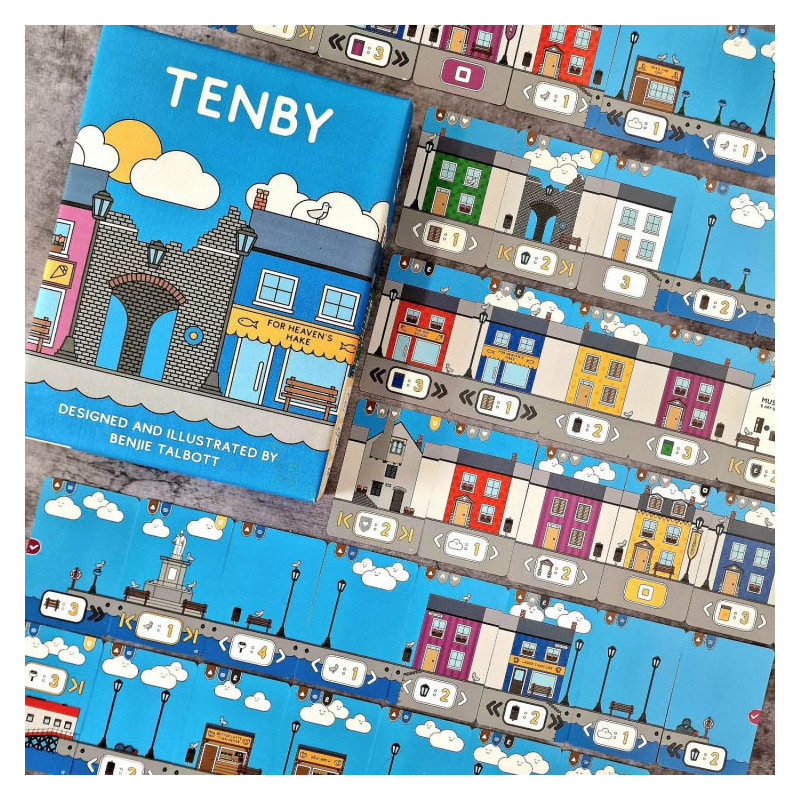
Tenby is also a new board game, loosely set in the town in that it borrows some of the colors of the buildings along the Croft and the Norton, and has players creating streets that combine buildings with various seaside features and piers. It’s a delight to play, if a bit of a table hog and tricky to score, and even comes with its own soundtrack (also on Apple) made by the game’s designer and illustrator, Ben Talbott.

In Tenby, players draft cards to build out their streets, with each card carrying some kind of scoring condition based on cards adjacent to it, or within two cards, or in their entire street. The game lasts ten rounds, and in each round, the players place their tokens on numbered action cards, where a higher number gives more/better actions but drops you in turn order for the next round. Selected cards can go on an existing street at either end, or can form a new street. Some cards also have check marks indicating that they end the street on that side. After the tenth round, players score their private objective cards, with higher rewards for streets that are are ‘finished’ by end cards, and every card on every street. The highest score wins, as that’s usually how that works.

There are four main card types in Tenby, as well as life jacket tokens which you can spend for extra actions, and your ability to draft those cards from the market depends on the action(s) on the action card you choose in the Day phase. Buildings are the lowest-valued cards, scoring only for the cards immediately adjacent to them. Piers score for the cards within two in either direction. Landmarks – they may be called monuments, same thing – score for the entire street. If you select an action card that gives you a Pier action, you can take a Pier card or a Building card but not a Landmark card – you can go down in value, but never up. There are also Resident cards that provide secret objectives; you’ll start the game with one, choosing from two drawn from the deck, and can add more as the game goes on with a Resident action.

Some action cards award the player one or more life jacket tokens, which they can use at any time. Spending one token lets the player draw another card into the market in any one row. Spending two lets the player select a Building card, or move a card already in their tableau, including placing it in the middle of an existing street. Three tokens yield a Pier card, and four tokens get the player a Landmark or a Resident card. The tokens are worthless at the end of the game, so there’s really no reason to hold on to them, and that one-token action to add a card to the market row of your choice is extremely useful later in the game when you might be looking for something specific and/or you find a row depleted by other players before your turn.

Most of the scoring in Tenby revolves around features found on the various cards, such as shutters, flowerboxes, birds, post-boxes, streetlights, happy little clouds, and so on. Some of these are small, and can be a little hard to distinguish. I’ve also read comments online from color-blind players who struggled with the scoring cards that relate to building colors. Those design questions aside, the various scoring opportunities are plentiful, so you’re rarely going to look to the market and come up empty unless you’re the last player to select.

The copious scoring opportunities do make the end of the game somewhat tedious; you’ll probably be scoring two dozen or more cards after ten rounds, some of which require you to examine every single card on a street. Pen and paper or a scoring app would help, of course, and the game comes with neither. Tenby also requires a lot of space for each player; your streets can be ten-plus cards long, and you’ll probably have 3-4 streets by the end of the game. With four people playing at a reasonably-sized picnic table, we still started to run into each other.

Tenby comes in a smallish box and has very clever packaging within it – there are four tiny boxes within it that fig snugly into the inner frame, and three of those boxes have symbols on the side showing you which card decks they should hold for optimal storage. The fourth holds the life jackets and player tokens. The art is appealing and different from almost any other game I can think of; there’s a Walking in Burano vibe because of the setting and similarly-colored buildings, but the art styles are completely different. It’s also a quick teach; the one rule that other players have found tricky is that adjacent cards have to match along the edges, which is hard to explain without showing the cards but does restrict your options for legal plays.

I’m a big fan of Tenby even beyond the Welsh connection; it’s an A- for me, one of the best new games I’ve played in 2026 . It’s a great family game that uses some familiar mechanics of pattern-building and action-selection, and a four-player game will take about an hour, maybe less once everyone knows the game. You can buy it directly from Mighty Boards, at Miniature Market (currently out of stock), or at Amazon.

The Incandescent.

Stories set in magic school have become commonplace to the point of cliché; unless the author is willing to take the story in a new direction, like weaving parody into a genuine story (Lev Grossman’s The Magicians), the work is going to suffer from comparisons to the very popular books in the space, including those by she-who-must-not-be named. In The Incandescent, Emily Tesh takes a different tack by setting her novel at a magic school, in an alternate-world England where magic is just part of normal life, while making her protagonist one of the teachers, as well as making at least two more significant plot decisions that set this delightful book apart from its peers.

In The Incandescent, Saffy Walden is a senior teacher who works primarily with some of the oldest and most advanced students at Chetwood School, a day and boarding school outside of London where Walden herself was a student twenty years previously. One of her academic and practical specialties is dealing with higher-order demons – most magicians can handle the lower-order imps who love to occupy electronic devices like photocopiers or even wall clocks, but Walden is one of the few magicians in the world who can handle the most difficult, higher-order demons, which may turn out to be significant. And since Chetwood is full of young magicians learning to harness their powers, it attracts many demons trying to break through from their plane into ours, including a very powerful one nicknamed Old Faithful who has killed some students in the past. The threat of Old Faithful leads the school to bring in a Marshal, a sort of magical security agent, named Laura Kenning, who immediately rubs Walden the wrong way, so you can probably see where that’s going.

The story of The Incandescent has multiple peaks, so if you were wondering, say, if the whole novel was heading towards a denouement where Walden fights Old Faithful, you may be surprised when the demon shows up before the book’s midpoint. It’s misdirection by adventure, as every subplot is interesting and intense, but Tesh’s ultimate goal won’t be apparent until quite close to the novel’s end, when she finally reveals where all of this has been going.

Walden is a wonderful main character, and by the time the novel is through, Tesh has given us a huge amount of her life story as well as insight into many aspects of her character, particularly her somewhat low interest in romantic relationships. She’s not aro, but she’s indifferent enough that romance ends up a tangential part of the story rather than the core plot point. Her flaws are realistic and fit within her character while eventually playing a significant part in the development of the plot. The Marshal, Laura Kenning, and at least two of the four students who comprise Walden’s main class are also well-developed and have some sort of arc within the novel’s various subplots, while several side characters show up and get enough screen time to feel more than two-dimensional. (I was particularly fond of Todd, the groundskeeper/maintenance guy who has some untapped magical potential of his own; he needs his own story at some point.)

When the actual climax comes, the whole ground beneath the book shifts, and the final fifty-odd pages are a full-on sprint, thanks to two twists, one I saw coming and one I didn’t. It all makes sense in hindsight, and Tesh set it up perfectly. An author has to earn this kind of massive plot shift, and Tesh did so, while staying completely true to her characters.

The Incandescent was nominated for this year’s Hugo Award for Best Novel, which Alix Harrow won for The Everlasting, as well as this year’s Nebula Award for the same. This is the first of the six Hugo nominees I’ve read, and I’m currently in the middle of Nnedi Okorafor’s Death of the Author. Tesh won previously for Some Desperate Glory, a sci-fi novel that was good but flawed, and this is a better work in almost every way, from plot to character development to playing with popular tropes. It’s also a more memorable novel. These characters and this wonderful setting will stay with me for some time, and while I don’t think it needs a sequel, I hope Tesh revisits this universe in some fashion.

Next up: I’m about a quarter of the way through Death of the Author, which feels like a very ambitious novel so far.

Mountain Goats.

Mountain Goats is a small-box game from Allplay that recently got two new editions – a tiny-box version for $9 called, appropriately enough, Tiny Mountain Goats, as well as an upcoming legacy game called Mountain Goats Legacy where you play a campaign but don’t destroy any components. I’ll get to that legacy game in a few weeks, but I’ve never actually reviewed the original game, which is one of Allplay’s best titles in that square-box line. (It’s also on Board Game Arena and Yucata last I checked.)

Mountain Goats is a simple game of dice-rolling that creates some strategy around the inherent randomness of the format. Players roll four dice and divide them into two sets however they wish, using the results to move their goats up six mountains numbered 5 through 10. If your roll contains two or more dice showing just one pip, you keep one of those and re-roll any others.

Once your goat reaches the top of any mountain (they vary a little in height), you take a point card from that pile matching the mountain’s value – so the top of the value-10 mountain is worth 10 points. If a player gets a card from all six mountains, they take a bonus card, starting at 15 points and declining from there. Play continues until all four bonus cards are claimed or three of the six mountains’ point cards are exhausted.

If your goat advances to the top of a mountain, and there’s already another player’s goat there, you knock it off, all the way to the bottom of that mountain’s column of cards. The 5 and 6 mountains’ columns are four cards high, the 7 and 8 are three cards, and the 9 and 10 are two cards. There are also more point cards for the lower-valued mountains. That setup produces some strategic considerations around how to split your dice and move your goats – you might choose a lower-point outcome to knock an opponent’s goat down a mountain, or try to target a specific mountain to get its last card or maybe get that sixth one for the bonus.

On most turns, you’re going to try to split your dice in a way that moves two goats one space each or one goat two spaces. However, as the game progresses, you might choose a split that only lets you move one goat one space, forfeiting the chance for a second move, because it does more damage to an opponent or because it gets you a card you need more.

Games move very quickly at any player count because turns are so fast – roll dice, split, move. You can’t plan in advance per se, but you’ll probably have some idea of what you’d like to do in certain scenarios, and which values you need for those bonus cards. And it’s easy for younger players to play along because the math is so simple; I think it’s a great game for working on basic math facts, at least for adding numbers up to 6.

For some reason, I didn’t own Mountain Goats in any form until Gen Con of this year, despite owning at least a half-dozen other Allplay square-box titles, including Sequoia (another dice-roller), Big Top, and Waddle. I got a review copy of Mountain Goats Legacy, while I picked up a copy of Tiny Mountain Goats, which is exactly the same game as the original but in their smallest format. It’s one of those games I’ll always throw in the bag when we’re traveling and might meet up with other families – I brought it on our recent beach trip and it was a hit with the other family’s kids. (Plus I could argue I was helping them retain their math skills on summer vacation.) It’s a solid grade B game for me, but also one I’ll recommend more than a lot of higher-ranked games because it is so accessible to even non-gamers.

Stick to baseball, 8/29/26.

Over on the Athletic this week, I had a new minor-league scouting notebook, covering some Mets, Orioles, Nats, and Phillies prospects, including two guys the Mets just acquired at the deadline. I’ll have another one early next week. I’m not bylined but I did contribute to this newser on Walker Jenkins’ first callup.

You should sign up for my free email newsletter, which I’m hoping to get back to on Monday. For socials, I’m still mostly on Bluesky, Instagram, and TikTok.

And now, the links…

  • Longreads first: This New York cover story on the proliferation of travel teams for young athletes, and the harm it’s doing to our kids (at great cost to the parents), is a must-read for anyone interested in sports, even professional ones, because this is how we fumble our future and create leagues full of the privileged at the expense of anyone unable to access this narrow pipeline. I have long had a personal policy to avoid pay-to-play events, but it’s a little easier for me because the amateur players I’m seeing are the best of the best.
  • German actress/journalist Collien Fernandes was being stalked and impersonated online by someone sending men explicit images and videos purporting to be of her. It turned out her assailant was her husband.
  • A Christian cult in Idaho called Followers of Christ keeps killing its babies by ‘praying’ instead of seeking medical care, and Idaho law lets them do it.
  • There’s been a lot of attention over the two reported deaths from measles in Pennsylvania, but that’s the tip of a giant iceberg. There’s an outbreak in Wisconsin now, almost entirely among unvaccinated people, with 41 reported cases.
  • Finland had set a goal to end homelessness by 2027, and was well on its way there until a right-wing government took power in 2024 and started cutting social welfare programs, reversing a long-standing decline in the country’s homelessness rate.
  • Rep. Max Miller made a writer delete a tweet that said he had broken his toddler daughter’s collarbone. She did so, because this remains an allegation, and in response she wrote about a bunch of violent things he’s done to women that are not mere allegations.

Operation Barclay.

Operation Barclay the board game is indeed based on Operation Barclay the military con, where Allied forces concocted an elaborate deception to fool the Axis powers into thinking their attack on southern Europe would come through the Balkans, rather than through Sicily. (If you’ve heard of Operation Mincemeat, it was part of Operation Barclay.) This two-player asymmetrical game has the players playing as Allies and Axis – not Axis & Allies, that’s an entirely different game that takes about ten years to play – where the Axis (Abwehr) player has a limited number of rounds to guess where the Allied (LCS) player’s attack will be, as well as where their backup location is. (As I write this, the game is on sale for $10 at 25th Century, 75% off the regular price.)

Each of the five theaters on the map of Europe gets five face-down evidence tokens, placed by the Allied player, which come in red or green. The Allied player’s primary area for attack gets four green tokens and one red; their secondary area gets three green tokens and two red; the other three areas get two green tokens and three red apiece.

The game play in Operation Barclay revolves around a sort of modified poker; the players will draw up hands of five cards, playing three cards face up, then playing two face down, with a betting phase in between that allows you to bet that your opponent will have the better hand. At the end of each round, the players divide up the available evidence tokens for that round, based on who has the stronger hand, who has more symbols on their cards, and who bet correctly on which player would end up with the stronger hand.

The Axis player then gets to flip over as many tokens on the map as they have collected evidence tokens in that round. Once they’ve flipped enough tokens to identify the two areas where the Allied player has planned an attack, they win the game; if they fail to do so after six rounds (months), the Allied player wins the game.

Not to bury the lede too much, but I couldn’t get there with Operation Barclay. There are some good ideas in the game, especially the deduction part around the evidence tokens, but I don’t think the poker aspect works, especially since there’s going to be a huge luck component there, and I’m already kind of over poker as a game mechanic anyway. I also think the game is a little unbalanced towards the Allied player, but that could be just a matter of needing more plays.

The deck does have some features that make this more than a poker derivative. Many cards have special powers that might let you draw two cards and keep one, or shuffle the three cards on top of the discard pile called the double-cross deck; some of these cards have number values, while others don’t, meaning they can’t help you form a better poker hand. Some cards have multiple values on them, so you can decide which one to use when you reveal your entire hand. (This also makes it possible to get five of a kind.) There are suits matching the various theaters, so you can still get a straight flush, although the game doesn’t appear to count a flush as anything. And some cards can only be played in the first phase, when you play three cards face-down, while others can only be played in the second phase, when you play your last two cards face-up.

There’s a decent idea here in the logic-puzzle mechanic for the Axis player to figure out where the Allies will attack. I think in the end I wish designer Maurice Suckling, who is mostly known for wargames, had done something other than use this poker-adjacent mechanic to determine how the Axis player gets to reveal tokens, not just because it’s incongruous with the theme, but because it doesn’t make the game that fun to play. I love deduction in games, and I wish Operation Barclay had more of it and less Axis Hold ‘Em.

The Anniversary.

What if each unhappy family is, in practice, unhappy in fundamentally the same way? Can you reduce all familial unhappiness to a simple formula of cruelty, alienation, and poor boundaries?

Andrea Bajani presents us with one very unhappy family in The Anniversary, refusing to even name his characters, as the now-adult son of the family marks ten years since he last spoke to either of his parents. He retells their story and his in sparse but significant terms, painting the picture of a marriage marked by power, control, terror, and maybe even violence, but in a voice that allows the narrator to examine his own feelings through two lenses, how he felt at the time and how he feels now with the benefit of time and distance.

The narrator’s father is the obvious villain in the story, as he is cut from similar cloth to David Melrose in Edward St. Aubyn’s Melrose novels and Sam Pollit in Christina Stead’s The Man Who Loved Children, terrorizing first his wife and then his entire family with his outbursts, his vicious tongue, and later his delusions, like believing he’s capable of giving his enemies cancer through his mental powers. The narrator begins with his parents meeting, telling how his mother was actually the more educated one, heading to university when her husband-to-be dropped out of high school, dreaming of a job as a teacher while he had to take a sales job because it was all that was available to him. He compensated for this power imbalance by taking her down through his words, eventually pressuring her into abandoning her studies and her hopes of a career so she could be first his servile housewife and later a stay-at-home mother to the two children they would have in quick succession after marrying. The husband set a perimeter around his wife and tightened it slowly over time, limiting her contact with her own parents, then her friends, and eventually isolating her almost completely in their apartment until the children were nearly grown.

The narrator was a witness to much of this behavior, but did little to stop it or push back until he was much older, and even in early adulthood remained obsequious to his domineering father and cipher mother, still largely obeying his father’s wishes or orders well into his 30s. His slightly older sister, from whom he is also estranged, although less strictly so, couldn’t get out of that environment quickly enough; there’s much less on their relationship, but it is clear from the hints Bajani drops that it’s also quite complicated, with resentment in both directions, her willingness to protect him somewhat as a child turning into disdain for his obeisance to their father in adulthood.

Part of the spell that The Anniversary casts comes from Bajani’s use of small moments in conversation to stand in for the giant breakpoints you might expect given that the narrator tells us in the first chapter that he has cut ties with his parents. There is, in fact, one almost-certain story of physical abuse here, but it isn’t an impetus for anything – in fact, the perpetrator ends up forgiving the victim in a perversion of the normal order of things, further underscoring how skewed these internal relationships are. Every time there’s a large shift in any of those relationships, husband to wife, husband to son, or wife to son, it’s over something modest, maybe a sentence spoken, sometimes something not spoken. The final conversation between son and parents, after which the narrator decides to change his phone number (we’re in the pre-cellular era), feels so small, hinging on one thing his father says, but it sits on a mountain of decades of lived experience.

The Anniversary won the Strega Prize, Italy’s equivalent to the Pulitzer Prize for Fiction – winners include The Leopard, The Name of the Rose, and The Solitude of Prime Numbers – this year, and comes out in English tomorrow. (I received a review copy from the publisher.) Like many other recent winners, it’s quite short, only 135 pages, and punches well above its weight thanks to its economy of prose. Bajani has crafted a scenario that feels specific yet applicable to so many families, real or constructed, where power imbalances or insufficient boundaries fester over time, and nobody makes a real move to change them because so many people are just conditioned to accept family, whatever it may look like.

I was probably predisposed to like the novel anyway, given my affinity for Italian literature, but The Anniversary is superb. It’s incisive, thoughtful, and, despite its bleak subject, gripping right to the end.

Next up: Emily Tesh’s The Incandescent, one of the nominees for this year’s Hugo Award for Best Novel.

Enchanted Ivy.

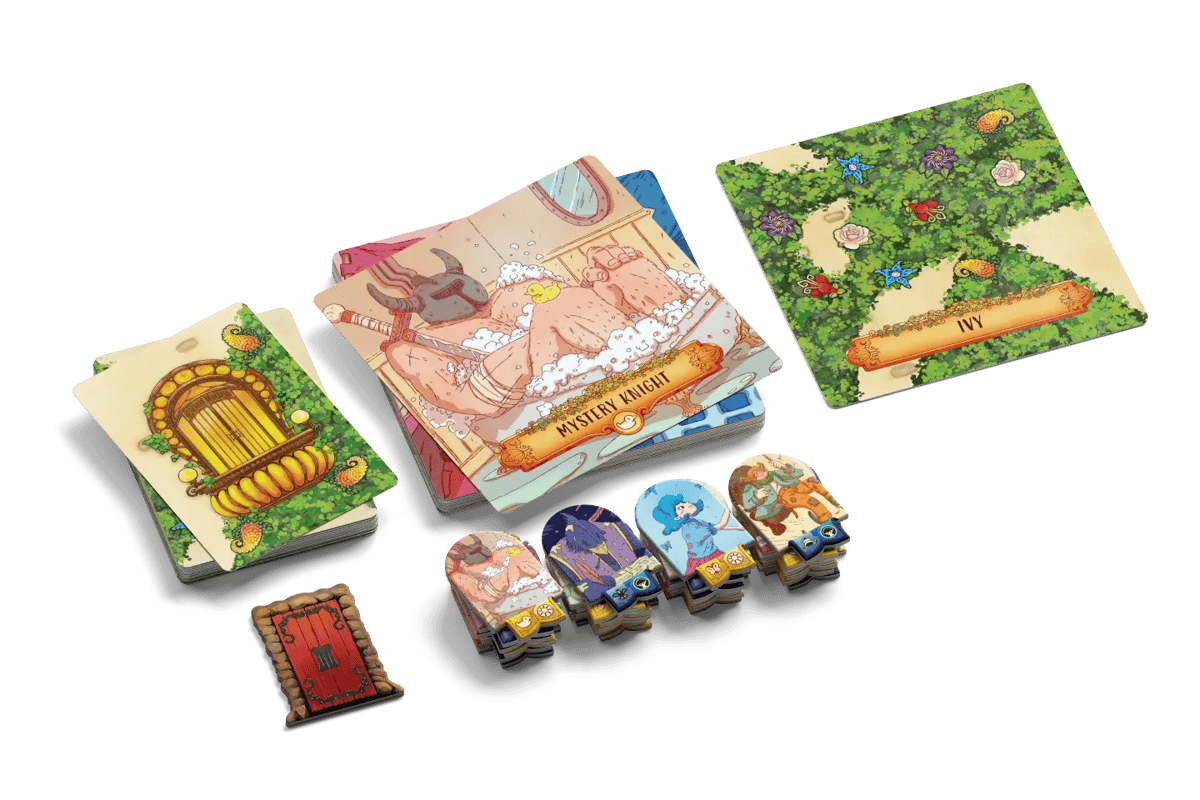
Packing a series of puzzles into its small box, Enchanted Ivy is easily one of the best pure solo games I’ve ever played. Coming from first-time designer Sarah Joshua, the game presents you with a seemingly simple challenge – build your tableau of ivy cards while placing guests on half of them in a way to maximize your scoring – that becomes increasingly difficult because of how well-designed those guests’ scoring methods are.

The gist of Enchanted Ivy is simple. Each ‘chapter’ presents you with a pattern of cards and a set of guests you’ll use in that game. On every turn, you’ll draw two cards, playing one with its door side and one with its ivy side (they’re called balconies and walls, but I don’t think those names are that intuitive), and will place one of the two guests in your hand on the door you just played. You’ll then draw a new guest from the bag and begin the next turn. You also begin the game with one bonus door that you can place on an ivy card at any point for 3 extra points, although it may end up costing you points on a nearby guest card. At game end, you must have played your cards in the pattern shown, and then you will score every guest according to their wishes.

That’s the whole game, although there are additional doors you can earn as you move through the campaign to get some extra powers. (I have only obtained the first one so far, and it’s quite useful). You can learn this game inside of five minutes, but playing it well enough to reach either the minimum victory score or the higher score for mastering the level is quite difficult, as the guests nearly all work against each other, and they tend not to appear from the bag when you need them, but whenever they feel like it. Jerks.

Each chapter also offers two additional bonus conditions that make winning it more difficult, but allow you to place stickers on a cardstock page of shelves; when you complete a shelf, which requires at least three stickers, you gain the associated bonus door. You don’t have to do those, but I wouldn’t want to pass up the additional abilities you get from those, and those stretch goals – see what I did there? – give chapters more replay value.

Enchanted Ivy’s design is extremely tight, in the best possible way. You have only a few options on each turn: which card to play ivy-side up, which of the two guests in your hand to use, and where to place the two cards within the pattern that chapter dictates. Once a card is placed, it’s there for the game, so you may get locked into a decision early in the game that costs you points – maybe a lot of points – later in the game. Some chapters have more ornate patterns, such as including gaps between cards, which make some guests happier and others quite irked. (Many of the guests are Garbo-esque, as they want to be let alone.) The first two chapters include scarecrows, inert guests who can help others score but are worth zero points on their own.

Because there’s so much randomness involved in the card and guest draws, you can play a chapter multiple times, to boost your score or just see how it goes with different sequences. The base game comes with eleven chapters, including the teaching game in the prologue, while there’s an expansion (which I haven’t played) already with three more chapters and some new guests. It’s going to take me plenty of plays to exhaust what’s here in the base game. My only quibble is that it’s a bit of a table hog for a solo game, at least if you want to have the guests’ scoring cards – which are beautifully rendered, but large – out on display while you build your tableau. Among purely solitaire games I’ve tried, Enchanted Ivy has only one rival for the top spot, Coffee Roaster, which has a better theme for me, while Enchanted Ivy is a more elegant design. So where’s the Wrigley Field tie-in? Enchanted Ivy is an A- game, and I’m not really sure if I could ever actually give a solitaire game a pure A anyway.

Stick to baseball, 8/22/26.

My only piece at Athletic this week was a contribution to this news story on Kade Anderon’s imminent promotion, although I did get to some games and will be back to writing scouting notebooks next week when I get to at least one more.

I appeared on NBC News to talk about Tommy John’s legacy, and on Bleed Dodger Blue to talk about the Dodgers’ farm system and recent trade for Tarik Skubal.

You should sign up for my free email newsletter. For socials, I’m still mostly on Bluesky, Instagram, and TikTok.

And now, the links…

  • The New Yorker looks at the legacy of Nobel Prize winner Carleton Gadjusek, who won the award in Physiology or Medicine for his work on the brain-wasting prion disease kuru, but also used his research trips to find young boys to bring back to the U.S. so he could molest them.
  • ICE agents also detained the Padres’ minor-league catching coordinator, claiming he had remained in the country illegally after his work visa expired. I’ll be very curious to see how MLB responds to this, given their obeisance to this Administration and its ideas on many other fronts.
  • 404 Media dropped a tracker in shipment of rare books to see which AI company bought it. The answer was Amazon, which then destroyed the books after scanning them.
  • Some board game kickstarters of note: Whisperwood is a sprawling bag-building game that can take up to 3.5 hours, to be published by Cardboard Alchemy (Flamecraft).