Wingspan Pocket is the fourth standalone Wingspan game, following the original, Wyrmspan, and Finspan, each bringing its own level of difficulty and rules tweaks. The Pocket version is the simplest, smallest, and cheapest of the line, as you might expect, and serves as a great introduction to the core concepts of the Wingspan games, especially for teaching people who want to know about “the bird game” but haven’t played any modern board games. (It’s available now for $16 on Miniature Market.)
In Wingspan, players play bird cards to three habitats, represented by rows on their player boards, spending food tokens in five varieties and eggs to do so. On other turns, they invoke the bird cards in one habitat, moving right to left and using the powers printed on some or all of those cards; or spend a turn drawing new bird cards. The game lasts four rounds, with each player getting 26 turns, and by the end of the game most players will have at least ten bird cards on their boards.
The Pocket version streamlines this game in several ways. You’re creating just one line of bird cards, and the game ends when any player plays their sixth. There are different food types, but they aren’t represented by separate tokens; the backs of bird cards show one or two food types, and if you take a ‘draw cards’ action, you take two cards – two birds, two food cards, or one of each, after which you can’t flip them to the other side (so food stays food and birds stay birds). There are only two public objectives in the Pocket game, rather than four, and no private ones.
Other than the size of the game, the biggest difference here is that you activate all of your bird cards on every turn. You can draw cards, or play a card, or lay 3 eggs total on your birds, and whichever you choose, you then run through the powers (printed in brown) on your bird cards, left to right. Drawing cards I described above; playing bird cards requires discarding the correct food cards from your hand, and possibly an egg as well. Placing eggs is straightforward, with one difference from the original: you must place the three eggs on three different birds.
Those ‘brown’ powers will be familiar to players of the original Wingspan. You may get to lay an egg, or ‘tuck’ a card from your hand beneath a bird you’ve played; each of those is worth 1 point at game end. You may also get to draw any card, a bird, a specific food type, or any food card of your choice. Some powers you’ll activate also give some benefit to other players. A majority of bird cards have these brown powers you activate on each turn, while some others have ongoing powers, printed in green, that are always active, such as giving you a permanent discount for birds that require a particular food type, or let you treat one particular food type as wild.
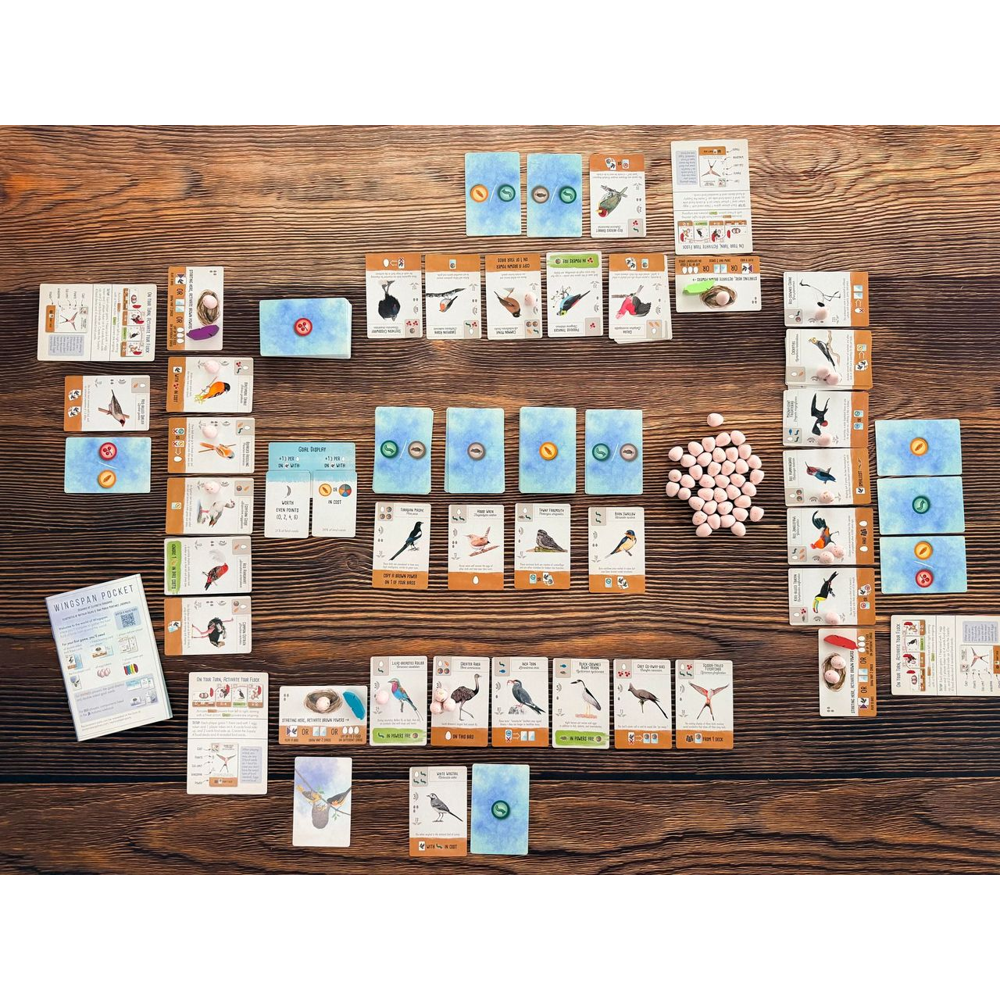
The objective cards give you one point per egg on a matching bird, so you’re looking for birds that meet a card’s criterion and that can hold more eggs. You also have space for up to three eggs on your starter nest card, and many birds require an egg to play them along with their food costs. The position in your row doesn’t matter for the bird’s cost; it only affects when it’s activated.
The end-game scoring is simple. You add up the points shown on each of your played bird cards, take 1 point for every egg and tucked card in your row, and then take 1 point for every egg you have on birds that match the two public objectives.
Wingspan Pocket plays 1-5 players; the solo mode is extremely easy to use, as is true for pretty much all Stonemaier titles. If you like Wingspan, or even Finspan, I don’t think you need Wingspan Pocket, unless you want a simpler version of these games to play with kids or to teach friends who are boardgame-curious. It distills Wingspan into a smaller box and much shorter play time – about a half an hour – and can give new/younger players a sense of the mechanics so that they might be able to play one of the full-length games, and might be more interested in playing them, since I have had plenty of adults and kids say they’ve seen Wingspan but found it intimidating. I wouldn’t choose to play this over any of the Fullspans, though, because I find the simpler game less satisfying now that I know what the whole experience is like. I’m giving it an A- because it is Wingspan, simplified, even though it’s probably not going to see a lot of table time in my house.
No comments yet. Be the first.
Leave a comment
Speak Your Mind