Ichor is the latest iteration of a Reiner Knizia game that dates back to 1993 and has been published under the names Tiku, when it was just an abstract game of moving pieces; and Battle for Olympus, which introduced some of the unique powers that you find in Ichor. This game, produced by Bitewing as part of their series of medium-box games that are heavier on the strategy, refines the powers from the preceding versions, while adding another board and several new characters you can use so that you can play the game differently every time. (You can buy Ichor at Amazon or Noble Knight.)
Ichor has two possible boards, a 6×6 board and a 7×7 one; the game is the same on either board, but the larger board gives each player another character and more stones. The goal of the game is to be the first player to place their last stone, or to put your opponent in a position where they lack any legal moves. You begin the game with your characters on the second row in from you – as in, the back row is empty – in random order.
On your turn, you take any of your characters and move it as far in any orthogonal direction as you wish, stopping if you run into any other character (yours or your opponent’s). You then place one of your stones on every place your character passed through, including the starting space. If any of those spaces contained an opponent’s token, they take it back and you replace it with one of your own.
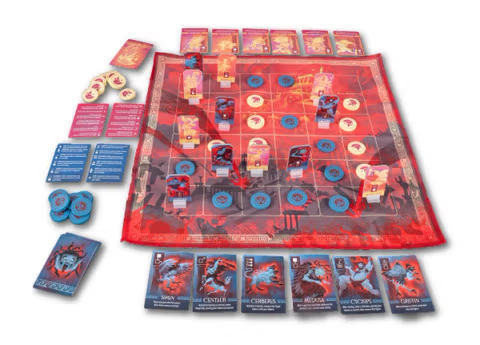
Instead of taking a regular move, however, you may use any character’s one-time power. Those range from breaking the movement rules, like allowing diagonal movement or pushing another character or jumping, to more substantial changes that might end with one or more characters removed from the game. Thus the real strategic heart of Ichor is deciding when and how to use those powers to maximum advantage.
The base game comes with 8 characters for each side, one gods and one monsters, all drawn from Greek mythology. (I didn’t find the theme to be that connected to the game play or the specific powers of most of the characters, but it’s a Knizia game, so it’s not like I expected otherwise.) There’s an expansion that comes with some versions of the game – my review copy didn’t have it – that adds four characters for each side, along with Gates that you place on the board and that are activated when a character passes horizontally through it. Even with just 8 characters per side, you have 28 possible rosters for each player on the smaller board, and they can be in any order, so you can see how every single game will probably be unique.
Ichor is solid enough, but a bit fiddly with six (or seven) character powers to grapple with. It’s very chess-adjacent; chess pieces have their own powers as well, of course, but they’re permanent, and while they’re not exactly intuitive (stares in knight), they are mostly easy enough to remember, and have the benefit of hundreds of years of precedence. With Ichor, there will be a lot of looking at the reference card for your side to remember what’s at your disposal. I do love the idea of each character having that single use, so that activating it feels momentous, and you will often wonder if you should have waited for another opportunity.
I reviewed Iliad, a new two-player game from Knizia that was also published by Bitewing, in January for AV Club, and it’s the superior game across the board – pun intended. It’s tighter, mostly symmetrical, and evokes some of Knizia’s best, including Samurai, while Ichor seems more like a good idea at the core that has some bells and whistles added to make the game more interesting. I would play Ichor if you asked, but I’m asking you to play Iliad (Amazon, Noble Knight) over this one.