I did not know that a group of penguins is called a waddle until I encountered the small-box board game Waddle, published by Allplay, last year at Gen Con. It’s one of the best games Allplay has produced, playing 2 to 5 but best with at least 3, and is great value at $19. (It’s $24 on amazon for some reason, but $19 direct from Allplay, or $26 for the base game and the three-in-one expansions.)
In Waddle, you’ll place your penguins on the white ice hexes on the modular board adjacent to the blue water hexes, which form fishing ponds of varying sizes. You only score points in two ways in Waddle, which is something of a relief: you score for every waddle of penguins you create, and you score for having the most or sometimes second- or third-most penguins around a pond with at least one fish (scoring icon) on it. So there’s some pattern-building and some classic area control, with very quick turns.
On your turn you either can place one of your penguin tokens, most of which show one penguin but two of which show a pair of penguins, or ‘scout ahead,’ passing your turn to move up in the turn order for the next pond. Once you’ve build the modular board, you find the pond with the white number 1 on it, and players begin placing penguins on open white hexes around it, going in turn order. Play moves to the pond with next number once all hexes around the current one are filled with penguins.
If you would rather jump ahead in turn order for the next pond, you can scout ahead, taking your marble off the current turn order track and moving it to the next track, either at the bottom or behind any players who’ve already scouted ahead. If you are the last player with a marble on the current track, however, you must place penguins on all open white hexes around the current pond before play can continue. (Single penguin tokens are considered unlimited, so you can’t run out.)
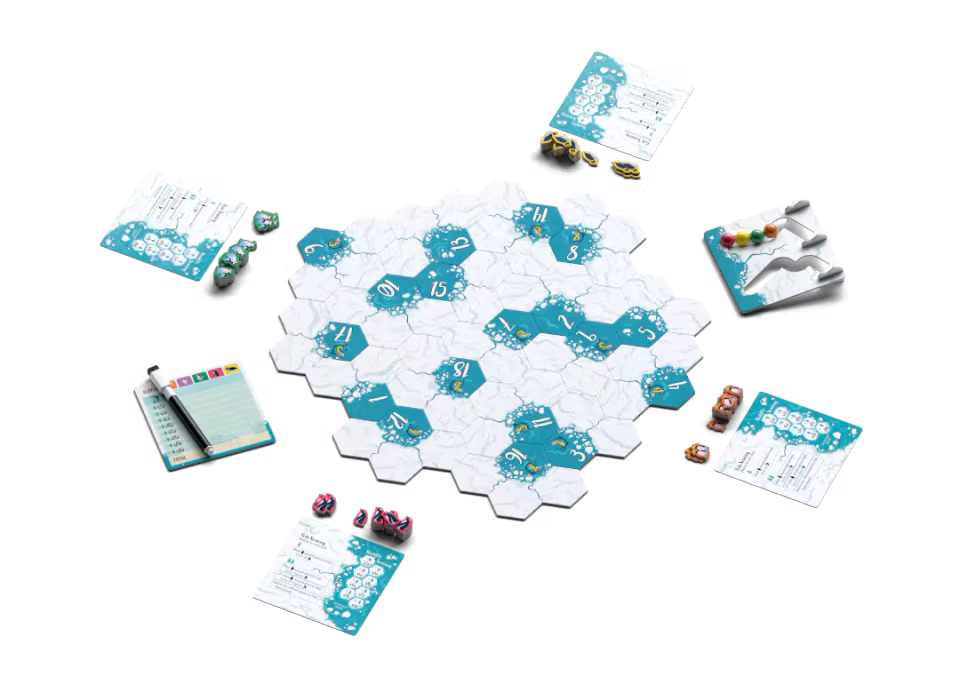
There are twenty pond tiles with numbers on them, and play progresses through them in ascending order, although you may skip some because there are no open hexes adjacent to them by the time you get there. Once you’ve finished pond 20, all white spaces should have penguins on them, and you begin the scoring. Your waddle is worth anywhere from 1 point for a single penguin all by its lonesome to 36 points for a waddle of 8 or more penguins; there’s a table on each player aid card, but for the math-inclined among you, the number of points for a waddle of size N is the sum of all integers from 1 through N. Double penguin tokens count as 2 penguins for both scoring methods.
Then you check each pond with yellow points icons and look at all white hexes surrounding the entire pond. The player with the most penguins around it gets the number of points shown on the highest icon in the pond. If there are multiple fish/scoring icons, then the player with the second-most penguins gets the second-highest points total, and so on, until you’ve either scored all of the fish or each player has scored once. All ties are ‘friendly,’ so ties players get the full amount shown.
There are a couple of rules tweaks for playing with two players, but that player count kind of obviates the scout-ahead mechanic, and I don’t think Waddle is nearly as good without at least three. It sings at four or five, though, as there’s a ton of competition and you can often find a move that helps you and blocks someone else, and with turns this quick you can play with five and never get bored. Allplay promises a one-minute teach and that’s about right – I think I described every single rule in this review, and you don’t need all of those details to get started.
I’ve played nine of the games in Allplay’s Small Box Big Game series, with one more on my Shelf of Shame (9 Lives), and I’d put this near the top. It might be second, behind Sail; I think Sequoia is a real sleeper, but I’m one of its bigger fans, I think. I would even put Waddle over Mountain Goats, which is good but I think has a limited ceiling. It’s a keeper for me, and the best game Allplay put out in 2025.