Johannes Goupy is one of the best and most prolific new game designers to pop up in the last few years, making a name for himself with a number of small-box/big-thinking games like his hit game Faraway (which just got its third expansion), Rauha, and the lighter Pixies, as well as the heavy game From the Moon, the last of which is on my shelf of shame at the moment. Space Lab is in that former category, with a decent amount of tension and strategy in a smaller box, although it is definitely more luck-driven than Faraway and might frustrate players looking for something that gives you more control over card draws.
In Space Lab, players will draw and draft cards to fill out the ten spaces in their personal tableaux, working around three space stations that each have unique scoring objectives, similar to Forest Shuffle’s tableau format but much simpler with only one card going into each slot. At the end of the game, you score for the cards you played, the objectives you completed, and project cards you picked up, mostly through the cards you played above your space stations (three spots).
On your turn, you can draw three cards from the deck, keeping all cards of any single color and placing the rest in the ‘recruitment center.’ You can also take all cards of one color from that recruitment center area. As long as you start your turn with fewer than five cards in your hand, those two actions are available. You can also play any card from your hand, paying its cost (in the upper left corner, from 0 to 3) by discarding that many cards from your hand. Those cards go to the discard pile, not the recruitment center, so they’re out of play until the deck is exhausted and you have to reshuffle.
There are four colors in the game, representing different space agencies, and four roles on the player cards, both of which matter for scoring. Objective cards in your three space stations show three colors, anything from three different ones to three identical, and you score those if you place those colors in the four spots around the station. (You have ten card slots because there are two shared ones, between the left and middle stations and middle and right ones.) The roles matter mostly for end-game scoring, although there are some in-game options on objective cards where you gain something if you play that symbol below the station you gain a project or regular card. Finishing an objective card allows you to take the top point token from the stack for that location, with the points declining and the top left and right tokens giving you a one-time bonus as well.
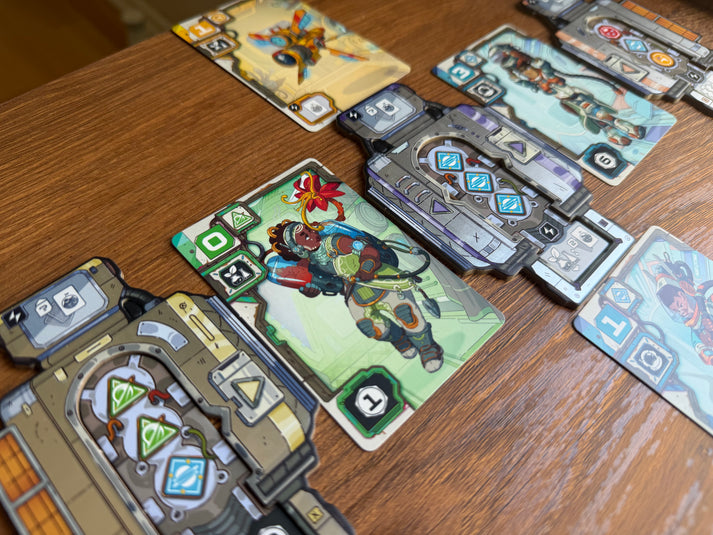
The project cards are a bit of a lottery ticket, and from what I see on BGG, they’re the part of the game that engenders the most disagreement. When you play a card to one of the three slots above your three stations, you draw project cards equal to the number/cost of the card you played. You then keep just one of the project cards, all of which score more if you collect more of the set. Thus, playing expensive cards to those slots in your tableau means cycling through more of the project deck and increasing your odds of getting the card(s) you need. It is random, mostly, but you have some say in the matter here, enough that, for a medium-light game, I’m good with the balance.
The game progresses until one player fills all ten spots in their tableau or fulfills all three objective cards, at which point, you score. Many cards have variable scoring based on what’s in your entire tableau (e.g., 1-3 points per astronaut card) or just that card’s row, while others have fixed point values from 1-7. There’s a scoring pad here, but it’s not very difficult to score in your head.
I’m definitely higher than the consensus on Space Lab, which is about to get its first U.S. release from Pandasaurus (who sent me a review copy). It’s a fun filler that has a tiny bit of player interaction through the shared card space of the recruitment center, but where mostly you’re trying to cycle through the decks to get stuff you need. I wouldn’t put it over Faraway, but I’d probably take it over Rauha, just among Goupy’s games I’ve played. The solo mode is pretty tight as well, because it keeps all of the game’s rules but ends when the deck is exhausted and has a single automatic step that discards quite a few cards on each turn. It’s a B+ for me, and you can pre-order it from Pandasaurus now.
No comments yet. Be the first.
Leave a comment
Speak Your Mind