Archives for September 2026

My tomato sauce recipe (for now).

I grew up Italian-American, eating some variety of pasta tomato sauce multiple times a week, plus some homemade pizza (with dough purchased from the same place for 25-30 years), but I didn’t grow up with a family tomato sauce recipe, and even into adulthood, when I made it from scratch, I’d almost always use canned tomatoes – which, out of season, are the better option anyway. (For years, when I would only need a small amount of sauce for pizza, I’d buy a jar of good sauce that had zero added sugar; Trader Joes has one that’s excellent for that.)

The last few years, however, we’ve grown so many tomatoes that we can’t eat them fast enough, and I’ve started getting into making sauce from fresh tomatoes. It’s not difficult, although the two things you need are time and a food mill, and I fully understand that some people have neither. It is amazing how different the finished product can be when you start with fresh tomatoes – and, contrary to what every cookbook and almost everything on the internet has told me, you can make a good sauce from any tomatoes you grow.

So here’s my current iteration of sauce from fresh tomatoes, as simple as I can make it, with six ingredients, one optional. It’ll keep a week-plus in the fridge and freezes for much longer, although I always use it up within a few days. You do need a food mill to get the skins off fresh tomatoes; you can follow the same ratio with canned tomatoes, but can hand-crush them if you’re willing to live with a few extra seeds, and I would probably simmer it for a shorter time because they’ve already been ‘cooked’ once in the canning process.

Tomato sauce from fresh tomatoes

2-3 pounds fresh, ripe tomatoes (the smaller the tomatoes, the more total weight you want)

1 onion, diced

1-2 Tbsp olive oil

Salt

¼ cup vodka (optional)

1-3 tsp minced thyme, to taste

1. Put all tomatoes in a saucepan or skillet with a cover over medium heat. Cook about ten minutes, covered, shaking the pan often to prevent sticking or scorching, until the tomatoes have started to burst their skins.

2. Pour everything – tomatoes, skins, juices, whatever – into a food mill set over a bowl large enough to hold at least 3 cups of liquid. Mill everything until no more pulp comes through the disc. (I have two discs for my food mill and I use the one with smaller holes for this.) Set the bowl aside and toss or compost the skins and seeds left in the food mill.

3. In the same pan, add the olive oil and sweat the diced onion with a pinch of salt over low heat until translucent, 7-10 minutes. You don’t want any browning here.

4. Add the milled tomatoes, the thyme, and the vodka (if using) and simmer 30 minutes to 1 hour over medium-low, stirring often, until the sauce is visibly thickened. The ultimate consistency is up to you, but there’s a lot of water to evaporate here. You can also skip the mincing and throw thyme sprigs in the sauce for the whole simmering stage, then discard them, if you don’t have time or prefer not to have the leaves in the sauce.

5. Season to taste with more salt, and black pepper if desired.

That’s all I use – no garlic, no basil (I love it, but it can overpower the tomatoes here), no cheese, and absolutely no sugar. I know sugar is a contentious topic in tomato sauces, and maybe if you’re using out-of-season tomatoes that have less sugar in them, you might want to add it … but I hate what sucrose does to the flavor and texture of tomato sauce. It’s cloying, and I think that because it’s hygroscopic it tightens up the sauce’s consistency. I want my tomato sauce to taste like tomatoes.

That’s just my palate, though. This is a template for a tomato sauce. You can add garlic if you want. Or crushed red pepper. (Add enough, or maybe use fresh chilies, and you’ll get an arrabbiata sauce. But you’ll need a tray.) Start with 4 ounces of diced guanciale or pancetta, drain the fat, set the meat aside, then add ¼ heavy cream at the end before adding back the meat, substituting basil for thyme, and you have pasta alla vodka. Skip the cream and alcohol, use guanciale/pancetta, add a lot of black pepper to serve, and you have pasta all’amatriciana. You can swap in white wine for the vodka; it’ll be sweeter and a little tangier, but the alcohol will still boost the flavor by liberating some alcohol-soluble compounds in the tomatoes.

I also use whatever shows up in the garden, which is always a mixture of red and yellow tomatoes, varying from grape and pear tomatoes up to round ones the size of a racquetball. Yellow tomatoes are less acidic than red, so I wouldn’t go more than half yellow because I’d worry the sauce would be too bland and might spoil faster. Yellows are also sweeter than red tomatoes, which further reduces the need for adding any sugar. You can make a pretty great uncooked sauce from yellow tomatoes, come to think of it, although I haven’t done that in ages.

Anyway, I hope that’s helpful to someone. If you’ve got your own method – or something passed down from your ancestors – I’d love to hear it.
The Everlasting.

Mousy academic and erstwhile war hero Owen Mallory uncovers a mythical manuscript about the folk hero Una the Everlasting, only to learn that the book is actually a time machine – and that he needs to go back in history to make sure that the real Una does what she’s supposed to do according to the myth. The two fall in love, however, which makes completing her legend a bit complicated, since it ends in her death. And so Owen goes back in time again, and again, egged on by the War Minister of his country, Dominion, to try to set the story straight, until he eventually discovers that someone else is writing their story, too.

Alix Harrow’s The Everlasting won the Hugo Award for Best Novel this year, quite handily according to the voting, and the Locus Award for Best Fantasy Novel, while acquiring what appears to be a dedicated fan base online for its sweeping romance, a love story that literally knows no bounds of time. The time-travel bits don’t add up here; you have to suspend your disbelief early and go with the flow, pun intended. That’s not a serious flaw when the time-travel aspect comes in service of a larger goal, and in The Everlasting, a story about power and loyalty and courage, that goal is evident. Where the story falls short, however, is in its two characters, and the weak chemistry between them that undermines much of the love story.

Una comes from the archetypal wild-child woman warrior, wielding a magical sword that apparently can’t be broken or destroyed, often living by her wits and her hunting prowess, feared by many of the peasants of her time but revered in hindsight by the Dominion of the present day. Dominion has just recently fought a bruising war that resembles our World War I in some ways, and Owen, still a coward, turned out to be a crack shot, dispatching enemy soldiers until he was nearly decapitated in a battle that became a massacre. He’s returned from that war dead-set on becoming a historian with a particular interest in Una’s legend, so finding and translating an original manuscript of her story, or any of the artifacts associated with her, would make his academic career. When the book arrives, of course he dives in, and he remains devoted to the task until he notices several details that make him question the nature of everything, from the righteousness of his cause to his own free will. Yet he’s much more of a Nick Jenkins here, observing, noticing, more involved in the action than Jenkins typically was but still on the outside of most of it, and as such ends up a blander character whose primary attribute is the cowardice that he tells us about – but seldom shows in these pages.

The world that Harrow has created may be the book’s real strength, as it’s recognizable and, other than the time travel, plausible, while allowing her to play around with setting and style. There are subtle shifts in the prose and tone between the more medieval settings of Una’s ‘true’ time and the contemporary vignettes of Owen’s childhood, the war, and the aftermath, along with an unsubtle warning about fascism and people who’ll destroy everything, even time itself, to gain power. (I’d also note that the identity of the villain here is as obvious as a sledgehammer to the forehead.)

The Everlasting is also an exploration of the gap between myth and reality, and the way that history, especially oral history, can change over time while also changing those who follow and hear it. Una’s legend turns out to be very far from the truth, and Owen, who grew up hearing some of the folk tales and believes he may have met Una under a yew tree when he was a child, has to grapple with the difference between the Una of the page and the one he’s traveling with, and whose mission he must protect to save Dominion. As he changes the story, however, the future changes as well, not quite in an A Sound of Thunder way, but enough to lay out an argument that past and future are intertwined in ways beyond the merely physical.

I read The Everlasting expecting to be sucked into the characters and their romance, but for the most part, I didn’t buy it. (There is one very well-written sex scene, however, especially shocking for a genre that produces some of the cringiest sex scenes put to paper.) I found the political and historical narrative much more compelling, which is enough for me to recommend the book, but also left me knowing I didn’t get what many readers seem to have gotten, and feeling like maybe I just missed something. Instead there’s some padding here and there on the duo’s repeated quests that was probably part of how Harrow tried to build their chemistry, and without that foundation, those parts dragged.

I’ve only read three of the six Hugo nominees this year, but I’d put this behind The Incandescent and ahead of Death of the Author. A Drop of Corruption is on my to-read shelf right now.

Next up: Tattoo by Manuel Vázquez Montalbán.

Stick to baseball, 9/12/26.

One post this week on The Athletic, a scouting notebook on Gage Wood, Zyhir Hope, and a couple of other Phillies & Tigers prospects. I feel like the minor-league schedule has been personally screwing me over the last month or so; I’ve been home and around to go to games, but the matchups have been lousy.

You can sign up for my free email newsletter. For socials, I’m still mostly on Bluesky, Instagram, and TikTok.

And now, the links…

  • I moved to New York to pay more in taxes – and I’m glad I did.” I resonated with this, having moved to Delaware in part for the lower taxes, only to learn that the outcome is worse public schools. Our taxes here should be higher, and people in many low-tax states don’t realize how much they’re losing in public services.
  • Kickstarter szn again: Tycoon Games has one up for Everdell Journeys, the latest game in the Everdell universe, with a card-drafting adventure rather than the forest city tableau- and engine-builder of the original.
  • Inside Up Games has a Kickstarter up for The Adventure Store, a deckbuilding trick-taking game built around the theme of buying equipment for your adventuring party.
  • The Kickstarter for the Clank! Big Box is already well over $1 million.
  • The annual Summit Awards honor games that represent historical themes through board gaming. This year’s winners include games about the 1968 protests in Chicago, one of the last Japanese soldiers to surrender after WWII, and queer life in early 1700s London.
  • Charlotte board game people – there’s a new FLGS (friendly local game store) opening in Camp North End called Good Game on September 19th. I’ll have to wait till spring to check it out, but I hope some of you can visit now and report back.

Death of the Author.

Metafiction can be a powerful tool in the hands of the right author; At Swim-Two-Birds is one of my favorite novels of all time, using the technique to explore the relationship between an author and their creation, and to ask broader questions of free will and the meaning of life. More frequently, at least in my experience as a reader, it’s a gimmick that interrupts the narrative and results in one good story and one mediocre one, as in The Blind Assassin, which creates a work that ends up less satisfying than it would have been had the author just focused on a single work.

(I’m using the term “metafiction” here to refer to a fictional story within a novel, which is the definition I learned in college while we studied Italo Calvino’s If on a winter’s night a traveler, one of the best examples of the genre I’ve ever read. Wikipedia defines it differently.)

Nnedi Okorafor’s Death of the Author, which made the shortlist for this year’s Nebula and Hugo Awards for Best Novel, is more than just one novel; it’s trying to be at least two, the story of a disabled Black woman named Zelu who writes a best-selling sci-fi novel, and the novel itself, called Rusted Robots, with interviews interspersed throughout the book. The result is more like one and a half novels, each of them feeling about three-quarters full.

Zelu is Nigerian-American, raised in Chicago, one of six children to a couple of Igbo and Yoruba origins. When she was 11, she fell out of a tree while playing with friends, an accident that left her a paraplegic and made her the subject of pity and infantilization from her parents and siblings and of scorn and fear from relatives in Africa. She’s tried for years to write serious literature, barely making ends meet by working as an adjunct professor, but as the novel opens, she’s fired from that job and gets her umpteenth rejection letter from a publisher, forcing her to move back in with her parents. At this personal nadir, she begins writing a science-fiction novel about a post-human world populated by two types of artificial life, robots in human-shaped shells called Humes and bodiless AI programs called NoBodies. The novel is an immediate success, sparking a bidding war before it’s published and making Zelu rich.

The sudden media attention brings her into the sights of a scientist who has developed a form of intelligent prosthetic limbs called exos; Zelu decides to take the leap, regaining some mobility and independence while making herself world-famous as “that robot author.” Her family, however, doesn’t understand her writing, despises her choice to use the exos as a violation of God’s will, and wishes she’d stop smoking so much weed. As the novel keeps building, along with a film adaptation and expectations of sequels, Zelu struggles to adjust to the rapid shift from anonymity to celebrity, and grapples with an existential crisis of her own – much as the protagonist of her novel, the Hume named Ankara, has to do in the escalating conflicts of its post-apocalyptic world.

Rusted Robots is not a very good or convincing novel, and that undermines huge parts of the rest of Death of the Author. It’s written in a different voice from Okorafor’s usual writing, and the result sounds like a stilted attempt at YA literature. There’s some character development, and there’s a plot-shaped object there, but because it’s maybe the length of a short novella and written in a simpler style, it feels like she’s showing us the veneer of a novel rather than an actual one.

The constant interruptions to veer into Rusted Robots or those interview segments also end up detracting from Zelu’s story, which is the most interesting and the most fleshed-out by far. She’s a fascinating character, at least in part an author surrogate, evolving in some ways as her life changes rapidly, while still maintaining the fatalism that forms her main line of defense against her family and the world in general. Her choices can be irrational, which makes her maddening but also recognizable as a three-dimensional character who feels human. She deserves a better partner than Msizi, the South African entrepreneur whose AI-powered personal assistant app ends up a secondary distraction throughout the book.

Then there’s the ending, which is clever, maybe extremely clever, but also rather unsatisfying. Okorafor throws several matters into question with the resolution of both of the main plot points, and I’m not sure it’s internally consistent with what came before. I’ve seen this novel described as a Möbius strip; that doesn’t fit the structure, as it’s not Finnegan’s Wake, but the conclusion at least should force readers to re-evaluate some of what’s come before.

Death of the Author is very much a novel of ideas, which does mitigate some of the plot deficiencies. The main story sits on a foundation of Zelu’s identity as a disabled Black woman born to immigrant parents, with a large extended family in Nigeria, and as someone who perceives herself as an intellectual but ends up finding success writing a genre piece wildly different from her previous work. Zelu lives much of her life feeling like whatever she does is going to go wrong, which at least in some part is a function of the number of people expecting something of her, and the number of different faces she has to present to the world. (Okorafor hints at a religious divide, where Zelu is secular but retains some of the trappings of belief, such as thinking the universe is ready to smack her down if she gets too high.) Yet her ability to interrogate these influences on her life is limited. Her decisions are often impetuous, even if they’re right, and she doesn’t seem to have the introspection required to understand what’s pushing her in any direction.

The role of technology in society and individual lives, including AI, pervades both the novel proper and Rusted Root, while that inner novella’s story hinges on the power of storytelling and whether that is unique to humanity. Okorafor seems to be an AI believer, or at least a proponent, as there’s no hint in the novel of anything going awry from the technology, and its presence in the story is only positive. Zelu’s meteoric rise is possible because of technological progress, including her exos, and it opens up further opportunities for her later in the novel, one of which comes about in part due to the absence of real privacy caused by tech firms gathering endless information on us. Even I found myself skeptical of some of the pro-technology language in this book, as someone whose career also arose due to the changes in our world that technological progress has brought about.

Death of the Author is a lot of book, and offers plenty to discuss and debate, more than even the typical Hugo winner would. It’s an ambitious book, and a profound one. It’s also not entirely successful as a work of fiction, thanks to the shared narrative that results in neither Zelu nor her robots getting their due in the end. It’s a better work of literature than The Incandescent, also nominated for those same two awards, but nowhere near as enjoyable a read.

(Aside: I have read Okorafor’s Who Fears Death, about a year ago, and loved it.)

Next up: Colson Whitehead’s Crook Manifesto, the second book in his Harlem trilogy.

Stick to baseball, 9/5/26.

Over on the Athletic this week, I looked at nine September(ish) callups of note; posted a minor-league scouting notebook on Jarlin Susana, Joseph Dzierwa, and other O’s and Nats prospects; and posted a draft scouting notebook covering both the PG All-American and Under Armour games.

I sent out a new issue of my free email newsletter this week. For socials, I’m still mostly on Bluesky, Instagram, and TikTok, and posted a new video to the latter two sites this week about the top three prospects recalled in the last week.

And now, the links…

  • ICE gave a 20-year-old Haitian immigrant and Wright State student, here legally, an ankle monitor. He killed himself a few days later. I’m unclear whose interests were served here.
  • Dan Ariely, the best-selling author of Predictably Irrational and the inspiration for the network procedural Irrational, is facing a new round of allegations of research fraud after a review of the data used for a major 2002 paper on procrastination found evidence of fabrication.
  • The police chief in Senatobia, Mississippi, where an officer shot and killed a 1-year-old while pursuing a woman suspected of shoplifting, has been fired. Harold Vanderford had also used racist slurs about Black people in text messages, and tried to resign before he was fired. Maybe Arizona State will hire him?
  • The widow of a U.S. airman killed in Trump’s illegal war on Iran had to go to social media to get death benefits because, in her words, the military claimed it wasn’t a war, so she wasn’t entitled to the benefits that accrue to the surviving spouse when a soldier is killed during a war.  

Music update, August 2026.

August was a monstrous month for new music in a great way, so much so that I posted a list of album grades on Bluesky covering LPs that came out in July or the first three weeks of August, which was before we got new records from Mastodon, Russian Circles, Elephant Stone, Billy Strings, flowerovlove, Interpol, and Alabama Shakes on the month’s final Friday. Anyway, as always, if you can’t see the widget below, you can access the playlist on Apple Music or Spotify.

The Afghan Whigs – House of I. The Whigs sound as good as ever, with their latest album, Soft Control, maybe their best yet, at least rivaling 2017’s In Spades, and up there with Gentlemen from the band’s first incarnation. This song and “Loose Talk” were two of the best new songs I heard all month; I picked this one because of the guitar riff that opens it.

Kiwi jr. – Pure Michigan. The answer to the eternal question: What if Vampire Weekend made a song that wasn’t twee as fuck? Anyway, this Canadian band’s latest album, Blowing Up, came out on August 14th, featuring their usual blend of jangle-pop sounds and sardonic lyrics.

Do Nothing – Act Natural. This song reminds me so much of peak Wild Beasts, whose farewell album Boy King remains one of my favorites of this century, that I have come back to it repeatedly since first hearing it a few weeks ago. Do Nothing’s sound is a similar blend of art rock and post-punk, but here with big, almost bombastic vocals. Their second album, Friend World, comes out on November 6th; they previously released another single, “Stars,” that’s a little blander and less catchy.

Squirrel Flower – Cleveland. Squirrel Flower is Ella O’Connor Williams, a multi-instrumentalist from Boston by way of Grinnell who has released five albums, with the latest, Say a Prayer to the Gods of Getting Going, among my favorites of the year so far. She blends indie folk with shoegaze elements, but the real star is her strong voice that communicates deep longing and sadness on much of the album.

she’s green – close your eyes. The final song on this Minneapolis shoegaze band’s debut album is seven minutes long, but it’s a stunner, calling to mind Slowdive and early Lush, with waves of sound washing over you beneath Zofia Smith’s atmospheric vocals.

Smidley – Love in Every Direction. Smidley is Conor Murphy, lead singer of the maybe-defunct band Foxing, who is set to release his second solo album Murphy Horse on the 25th. It’s different from most of Foxing’s work, especially their last album, and feels more like the kind of indie rock that was popular in the wake of the Killers’ massively successful debut album.

Keo – That’s Me. Based in London but with roots all over Europe, Keo will release its first album, Put A Smile On For Me, on the 25th, with this song sounding like the Gin Blossoms by way of the Amazons with a lyrical reference to R.E.M. in the chorus.

Sailor Honeymoon – Click Click. This South Korean all-girl punk band’s debut album The Worst of Sailor Honeymoon came out in August and shows plenty of promise, although it’s pretty short (27 minutes) and gets a little repetitive over 13 songs. This song, “I Wanna Leave You,” and “Bad Apple” are standouts.

Ceremony – Dark Summer. I did not like Ceremony’s latest album, Tell Me Your Dream, which has no real identity and features a lot of filler tracks. This is one of two tracks on the record I liked, along with “Other Hells,” but there’s nothing here to rival In the Spirit World Now.

DIIV – The Fountain. DIIV’s critical acclaim has always outpaced their music for me; this song, from their upcoming fifth album Zirp! (due October 30), might be my favorite song by this Brooklyn indie-rock band, blending genres while maintaining a consistently strong hook in the chorus.

Quicksand – Bring on the Psychics. The title track from this seminal post-hardcore band’s third post-reunion album is one of its strongest, and the record as a whole might be their best. It’s certainly their most cohesive, and stays true to their musical roots while tightening up some of the noise-rock elements more present in their first two records.

Elephant Stone – I Got a Pill. Elephant Stone’s latest album ASHA came out on August 28th; I’ve heard three songs, this power-pop track, the tremendous rocker “Everything Evil,” and “Fascists Killed Yer Rock ‘n’ Roll,” which made NPR’s best songs of the week list last week. I wasn’t familiar with the band before this year, but they’ve been around since 2009, and I’m a fan of what I’ve heard so far.

The Olivia Tremor Control – Garden of Light. OTC was part of the Elephant 6 collective in Athens, Georgia, that also spawned Apples in Stereo and Neutral Milk Hotel, releasing two albums of jangly power-pop before internal strife ended the band’s first run in 2000. Founding members Bill Doss and Will Hart recorded most of a third album before Doss died in 2012, and the band released two singles from the record in 2024 on the same day that Hart died at age 53. The band’s final album, The Same Place, comes out on October 23rd, including this song and the just-released “Advice from the Oceans.”

Billy Strings – Burn the Other End. Strings won the Grammy for Best Bluegrass album in February, and he’s already back with a new LP, So Much for Goodbyes, which came out in August. He also hopped on stage with the latest version of Canadian death metal band Cryptopsy at his own Ionia Freak Fair last week.

Wolf Alice – Hammond Song. How the hell is this a B-side from The Clearing? It would have been among the five best songs on the album, easily, maybe top three after “White Horses” and “Bloom Baby Bloom,” and it’s the best showcase of Ellie Rowsell’s voice of anything from those sessions.

beabadoobee – Memories. This is the third single ahead of Beatrice Laus’ fourth album, Pylon, due out on the 18th, which apparently is not a note-for-note cover of Killing Joke’s final LP.

flowerovlove – KISS KISS KISS. Joyce Cissé’s debut album MINI SKIRT WARRIOR dropped on August 28th, and it’s one of the best pure pop albums of the year. Her ear for a great melody is incredible, and the album is littered with songs that should be all over pop radio, including this one, “American Wedding,” “I’m Your First,” “girls will be girls” (featuring Willow), and “shady.” I hate the term “sophisti-pop” but it would certainly apply here.

Iben – Dead End. A Norwegian singer who just released her debut album Hulder, Iben blends folk music, atmospheric metal, and morbid lyrics for an intriguing combination that somehow also sounds … not poppy, but potentially mainstream. I can’t figure out if she’s the same Iben who released a pure pop song a few years ago called “Childish;” Spotify has them as separate artists but I wouldn’t swear those are different voices.

Heathers – Bite. Heathers is Heath Michael Thomas – there’s an Irish pop duo of the same name, but this ain’t them – who’s released three singles so far this year, with his debut album Awesome coming out on October 30th. It’s very lo-fi, DIY, garage rock; sometimes he sounds like he’s singing with his mouth pressed up against a screen door. There’s a real melodic sensibility here, though. Props to Jon Natchez from The War on Drugs for the rec.

Soft Science – Fade. More power-pop with some shoegaze elements, reminiscent of Velocity Girl and Belly, from this long-running Sacramento band whose fifth album, Sand, comes out this Friday.

Gang of Youths – Things Take Time. This one-off single is the Australian band’s first new music since 2022’s Angel in Realtime, which had a couple of stellar singles in “The Angel of 8th Ave.” and “In the Wake of Your Leave.” This feels like a lyrical throwaway, and singer/songwriter David Le’aupepe has said the song isn’t really about anything. The music’s fine, though.

Ezra Collective – Jubilee Feeling. This Mercury Prize-winning jazz quintet will release its fourth album, Here Because of Hope, on September 18th. This single is the first instrumental and third single they’ve released from the LP, after “Only Love” (feat. Pa Salieu) and “Well Organized” (feat. Lila Iké).

Jorja Smith – Dancing. I love Jorja Smith’s voice, but prefer when she leans more towards jazz or classic R&B sounds than EDM. Her latest album What Are the Odds bridges the gap between the two, with largely electronic beats but less frenetic tempos, allowing her voice to remain front and center, as on this Afrobeat-tinged dance track.

Jungle – Sunshine. The best song off Jungle’s disappointing new album is the title track, which has a good enough hook to stand out over the sea of sameness on the rest of the record. There’s no “Busy Earnin” or “Happy Man” to be found anywhere on the LP.

Rakim, Kurupt, Masta Killa, & Kokane – Goin Down. The first three MCs here have collaborated on The Godbody LP, which was supposed to be released on August 28th, and has now been pushed back to September 18th. This lead single is basically an average Rakim rhyme and some other dudes. By the way, there are a couple of new Rakim collaboration videos on Youtube that I think are AI slop – they sound entirely plausible but there’s no media coverage whatsoever and the videos are just stitched together from old clips.

CZARFACE & Frankie Pulitzer feat. Method Man – Mad Technology. CZARFACE is Inspectah Deck, 7L, and Esoteric, but more importantly, Frankie Pulitzer is Tom Hardy – and he can rap a little! He’s better than Esoteric, at least, and isn’t embarrassed rhyming after two Wu-Tang members.

Royal Blood – Ten Over Ten. This heavy-rock duo’s fifth album, Dead Company, comes out on November 13th, with this track the first single. It might be a sign they’re returning to their heavier roots from their first two albums after Typhoons went for a little more funk and pop and Stuck in the Water Below felt like a lesser version of their previous work.

Sleep – The Morrisist. Sleep’s newest album, Hemispheres, comes out today, featuring only Al Cisneros from the original lineup; guitarist Matt Pike is out, replaced by Bubba Dupree of the early ‘80s punk band Void, while drummer Jason Roeder has been replaced by Melvins drummer Dale Crover. I know some Sleep fans are pissed about this, but 1) Pike’s public comments and his embrace of antisemitic conspiracy theorist David Icke are a serious problem and 2) this song is great, so just enjoy it.

The HU – Second Face. HUN, the latest album from this Mongolian folk-metal band, is one of the best albums of the year for me – it blends a genre I know nothing about with a genre I know a lot about, classic heavy metal like that of the New Wave of British Heavy Metal. It’s no surprise that the Hu covered Maiden’s “The Trooper.”

Mastodon – Snakes for Dinner. Mastodon’s latest album and their first since the death of Brent Hinds, Marrow Deep, is solid but unfocused; it’s a collection of songs, some pretty good, including “Your Ghost Again” (which, I’m calling it now, is going to get a Grammy nomination and maybe win) and this track. I only felt like one track was a miss, “A Vampire’s Demeanor,” and thought the closer “The Three Fates” was a strong finish that recalled some of Mastodon’s more ambitious and longer tracks.

Sarcator – In Search of Oblivion. This young blackened thrash band from Sweden came up with its name by combining the names of two of their favorite bands, the early death-metal act Sarcófago and German thrash titans Kreator. You can really hear the latter’s influence in the vocals on this track from the band’s upcoming fourth album, The Ones We Follow, due out October 30th.

Flotsam & Jetsam – The Edge of Nowhere. Flotsam & Jetsam were probably best known in the 1980s for being the original band of Jason Newsted, who served as Metallica’s bassist after Cliff Burton’s death; and for their commercial track “Wading Through the Darkness” from 1992’s Cuatro. Unlike many bands from that first wave of American thrash, however, they never stopped recording, and I loved “Primal” from their last album. Their newest, Rats in the Temple, seemed a little heavier to me, and thus less like the classic thrash sound I love.

Russian Circles – Seventh Seal. This instrumental metal band’s latest album, Nine, is heavy and proggy and pretty endlessly interesting, which is what I want from this kind of music. It’s seven tracks, one of which is just shy of two minutes, with the others all 4:57 or longer.

Tenby.

Tenby is a seaside town in southwestern Wales, and is a popular destination for beachgoers and vacationers, with two beaches and a nearby island you can walk to at low tide. Known as Dinbych-y-pysgod (Small fort of the fish) in Welsh, it’s small – fewer than 5000 people live there – and extremely cute, with plenty of shops and restaurants to cater to the summer visitors. I went there with my wife and her cousins in 2022, walking along the beach and stopping by the Park Hotel (owned by some more of her cousins) for a drink.

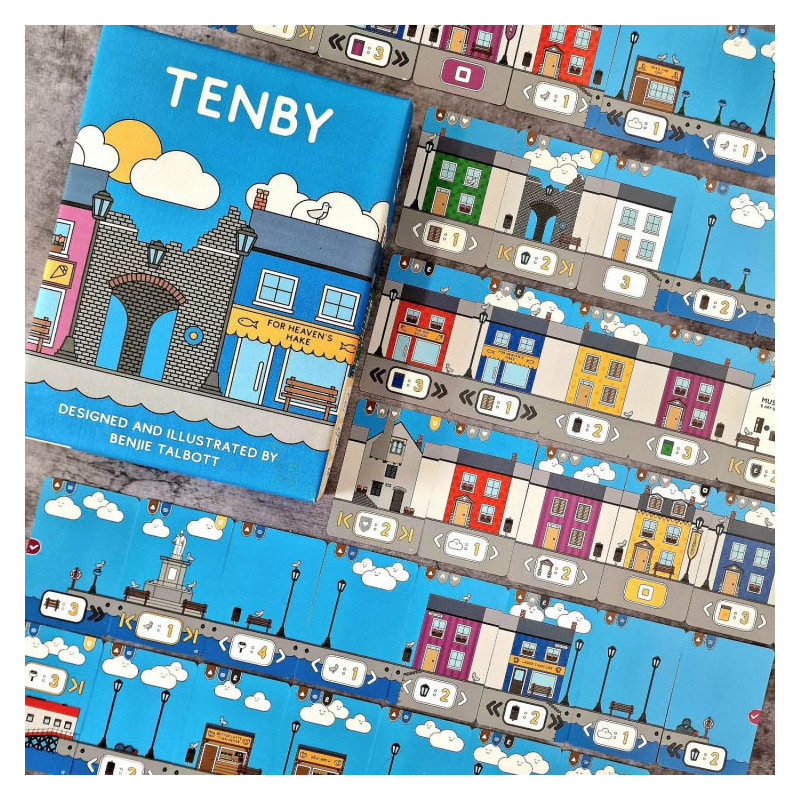
Tenby is also a new board game, loosely set in the town in that it borrows some of the colors of the buildings along the Croft and the Norton, and has players creating streets that combine buildings with various seaside features and piers. It’s a delight to play, if a bit of a table hog and tricky to score, and even comes with its own soundtrack (also on Apple) made by the game’s designer and illustrator, Ben Talbott.

In Tenby, players draft cards to build out their streets, with each card carrying some kind of scoring condition based on cards adjacent to it, or within two cards, or in their entire street. The game lasts ten rounds, and in each round, the players place their tokens on numbered action cards, where a higher number gives more/better actions but drops you in turn order for the next round. Selected cards can go on an existing street at either end, or can form a new street. Some cards also have check marks indicating that they end the street on that side. After the tenth round, players score their private objective cards, with higher rewards for streets that are are ‘finished’ by end cards, and every card on every street. The highest score wins, as that’s usually how that works.

There are four main card types in Tenby, as well as life jacket tokens which you can spend for extra actions, and your ability to draft those cards from the market depends on the action(s) on the action card you choose in the Day phase. Buildings are the lowest-valued cards, scoring only for the cards immediately adjacent to them. Piers score for the cards within two in either direction. Landmarks – they may be called monuments, same thing – score for the entire street. If you select an action card that gives you a Pier action, you can take a Pier card or a Building card but not a Landmark card – you can go down in value, but never up. There are also Resident cards that provide secret objectives; you’ll start the game with one, choosing from two drawn from the deck, and can add more as the game goes on with a Resident action.

Some action cards award the player one or more life jacket tokens, which they can use at any time. Spending one token lets the player draw another card into the market in any one row. Spending two lets the player select a Building card, or move a card already in their tableau, including placing it in the middle of an existing street. Three tokens yield a Pier card, and four tokens get the player a Landmark or a Resident card. The tokens are worthless at the end of the game, so there’s really no reason to hold on to them, and that one-token action to add a card to the market row of your choice is extremely useful later in the game when you might be looking for something specific and/or you find a row depleted by other players before your turn.

Most of the scoring in Tenby revolves around features found on the various cards, such as shutters, flowerboxes, birds, post-boxes, streetlights, happy little clouds, and so on. Some of these are small, and can be a little hard to distinguish. I’ve also read comments online from color-blind players who struggled with the scoring cards that relate to building colors. Those design questions aside, the various scoring opportunities are plentiful, so you’re rarely going to look to the market and come up empty unless you’re the last player to select.

The copious scoring opportunities do make the end of the game somewhat tedious; you’ll probably be scoring two dozen or more cards after ten rounds, some of which require you to examine every single card on a street. Pen and paper or a scoring app would help, of course, and the game comes with neither. Tenby also requires a lot of space for each player; your streets can be ten-plus cards long, and you’ll probably have 3-4 streets by the end of the game. With four people playing at a reasonably-sized picnic table, we still started to run into each other.

Tenby comes in a smallish box and has very clever packaging within it – there are four tiny boxes within it that fig snugly into the inner frame, and three of those boxes have symbols on the side showing you which card decks they should hold for optimal storage. The fourth holds the life jackets and player tokens. The art is appealing and different from almost any other game I can think of; there’s a Walking in Burano vibe because of the setting and similarly-colored buildings, but the art styles are completely different. It’s also a quick teach; the one rule that other players have found tricky is that adjacent cards have to match along the edges, which is hard to explain without showing the cards but does restrict your options for legal plays.

I’m a big fan of Tenby even beyond the Welsh connection; it’s an A- for me, one of the best new games I’ve played in 2026 . It’s a great family game that uses some familiar mechanics of pattern-building and action-selection, and a four-player game will take about an hour, maybe less once everyone knows the game. You can buy it directly from Mighty Boards, at Miniature Market (currently out of stock), or at Amazon.

The Incandescent.

Stories set in magic school have become commonplace to the point of cliché; unless the author is willing to take the story in a new direction, like weaving parody into a genuine story (Lev Grossman’s The Magicians), the work is going to suffer from comparisons to the very popular books in the space, including those by she-who-must-not-be named. In The Incandescent, Emily Tesh takes a different tack by setting her novel at a magic school, in an alternate-world England where magic is just part of normal life, while making her protagonist one of the teachers, as well as making at least two more significant plot decisions that set this delightful book apart from its peers.

In The Incandescent, Saffy Walden is a senior teacher who works primarily with some of the oldest and most advanced students at Chetwood School, a day and boarding school outside of London where Walden herself was a student twenty years previously. One of her academic and practical specialties is dealing with higher-order demons – most magicians can handle the lower-order imps who love to occupy electronic devices like photocopiers or even wall clocks, but Walden is one of the few magicians in the world who can handle the most difficult, higher-order demons, which may turn out to be significant. And since Chetwood is full of young magicians learning to harness their powers, it attracts many demons trying to break through from their plane into ours, including a very powerful one nicknamed Old Faithful who has killed some students in the past. The threat of Old Faithful leads the school to bring in a Marshal, a sort of magical security agent, named Laura Kenning, who immediately rubs Walden the wrong way, so you can probably see where that’s going.

The story of The Incandescent has multiple peaks, so if you were wondering, say, if the whole novel was heading towards a denouement where Walden fights Old Faithful, you may be surprised when the demon shows up before the book’s midpoint. It’s misdirection by adventure, as every subplot is interesting and intense, but Tesh’s ultimate goal won’t be apparent until quite close to the novel’s end, when she finally reveals where all of this has been going.

Walden is a wonderful main character, and by the time the novel is through, Tesh has given us a huge amount of her life story as well as insight into many aspects of her character, particularly her somewhat low interest in romantic relationships. She’s not aro, but she’s indifferent enough that romance ends up a tangential part of the story rather than the core plot point. Her flaws are realistic and fit within her character while eventually playing a significant part in the development of the plot. The Marshal, Laura Kenning, and at least two of the four students who comprise Walden’s main class are also well-developed and have some sort of arc within the novel’s various subplots, while several side characters show up and get enough screen time to feel more than two-dimensional. (I was particularly fond of Todd, the groundskeeper/maintenance guy who has some untapped magical potential of his own; he needs his own story at some point.)

When the actual climax comes, the whole ground beneath the book shifts, and the final fifty-odd pages are a full-on sprint, thanks to two twists, one I saw coming and one I didn’t. It all makes sense in hindsight, and Tesh set it up perfectly. An author has to earn this kind of massive plot shift, and Tesh did so, while staying completely true to her characters.

The Incandescent was nominated for this year’s Hugo Award for Best Novel, which Alix Harrow won for The Everlasting, as well as this year’s Nebula Award for the same. This is the first of the six Hugo nominees I’ve read, and I’m currently in the middle of Nnedi Okorafor’s Death of the Author. Tesh won previously for Some Desperate Glory, a sci-fi novel that was good but flawed, and this is a better work in almost every way, from plot to character development to playing with popular tropes. It’s also a more memorable novel. These characters and this wonderful setting will stay with me for some time, and while I don’t think it needs a sequel, I hope Tesh revisits this universe in some fashion.

Next up: I’m about a quarter of the way through Death of the Author, which feels like a very ambitious novel so far.

Designed by