Packing a series of puzzles into its small box, Enchanted Ivy is easily one of the best pure solo games I’ve ever played. Coming from first-time designer Sarah Joshua, the game presents you with a seemingly simple challenge – build your tableau of ivy cards while placing guests on half of them in a way to maximize your scoring – that becomes increasingly difficult because of how well-designed those guests’ scoring methods are.
The gist of Enchanted Ivy is simple. Each ‘chapter’ presents you with a pattern of cards and a set of guests you’ll use in that game. On every turn, you’ll draw two cards, playing one with its door side and one with its ivy side (they’re called balconies and walls, but I don’t think those names are that intuitive), and will place one of the two guests in your hand on the door you just played. You’ll then draw a new guest from the bag and begin the next turn. You also begin the game with one bonus door that you can place on an ivy card at any point for 3 extra points, although it may end up costing you points on a nearby guest card. At game end, you must have played your cards in the pattern shown, and then you will score every guest according to their wishes.

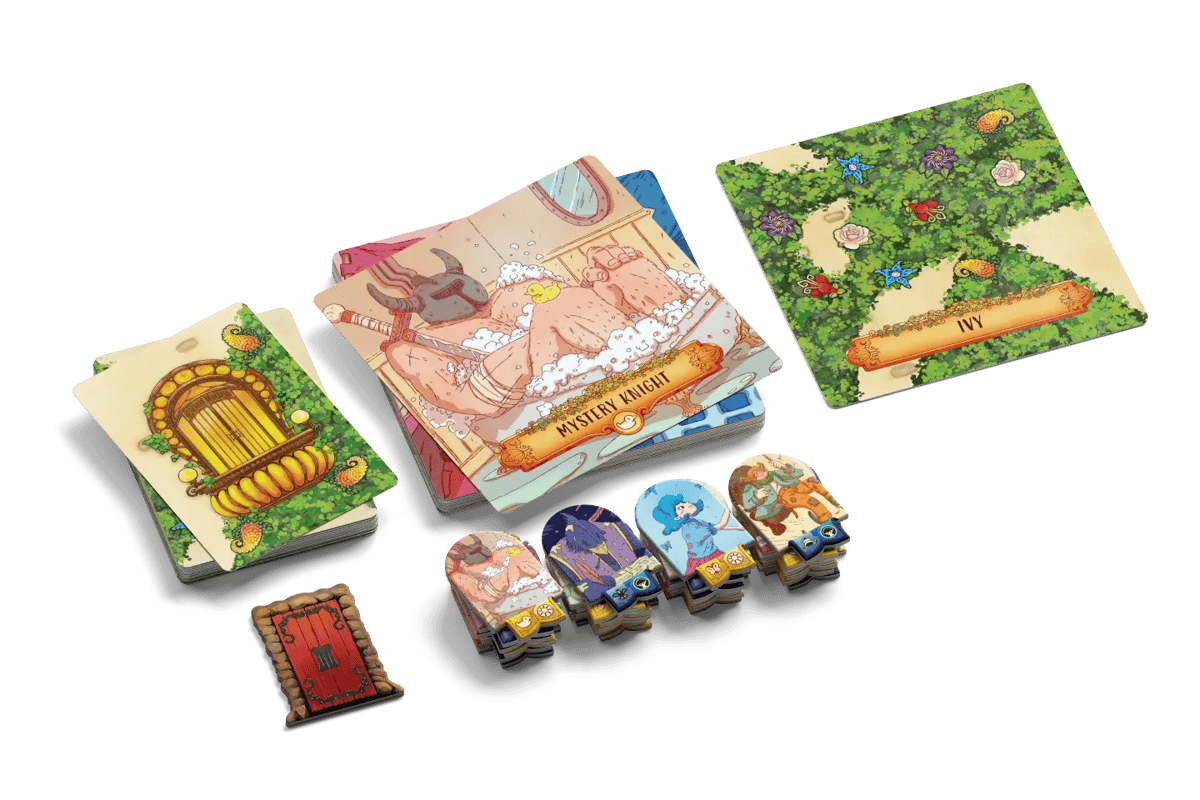
That’s the whole game, although there are additional doors you can earn as you move through the campaign to get some extra powers. (I have only obtained the first one so far, and it’s quite useful). You can learn this game inside of five minutes, but playing it well enough to reach either the minimum victory score or the higher score for mastering the level is quite difficult, as the guests nearly all work against each other, and they tend not to appear from the bag when you need them, but whenever they feel like it. Jerks.
Each chapter also offers two additional bonus conditions that make winning it more difficult, but allow you to place stickers on a cardstock page of shelves; when you complete a shelf, which requires at least three stickers, you gain the associated bonus door. You don’t have to do those, but I wouldn’t want to pass up the additional abilities you get from those, and those stretch goals – see what I did there? – give chapters more replay value.
Enchanted Ivy’s design is extremely tight, in the best possible way. You have only a few options on each turn: which card to play ivy-side up, which of the two guests in your hand to use, and where to place the two cards within the pattern that chapter dictates. Once a card is placed, it’s there for the game, so you may get locked into a decision early in the game that costs you points – maybe a lot of points – later in the game. Some chapters have more ornate patterns, such as including gaps between cards, which make some guests happier and others quite irked. (Many of the guests are Garbo-esque, as they want to be let alone.) The first two chapters include scarecrows, inert guests who can help others score but are worth zero points on their own.
Because there’s so much randomness involved in the card and guest draws, you can play a chapter multiple times, to boost your score or just see how it goes with different sequences. The base game comes with eleven chapters, including the teaching game in the prologue, while there’s an expansion (which I haven’t played) already with three more chapters and some new guests. It’s going to take me plenty of plays to exhaust what’s here in the base game. My only quibble is that it’s a bit of a table hog for a solo game, at least if you want to have the guests’ scoring cards – which are beautifully rendered, but large – out on display while you build your tableau. Among purely solitaire games I’ve tried, Enchanted Ivy has only one rival for the top spot, Coffee Roaster, which has a better theme for me, while Enchanted Ivy is a more elegant design. So where’s the Wrigley Field tie-in? Enchanted Ivy is an A- game, and I’m not really sure if I could ever actually give a solitaire game a pure A anyway.