It’s a beautiful day in the Feather Lane neighborhood, with tree-lined streets and brightly-colored houses, along with birds who are definitely not drones to spy on you. Can you build the nicest trio of streets with the right combinations of houses, birds, and trees to earn the most points?
Feather Lane is the newest title from Last Night Games, owned by designers Nathan and Jake Jenne, whose biggest hit is the dice-drafter Panda Royale and who also made the cute flip-and-write game Horticulture. This title is also pretty light, and very easy to learn, with enough strategy and variety in the cards to give it high replay value. You can pre-order it now on Miniature Market.
Players in Feather Lane will draft 24 cards over 12 turns to build three streets in front of them, with the goal of scoring the most points from the four public objective cards and from having the longest top, middle, or bottom streets. Each card has three segments on it, with each segment showing a house, a tree, or a birdbath. When you add a card to a street, you must overlap cards – the new one can go over or under an existing one, and you can cover as many segments as you like, but you must cover at least one segment on a new or current card. Each pair of cards you draft also gets you a bird token that you’ll place on a house of the same color at the end of that round.

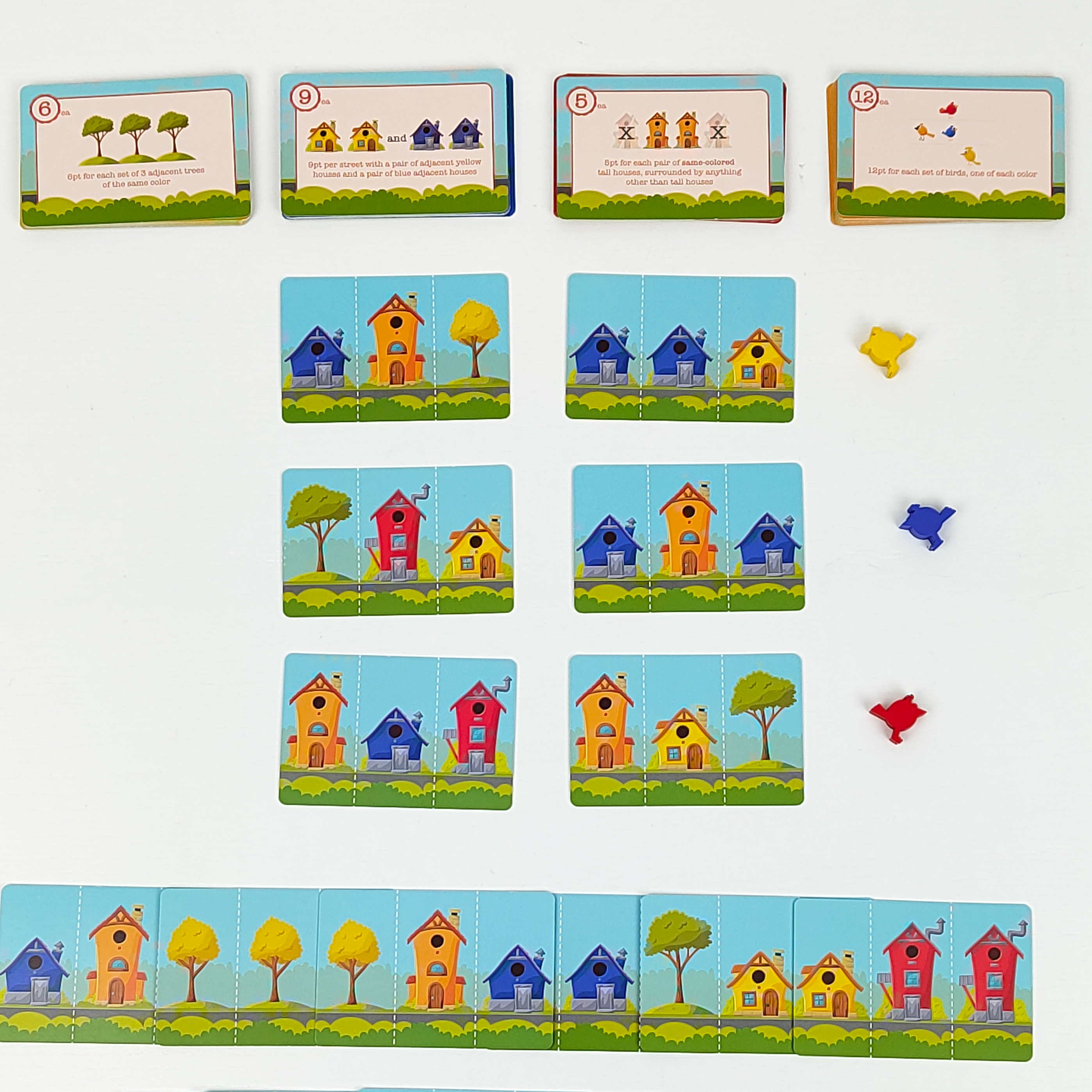
There’s a central market of cards that allows the active player to select from sets of two cards and a bird. After each selection, the market is refilled so that the pairs change – the left column’s cards shift down into the open space, the right column’s cards shift up, and then new cards go to the top-left and bottom-right spaces. (The birds don’t move. They do what they please.) The round ends once every player has made four selections, getting eight cards and four effin’ birds, after which players place their four birds anywhere on their streets as long as the birds’ colors match their buildings. If a player can’t place a bird, or doesn’t want to, they can return it to the bag and take one mouse instead; a mouse on a building is worth one point at game-end.
There are four decks of objective cards in Feather Lane, each covering a different type of criteria, and you’ll choose one card randomly per deck at the start of each game. One deck is specific to birds, one to trees, and two to different buildings. There are four colors of buildings and of birds, and buildings come in large or small, while there are also different colors of trees. Bird baths are worth a flat two points each and I don’t believe they count for any objectives (but it’s possible I haven’t seen one of those yet). The points for these objectives vary based on how difficult they are to achieve, and you can rack up a lot of points if you hit some of them repeatedly.
Feather Lane suggests a play time of 30 minutes, but I’d say that’s the low end of the range; it plays up to six people, which I haven’t tried, but there is no chance six people play this in a half hour unless everyone plays like Chandler Simpson runs. If it weren’t for the complexity of some of the objective cards, you could play this with an 8-year-old, and you could probably select specific objective cards if you wanted to get some younger kids to the table.
I can’t help but compare this game to Tenby, another street-building game that came out this year, but a more complex and challenging one that tickled my brain more – but also isn’t a great game for new or younger players, which Feather Lane would be. I could teach anyone Feather Lane in five minutes; Tenby almost requires a few rounds to fully teach someone the selection and scoring mechanics involved. Tenby is the better game, but I would recommend Feather Lane first for family play. It’s a grade B for me,