Tenby is a seaside town in southwestern Wales, and is a popular destination for beachgoers and vacationers, with two beaches and a nearby island you can walk to at low tide. Known as Dinbych-y-pysgod (Small fort of the fish) in Welsh, it’s small – fewer than 5000 people live there – and extremely cute, with plenty of shops and restaurants to cater to the summer visitors. I went there with my wife and her cousins in 2022, walking along the beach and stopping by the Park Hotel (owned by some more of her cousins) for a drink.
Tenby is also a new board game, loosely set in the town in that it borrows some of the colors of the buildings along the Croft and the Norton, and has players creating streets that combine buildings with various seaside features and piers. It’s a delight to play, if a bit of a table hog and tricky to score, and even comes with its own soundtrack (also on Apple) made by the game’s designer and illustrator, Ben Talbott.
In Tenby, players draft cards to build out their streets, with each card carrying some kind of scoring condition based on cards adjacent to it, or within two cards, or in their entire street. The game lasts ten rounds, and in each round, the players place their tokens on numbered action cards, where a higher number gives more/better actions but drops you in turn order for the next round. Selected cards can go on an existing street at either end, or can form a new street. Some cards also have check marks indicating that they end the street on that side. After the tenth round, players score their private objective cards, with higher rewards for streets that are are ‘finished’ by end cards, and every card on every street. The highest score wins, as that’s usually how that works.
There are four main card types in Tenby, as well as life jacket tokens which you can spend for extra actions, and your ability to draft those cards from the market depends on the action(s) on the action card you choose in the Day phase. Buildings are the lowest-valued cards, scoring only for the cards immediately adjacent to them. Piers score for the cards within two in either direction. Landmarks – they may be called monuments, same thing – score for the entire street. If you select an action card that gives you a Pier action, you can take a Pier card or a Building card but not a Landmark card – you can go down in value, but never up. There are also Resident cards that provide secret objectives; you’ll start the game with one, choosing from two drawn from the deck, and can add more as the game goes on with a Resident action.
Some action cards award the player one or more life jacket tokens, which they can use at any time. Spending one token lets the player draw another card into the market in any one row. Spending two lets the player select a Building card, or move a card already in their tableau, including placing it in the middle of an existing street. Three tokens yield a Pier card, and four tokens get the player a Landmark or a Resident card. The tokens are worthless at the end of the game, so there’s really no reason to hold on to them, and that one-token action to add a card to the market row of your choice is extremely useful later in the game when you might be looking for something specific and/or you find a row depleted by other players before your turn.
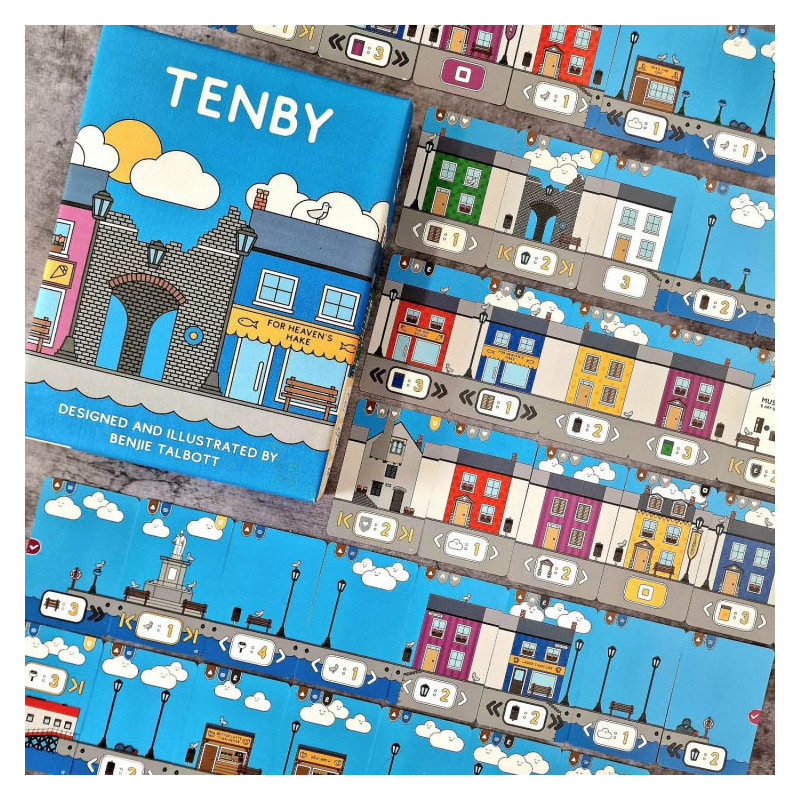
Most of the scoring in Tenby revolves around features found on the various cards, such as shutters, flowerboxes, birds, post-boxes, streetlights, happy little clouds, and so on. Some of these are small, and can be a little hard to distinguish. I’ve also read comments online from color-blind players who struggled with the scoring cards that relate to building colors. Those design questions aside, the various scoring opportunities are plentiful, so you’re rarely going to look to the market and come up empty unless you’re the last player to select.
The copious scoring opportunities do make the end of the game somewhat tedious; you’ll probably be scoring two dozen or more cards after ten rounds, some of which require you to examine every single card on a street. Pen and paper or a scoring app would help, of course, and the game comes with neither. Tenby also requires a lot of space for each player; your streets can be ten-plus cards long, and you’ll probably have 3-4 streets by the end of the game. With four people playing at a reasonably-sized picnic table, we still started to run into each other.
Tenby comes in a smallish box and has very clever packaging within it – there are four tiny boxes within it that fig snugly into the inner frame, and three of those boxes have symbols on the side showing you which card decks they should hold for optimal storage. The fourth holds the life jackets and player tokens. The art is appealing and different from almost any other game I can think of; there’s a Walking in Burano vibe because of the setting and similarly-colored buildings, but the art styles are completely different. It’s also a quick teach; the one rule that other players have found tricky is that adjacent cards have to match along the edges, which is hard to explain without showing the cards but does restrict your options for legal plays.
I’m a big fan of Tenby even beyond the Welsh connection; it’s an A- for me, one of the best new games I’ve played in 2026 . It’s a great family game that uses some familiar mechanics of pattern-building and action-selection, and a four-player game will take about an hour, maybe less once everyone knows the game. You can buy it directly from Mighty Boards, at Miniature Market (currently out of stock), or at Amazon.
Comments are closed on this post. 2 comments below.
I’d seen some positive mention of this game, so watched a on-line review. It struck me as very similar to Santa Monica in terms of drafting cards and placing them along two rows to score for adjacencies, although Santa Monica is complicated somewhat by the need to move locals/tourists/VIPs along to specific locations. I see you’ve reviewed that one previously (which is probably why I searched it out to buy), so surprised you didn’t mention the likeness.
I think I played Santa Monica six years ago, and didn’t care for it, which is probably why I didn’t pick up on any similarities.