dnup is – or will be shortly, as the game comes out in the U.S. on May 29th – the latest game from SCOUT designer Kei Kajino, and once again we have a card-shedding game of two-valued cards, which have a top and bottom value but can’t be flipped once they’re in your hand. It’s not quite as good a game as SCOUT, but it’s a more clever design, and I’ve found it quite addictive because of how much you thought each move requires.
In dnup, the deck has cards valued 1 through 10, with differing values top and bottom and no connection between them. That is, a 7 card could have any second value on the other side. Players will try to play sets of same-valued cards to the table, but must beat the value of any sets of the same size already in play. So if there is a set of 2 cards on the table on your turn, you can only play another set of 2 if the value is higher than that of the cards already out there. If your played set lasts all the way around the table until your turn comes up again, you get to discard it and play something else. If someone else beats your set, however, you must take those cards back into your hand and rotate them so their values flip.
On your turn, you can play any number of cards from your hand to form a set in front of you, as long as it’s a legal play by beating any set of the same quantity already on the table. You can also take a single card from your hand and add it to someone else’s set, as long as you aren’t creating an illegal set: If there’s a set three 7s and a set of two 4s, you can’t add a 4 to the latter because it would create a set of three 4s that doesn’t beat the set of 7s. If someone later beats that set, you don’t get your card back – the set’s ‘owner’ does. Or you can rotate your entire hand at once and play nothing.
This all means that you will often want to play cards to the table with the hope that someone will top them, returning them to your hand rotated so that you can end up with a more powerful set (or two, or three) to play on future turns. Every time you get to play, you have to consider whether you can play a set in the hopes of shedding those cards permanently, or should play something to top someone else (such as to prevent them from going out too soon), or should play cards to try to get them rotated.

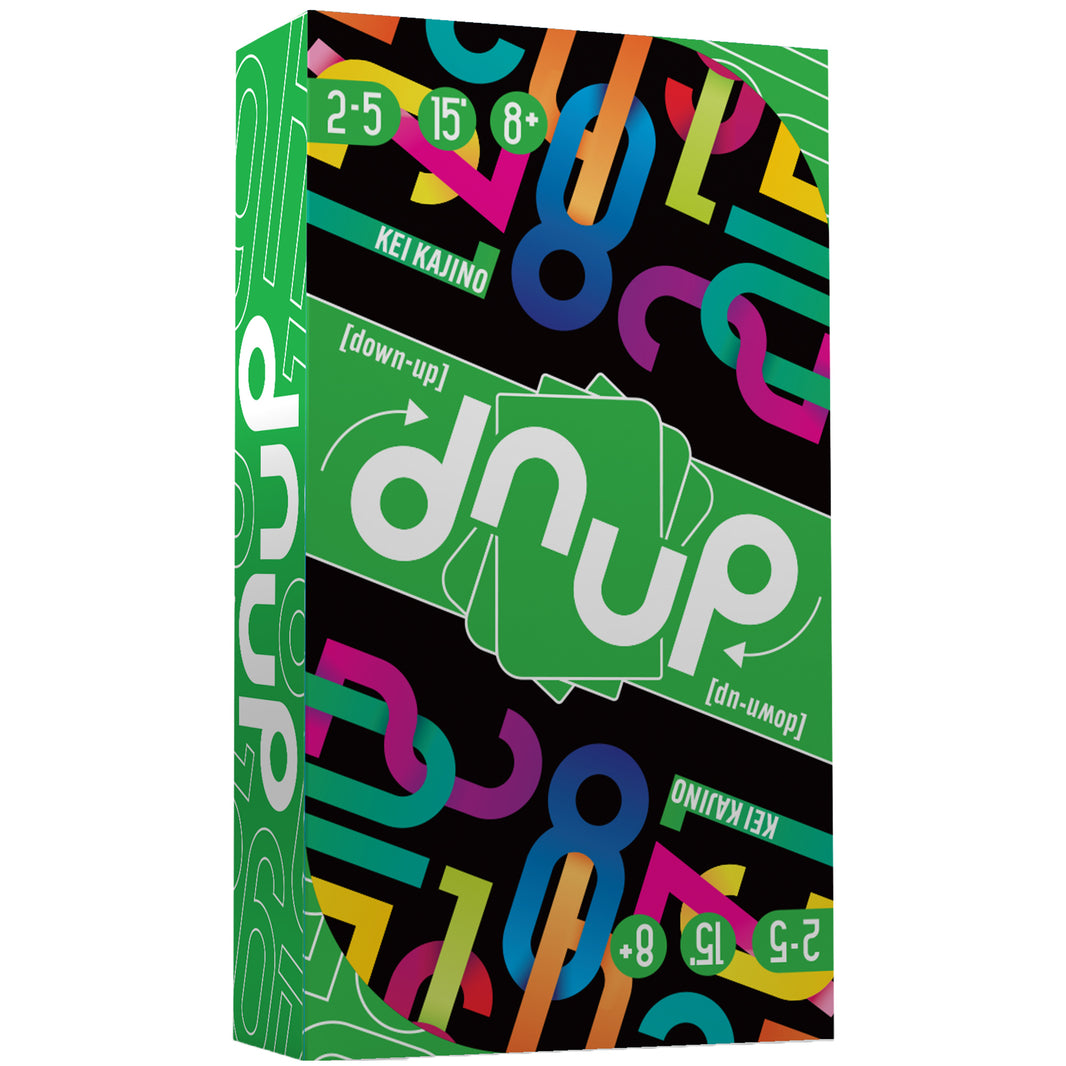
The round ends when two players go out: The first player to do so gets two letters, and the second gets one. The game ends when any player has reached all four letters of “dnup,” regardless of how they got there. This means the number of rounds is limited by the player count – I believe a game can only last as many rounds as there are players.
That’s the real genius of this design: Your decision set is limited, but there are enough factors going into each decision that it feels very tense, and you also can only partly plan for each move because the previous player’s decision can change everything, including putting cards back in your hand you didn’t expect to have.
dnup says it plays 2 to 5, but it is clearly better with more; with three players, your odds of having another player beat your card/set are too low, and it reduces that essential conflict that makes this such a fun, clever game. There are rules for two players where each player plays to two ‘zones’, simulating a table of four players, but I haven’t tried it and the variant seems to take much of the fun out of the game. Some games are just meant for more players – SCOUT is one, dnup is another. I’m a huge fan of dnup, in case you couldn’t tell, even though it took me a lot of plays online to grasp some basic strategy and find that balance between shedding cards and setting up my hand.